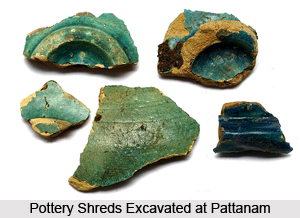
 Archaeological excavations in Pattanam, a village located in Ernakulum district of Kerala have furnished artefacts belonging to 1000 BC. It is precisely located at 2 km north of North Paravur and 25 kilometres from the northern part of Kochi. It has been researched that the place was first occupied around 1000 BC and its inhabitation continued till 10th century AD. Periyar Thodu, also known as Periyar canal, is a branch of the Periyar River that flows close to the village. Geological evidences acquired through satellite imagery have inferred that the Periyar river delta is situated on the southern side. Plethora of broken pottery shards and olden fired bricks are often unearthed in Pattanam. These evidences suggest that about 2,000 years ago the Periyar River possibly flowed close to Pattanam.
Archaeological Significance of Pattanam
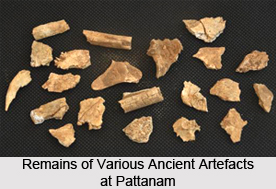 Archaeological excavations at Pattanam began since 2007 on multi-seasonal and multi-disciplinary levels by the Kerala Council for Historical Research (KCHR). This is regarded as a pioneering initiative in the archaeological history of Kerala. Later British Academy (BASAS) rendered recognition to an international research group based on Pattanam. 45 hectares of the land of Pattanam is under the archaeological research. However due to the residential complexes the place is known to be a disturbed archaeological site. Sand quarrying in some of the parts of the village has destroyed certain sites partially. The AMS 14C analysis of wood and charcoal samples from the layer belonging to the Iron Age and wharf context has estimated the antiquity of certain artefacts as belonging to first millennium BC.
Artefacts Excavated in Pattanam
Square copper coins are enlisted amongst the prominent excavations of Pattanam, having the image of an elephant and bows and arrows on their either sides. These coins were minted at the onset of Christian era. However no evidences have been found to establish the fact that the artefacts recovered from the site belongs to Rome. Apart from these, large amount of Cameo Blanks made of semi-precious stones, Terra Sigillatta, Amphora, Chera coins and glass and stone beads have also been found here. Architectural ruins made of burnt bricks have been excavated from Pattanam. A six metre dugout canoe has been found at a wharf context which is made of `anjili wood` along with teak wood bollards. Vast amount of botanical remains have also been revealed here. Other antiquities found in archaeological excavations in Pattanam are a broken rim having Brahmi script, pendants or lockets, fragments of objects composed of iron, lead, copper and sometimes gold, pre-firing pottery inscription, Roman glass and many more. Excavations of pottery associated with 1st century BC to 4th century AD suggest that it was the prime occupation of the region during this era.