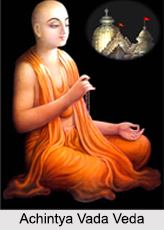
 Achintya Vada Veda falls under the philosophical doctrine characterized by dualism-non-dualism. Achintya Vada Veda philosophy refers to the inconceivable oneness and difference of the Supreme Person and His energies. This is one of the key points of theistic philosophy taught by Chaitanya Mahaprabhu. Achintya Vada Veda is followed by the Chaitanya Vaishnavas. Greater number of followers of the Achintya Vada Veda philosophy belongs to the Vaishnava Brahmans of Nadiya and Santipur in West Bengal.
Saints of Achintya Vada Veda
The two leading saints of Achintya Vada Veda were Adwaitananda and Nityananda but as they were leading a domestic and settled life they were not suitable for going from place to place to preach Vaishnavism. They therefore set up Chaitanya who had earlier embraced the ascetic order as the founder of a new form of Vaishnava worship, which subscribed to the philosophical principle of dualism-non-dualism.
6 Gosains of Achintya Vada Veda
Besides the three Mahaprabhus Chaitanya, Adwaitananda and Nityananda; the Vaishnavas of this order acknowledged six Gosains as their original and chief teachers. The six Gosains of Bengal Vaishnavas were:
1. Rupa
2. Sanatana
3. Jiva
4. Raghunath Bhatt
5. Raghunath Das
6. Gopal Bhatt
The first two Gosains though considered as outcaste or low caste were accepted into the order of Chaitanya Vaishnavism as there was no bar for any caste to be admitted to the Chaitanya`s Vaishnavism. This is because it was believed by the followers of Chaitanya Vaishnavism that devotion and faith can be experienced by men regardless of caste, creed and nationality. Jiva being the son of Rupa"s younger brother and founder of a temple at Vrindavan, which is dedicated to Radha Damodar, was taken in the system of Bengal Vaishnavism. Raghunath Bhatt and Raghunath Das were both Brahmins of Bengal and men of greater scholarship and learning. They both established themselves in the vicinity of Mathura and Vrindavan. Gopal Bhatt was a pious man and founder of a temple at Vrindavan, which was dedicated to Radharamana.
Mathas of Achintya Vada Veda
Following the philosophical doctrine of Achintya Vada Veda several monasteries have sprung up in Puri. Some of them are Chaitanya Radhakanta Matha, Suna Goswami Matha and many other small Mathas which have sprung up in and around the Chaitanya Radhakanta Matha.
Some of the Mathas though belongs to Achintya Vada Veda philosophy but they go along with the Gadwa Madhava sect in their daily activities. The Mathas which go along with the Gadwa Madhva sect are Habeli, Khajura and Indraswami.