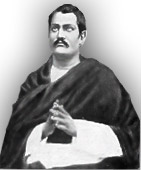
 Vaishnavism is a tradition of Hinduism, which is known to worship Lord Vishnu or his associated avatars. Vaishnava theology includes the central beliefs of Hinduism such as reincarnation, samsara, karma, and the various Yoga systems. Vaishnavism is followed in all parts of the country and it has undergone a transition in many states. Vaishnavite revival in Bengal took place in February 1880. Keshab Chandra Sen followed a universalistic religious ideology. He called upon his supporters to create a religious revival. Sen organized a procession with musical instruments and sang hymns with his disciples representing Chaitanya`s devotional Vaishnavism. The religious path undertaken by Keshab Chandra Sen, thus, can be defined as new-Vaishnavism. This became one of the famous socio-religious movements in India.
Vaishnavite revival in Bengal also established newer dimension with the support of Bijoy Krishna Goswami. Goswami studied several religious works such as the Chaitanya Charitamrita, a biography of the great Bhakti saint, under the guidance of Harimohun Pramanil. In addition to that Bijoy Krishna Goswami visited various Vaishnava gurus to gather more knowledge on Vaishnavism. He continued his works as a Brahmo missionary yet blended devotional Vaishnavism as taught by Chaitanya with his own concept of Brahmoism. He even spent most of his qualitative time by studying yogas and bhakti. Bijoy Krishna Goswami started worshipping the idols of Radha, Krishna, and Durga. In 1885 Goswami broke completely with the Brahmo movement and continued as a presenter of revived Vaishnavism. In 1890, he even visited Brindaban and Mathura and four years later travelled to Allahabad for the festival of Kumba Mela.
Vaishnavite revival in Bengal took place because of the interest and involvement of Bijoy Krishna Goswami as an orthodox Vaishnavism. He inspired a revival of Vaishnavism through his disciples such as Bipan Chandra Pal. Revival of Vaishnavism was also possible through the religious literature produced by the disciples of Goswami. Thus, Bijoy Krishna`s drift away from Brahmo ideals toward a revival of orthodox Vaishnava bhakti paralleled Keshab Chandra Sen`s own path. This action also acted as a force helping the rise of nationalism and the emergence of another socio-religious movement that combined defence of Hinduism, social service, and a restructuring of ancient monasticism.