Introduction
Kolar district, lying in the Karnataka state, is one such district that has easily drawn the attention of tourists from all over the country. To many Kolar district is identified as Gold Land of India. This is due to the recent discovery of major gold mines that have been built in hook and corner of the region.
History of Kolar District
The rich historical heritage of Kolar district has been highly acclaimed in all over the region. There has been no denying of the fact that it is a hub of numerous dynasties that have ruled here at different times.
Till 9th century Banas and Ganga dynasty have established their dominion. Also the famous Chola kings took possession of Kolar district around 1000 CE. The rulers of the later period who have reigned in Kolar are Hoysala Empire and Vijayanagara. Bijapur of Deccan region and then Wodeyars of Mysore succeeded them. Centering on this Kolar district, legends and myths are widely popular amongst the people. Most of these stories and saying are linked to great Indian epics of Ramayana and Mahabharata. One such belief is that after his triumphant feat and on his return to Ayodhya from Lanka Rama resides temporarily in Kolar district.
Till 9th century Banas and Ganga dynasty have established their dominion. Also the famous Chola kings took possession of Kolar district around 1000 CE. The rulers of the later period who have reigned in Kolar are Hoysala Empire and Vijayanagara. Bijapur of Deccan region and then Wodeyars of Mysore succeeded them. Centering on this Kolar district, legends and myths are widely popular amongst the people. Most of these stories and saying are linked to great Indian epics of Ramayana and Mahabharata. One such belief is that after his triumphant feat and on his return to Ayodhya from Lanka Rama resides temporarily in Kolar district.
Geography of Kolar District
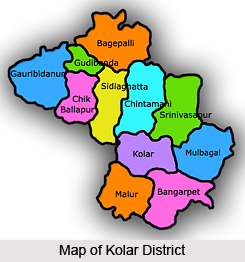 Strategic location of Kolar district acts as its identifiable mark. It stretches up to an approximate area of 8,225 sq. km, lying tentatively at 77 degree and 21 minutes to 35 degree east longitude and 12 degree and 46 minutes to 13 degree and 58 minutes north latitude.
Kolar district is located in the southern region of the State and happens to be the eastern-most district of the Karnataka State. Other districts act as boundaries to Kolar district. For example, Bangalore and Tumkur districts form the western boundaries. Also some other districts of near by states like Andhra Pradesh and Tamil Nadu also bounded Kolar district from all possible sides.
To take for instance Anantapur district cushions Kolar district on the north; Chittoor district of Andhra Pradesh and Tamil Nadu`s Krishnagiri and Vellore districts lies on the eastern sides and south respectively. The highest length of Kolar district stretches to about 135 km from north to south.
From east to western sides as well the district covers the same distance. . It Mysore, which border the Eastern Ghats also is a part of Kolar district. Other features of Kolar district is that it is transacted by several mountains and summits of varied ranges, especially in its northern side.
Kolar districts`s major mountain chains include Nandidurga range running north from Nandi towards Andhra Pradesh`s Penukonda and Dharmavaram. Lands of Kolar district are prone to droughts and therefore dry with less rainfall. In Kolar district also rivers are small, stonily fed and mostly originated in high regions. Rivers, namely Palar River, Uttara Pinakini River and Dakshina Pinakini River deserve to be worth mentioning.
Culture of kolkar District
Festivals are an integral part of Kolar district. Each and every person of the district gets enthralled with the gala mood of festivals like Karaga, Theppothsava, Dyavara. To sustain their living people in this Kolar district have adapted to several occupations. Apart from the resources of gold mines many people also have been dependant on agriculture, dairy and sericulture. Due to this reason Kolar district also been popularized as the land of "Silk, Milk and Gold". Agriculture also is practiced. Thus cultivators fully utilize bore well water for irrigational as well drinking facilities.
Temples of Kolar District
 The temples of Kolar district depict the story of Ramayana through its sculptures. Kolar district is situated in the southern plains of Karnataka and the mainstay of the economy is agriculture along with dairy and sericulture. The village of Kaivara is associated with the legends of the temples of Kolar district. Since the Pandavas spent their exile at this site, their form of art is explicitly noticeable in the temples of Kolar district. Most of the temples of Kolar district are dedicated to the incarnations of Bhimeshwara and Amaranarayana.
Anjaneya Swamy Temple, Kaudinya Mahaganapati Temple, Vijayendra Temple, Bhoganandishwara Temple are some of the temples of Kolar district. Sri Lakshmi Adinarayanaswamy Temple is a cave temple located at the top of Yellodu hills in Kolar District. This temple enshrines a stone idol named Udbhavamurthy without any jewels or ornaments. Special pujas are performed on every Sundays and a car festival is celebrated on the third Sunday of Magha month, third lunar month, which usually falls in February-March. The devotees have to climb 618 steps to reach the temple. The two steps near the temple are unusually tall and can be climbed only with the help of a hanging rope.
Vijayendra Temple is one of the oldest temples of Kolar district. This ancient temple is located at Bethamangala and enshrines a reclining statue of Ranganthaswamy (Lord Vishnu). The history of this temple dates back to over 5,000 years. According to legends, the hermits heard a celestial voice asking for a temple of Lord Vishnu to be built here. The temple also houses imposing statues of Sridevi and Bhudevi. Anjaneya Swamy Temple is one of the famous Hanuman temples of Kolar district. Located in Mulbagal Taluk, this temple is a stopover for the travelers to the pilgrim town of Tirupati. The temple enshrines a 10-foot high standing idol of Lord Hanuman. Built by Raja Thodarmmal, the attractive Mukhamandapa houses the shrines of Kodandarama, Keshava, Gopalakrishna and Narasimha. The eastern entrance of the temple has an complex gopuram.
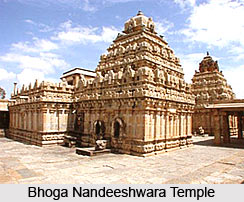
Bhoganandishwara Temple was built in the 9th century in Nolamba style. Located at the foot of Nandi hills, this is an ancient temple dedicated to Lord Shiva. Besides Bhoganandishwara, the temple also enshrines Umamaheshwara and Arunachaleshwara. This is one of the temples of Kolar district that reflects the Vijayanagara style of architecture. Some more temples of Kolar district include Kolaramma Temple, Yoga Nandishvara Temple, Chikballapur Channakesava Temple, Kotilingeshwara Temple, Gudibanda Cave Temple and Sri Lakshmi Adinarayanaswamy Temple.
Tourism In Kolar District
 Tourism in Kolar district will comprise visiting a number of different temples and places of historic interest located in the city. A journey to Kolar district is bound to be a most fulfilling experience for the religiously inclined as there are a number of temples found located here.
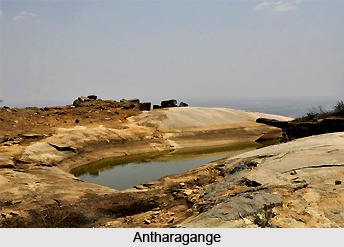
Pilgrimage Tourism In Kolar District : Located 3 Kms from Kolar, the Antharagange is a sacred stream which pours sweet water from the mouth of a bull. This scenic spot, known as Shatha Shringa Parvatha, abounds in rocks of many shapes and rare flora and fauna. The hill top, resembling snakehood- (Havina Hede), gives a bird`s eye view of the seven towns. It is a trekker`s delight, accessible from two routes, steep steps on one side and a motorable route on the other. The granite temple of Neelakanteshwara, at the foothills, is an added attraction.
Known as the Gaya of the south, Avani has a cluster of Ramalingeshwara temples all within one courtyard dedicated to Lakshmana, Bharata and Shatrughna as well as a Shankar Math built by the Nolamba dynasty. Legend has it, that the hill above was home to Valmiki`s ashram, where Lava and Kusha were born and raised.
Mulbagal situated 29 Kms from Kolar, is a popular tourist spot, enroute Tirupati. The Anjaneya temple and the Someshwara temple, with its exquisite bronze icon of the Dancing Nataraja, from the time of the Vijayanagar Empire are a great draw. The tomb of Haider Oulia, a great Muslim saint and 13 Kms. away, the tomb of the 15th Century Madhwa saint, Shripadaraya are also popular spots.
On the way from Chikkaballapur to Gouribidanur, the village of Rangasthala has a beautiful temple of Lord Ranganatha (Lord Vishnu) in the Vijayanagar style.
Kurdumale, twelve Kms. away from Mulbagal, was the capital of the Hoysala Empire. The giant, thirteen and a half foot sculpture of Kurdumale Ganesha and the Someshwara temple, attract thousands of visitors from the surrounding states.
Modelled on the famous Venkateshwara temple of Tirupati in Andhra Pradesh nearby, the Bangaru Tirupati temple is thronged by pilgrims, particularly during the month of Shravana (July-August). Darshan of the deity is through a small window in the sanctum.
Virupakshi, located 5 Kms from Mulbagal, has a Virupaksha temple. It was built during the reign of the Vijayanagar King Deva Raya II. The Parvati shrine here has the figure of a lion on front of it just like Nandi in front of the Shiva temples. This is rather unusual.
Leisure Tourism In Kolar District : The Kolar Gold fields in Karnataka go a long way down in history. This little mining town, about 22 Kms, east of Bengaluru, was once the pride of the erstwhile Mysore state, and also that of India. This gold mine produced a sizeable amount of gold during the days of the British Raj. It employed nationals from Britain, Italy, Germany and also a good number of Anglo-Indians.
The town of Kaivara is associated with the epic Mahabharata. Known as Ekchakrapura, this is where the Pandavas of Mahabharata lived in exile, incognito. Bhima, one of the Pandava brothers is said to have killed the asura (demon) Bakasura, who was tormenting the people. Myth has it that a nearby cave in the hill contains the corpse of the demon, which supposedly drips blood during Shivaratri. There is a garden complex in Kaivara, containing gardens and musical fountains. Also, in the garden are five cottages named after the pandavas and a mini zoo with herbarium. The temples of Amaranarayana and Bhimeshwara as well as the Yogi Narayana ashram are worth a visit.
Budikote is a village, about 15 Kms. southwest of Bangarpet town, whose history dates to the 8th Century A.D. Budikote, meaning "fort of ashes" is said to derive its name from an immense holocaust, believed to have been performed there, in its hoary past. Budikote is the birthplace of Hyder Ali and a spot among the boulders in the fort is known to tourists as the place where his cradle was rocked. The important temples here are those of Venkataramana and Someshwara.
Muddenhalli is the birthplace of Sir M. Visweswaraya, visionary engineer and statesman and architect of Karnataka`s progress. Many tourists visit his home, now converted into a museum. The village of Nandi, houses the Bhoga Nandeeshwara temple. It is really a confluence of two temples and one of the finest examples of Dravidian temple architecture.
The various places of religious and historical interest are well worth a visit when visiting Kolar district.