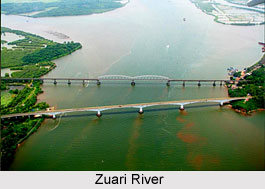
While the Zuari is vital to Goa, it faces significant
environmental challenges. Government has recently analyzed the water quality of
the river and measures has been taken to control pollution on Zuari river and
restore its water quality.
Monitoring and Reports
The Goa State Pollution Control Board (GSPCB) monitors the
river’s water quality at Panchawadi, Borim Bridge, and Marcaim Jetty. These
efforts, carried out under the National Water Quality Monitoring Programme,
have revealed worrying trends.
The stretch between Curchorem and Madkai, about 28 km long,
has been classified under Priority V pollution category, with biochemical
oxygen demand (BOD) levels ranging from 3.2 to 5.1 mg/litre. Fecal coliform
levels also exceed the permissible limits for bathing and recreational use,
indicating untreated sewage discharge as a primary pollutant.
Mining Impacts
Research by the National Institute of Oceanography (NIO)
highlights the impact of mining activities. Iron ore dumps along the banks
leach iron, manganese, cobalt, and other trace elements into the waters.
Spillage from ore transportation has further aggravated the issue. The
resulting turbidity reduces primary productivity, disrupts fish populations,
and accelerates siltation in river channels.