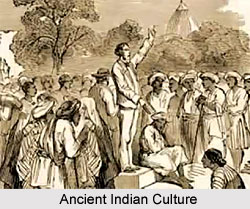
 The cultural elements comprise musical melodies, paintings, recitations and art and crafts. Indian art and culture, which is now so much an integral part of Indian tradition, has its root deep-seated in the Vedic era. In the ancient era, the practice of recitation was in vogue. The ancient literature, Vedas, Shrutis, Smritis are verbally communicated; writing practice came much later.
Origin of Ancient Indian Culture
The cultural evolution of ancient India begins with the culture of Harappa and Mohenjo-Daro. This civilization dates from 3250 to 2750 B.C. As for the Vedic culture, the period of the Vedas, roughly dates from 2500 B.C. to 1500 B.C. The Vedic period witnessed the rise of tribal chieftainship and democratic assemblies. It is only during the age of the Upanishads that there was the birth of territorial sovereignty and the conception of Bharata Varsha came into being. During the epic period India was divided into a number of kingdoms. Territorial sovereignty had come into existence and there were attempts to weld the whole country into one unit under one sovereign. Such attempts were made by Bharat, Shri Ramachandra and Yudhisthir. Roughly the age of Bharat was somewhere about 2250 B.C., of Ramachandra 1900 B.C., and of Mahabharata 1500 B.C. and so also of the Bhagavad Gita.
Culture in Vedic Age
Drama belonged to 4000 BC in the tribal society of Vedic Aryans was a general assumption as no written documents were found. It was again Natyashastra, which took the pioneering task of documentation about the origin and development of drama. It was stated in a striking mode that it was Lord Brahma who also created the drama. In fact, Sage Narad had thrown light on different aspects of drama in an elaborate fashion in his masterpiece. The Ramayana and the Mahabharata can be considered the first recognized plays that originated in India. These epics also provided the inspiration to the ancient Indian dramatists. The legend of ancient Indian literature, Kalidasa, the court poet of Gupta period, is highly acclaimed everywhere for his dramatic exponents like Abhijnanasakuntalam and Meghaduta.
Culture in Classical Age
During the Classical Age India had witnessed political and cultural upsurge. Politically Magadha continues to be the centre of attraction and first the Nanda dynasty and then the Maurya dynasty ruled it. Alexander attacked during the rule of the Nandas in the year 320 B.C. The Maurya dynasty`s rule began under Chandragupta in the year 322 B.C. and ended in 185 B.C. Chandragupta Maurya and Ashoka were the prominent kings of this dynasty. The political unity of India is restored under the rule of this dynasty. As a result political and cultural consciousness of the people was very high. In the sphere of administration and culture, great experiments and innovations were witnessed.
Culture in Post-Maurya Era
After the decline of the Mauryan Empire, India was divided into a number of independent kingdoms. In Magadha there was the Sunya and the Kanva dynasties from 185 B.C. to 225 A.D. Simultaneously there was an incursion of foreign races like those of the Shakas, Greeks and the Kushans, a branch of the Yueh-Chis into India in south and central India Among the kings of foreign extraction the most famous was Kanishka. A large part of Northern India was united and the country witnessed a great cultural upsurge. Thereafter the country witnessed dynastic struggles between the Shakas and the Satvahans.
Culture Under Gupta Empire
Some time later the rise of a fresh empire under the Guptas from 319 or 320 A.D. was witnessed. Pataliputra was the capital. The Gupta period was the golden age of Indian culture in the Classical period. Samudragupta and Chandragupta were the most famous kings of this dynasty. They restored political unity and Indian culture was raised to its greatest heights under their patronage.
Ancient Indian culture is a treasure house of classical forms of dance. Traditionally the temples patronized these dances to appease the gods and goddesses, mingling both dance form and worship. Sage Narada`s Natyashastra is the primitive manuscript dealing with aesthetics of different art forms had references of famous dance styles like Bharatnatyam, Odissi and Kathakali. In various Hindu temples like Konark Temple, Rameshwaram, Nataraja, dance form of Lord Shiva, is revealed to be dancing in a figure called the Tandava.
The rich tradition of the ancient Indian culture dates back to the ancient societies, such as, the epic societies and Vedic age. The practices, customs and beliefs that are followed in today`s age are an outcome of the ancient Indian cultures. The foundation base of the Indian ethos, despite of existence of several beliefs, remained unaffected.
Ancient Indian Culture
Ancient Indian Culture is ennobled by a rich and composite tradition. This has restored it to the arena of world cultural exuberance.