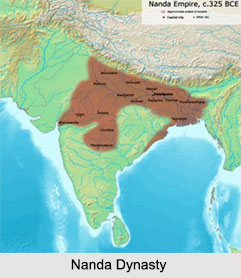
 Nanda Dynasty was an ancient Indian dynasty originated from Magadha and was established in 424 BC. Mahapadma Nanda was the founder and the first king of the Nanda Dynasty. Nanda Dynasty came into existence after Shishunaga dynasty and was in prominence for 100 years. He overthrew the Shishunaga dynasty and established his new Empire. The founder of the dynasty ruled the kingdom for a very vast span of time. Mahapadma Nanda, who was quoted as the "destroyer of all the Kshatriyas", set up Nanda dynasty. Among a number of dynasties in northern India, the Nanda dynasty was of non-Kshatriya origin. Dhana Nanda was the last ruler of Nanda Dynasty. The Nandas were said to have low origin descending from a Sudra mother.
Emperors of Nanda Dynasty
As mentioned earlier, the Nanda dynasty was founded by Mahapadma Nanda and after his long rule and death it was taken over by Pandhuka. Then a series of kings came and held the reigns. They are Panghupati, Bhutapala, Rashtrapala, Govishanaka, Dashasidkhaka, Kaivarta ending with Dhana Nanda. Dhana Nanda was the most hated among his subjects. His wickedness was responsible for the widespread antipathy among the people.
Administration of Nanda Dynasty
The Nanda kings had set up a good administrative system necessary to run the huge empire. This system continued even during the Maurya period. The Nandas inherited the kingdom of Magadha which had enormous potential for growth and development. The administration was looked after by officials who collected the taxes regularly. It was a systematic way in which the collection and appointments of the officials were made.
 Economy of Nanda Dynasty
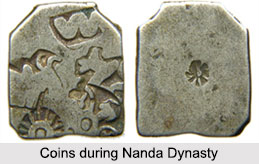
The economic structure of the Nanda dynasty was primarily agrarian. This had huge potential for development and growth though this could not take proper shape due to the abrupt decline of the dynasty. Treasury of the Nandas was refilled from time to time and so the wealth of the Kingdom never ran short. This immense storage of wealth helped the economy to prosper. Agriculture being the primary occupation was helped to develop and flourish by the construction of canals. These provided the infrastructure for irrigation.
Extension of Nanda Dynasty
The Nanda dynasty after inheriting Magadha was on a continuous operation of empire extension. For this purpose they built up a huge army comprising of 200,000 infantry, 20,000 cavalry, 2,000 war chariots and 3,000 war elephants. These helped in the organisation of a very powerful army that had huge capacities to even stand in opposition against the Greeks. At its peak, the Nanda Empire expanded from Bihar in the east to Punjab in the west. In the southern side it extended to the Vindhya Range.
Religion of Nanda Dynasty
The Nanda dynasty followed Jainism. After the Nanda conquest of Kalinga, the "Kalinga Jina" was brought by him and established in his capital Pataliputra. The last Nanda ruler respected the Digambar Saint Jivasiddhi. In this regard, stupas which are important sacred religious place have been built in great number by the last Nanda king. These are found in plenty in Rajgir.
Decline of Nanda Dynasty
The last king Dhana Nanda was murdered and this signalled the decline of the Nanda dynasty. In 321 BC, the Maurya dynasty rose to power and Chandragupta was in an advantageous position by begetting the Nanda kingdom.