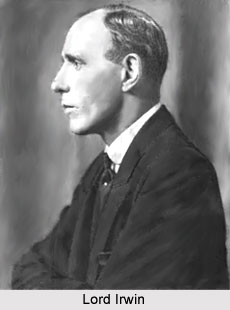
 Edward Frederick Lindley Wood, more commonly known as Lord Irwin, was a prominent British Conservative politician of the 1930s and served as the Viceroy of British India from April 3, 1926, to April 18, 1931. With a distinguished career in politics and governance, Lord Irwin left a lasting impact on the history of British India.
Early Life of Lord Irwin
Lord Irwin was born on April 16, 1881, at Powderham Castle in Devon. He received his education at St David`s Prep School and later attended Eton College. After graduating, he ventured into politics and made his mark in the 1906 general elections when he won a landslide victory as a member of the Liberal faction. Following this, he served on the frontlines during World War I, holding the rank of Major in 1917.
Career Highlights of Lord Irwin
In May 1920, Lord Irwin was offered the Governor-Generalship of South Africa, but the offer was withdrawn after the South African government expressed its preference for a Cabinet minister or a member of the Royal Family. However, when the Conservatives came to power on November 6, 1924, Lord Irwin was appointed Minister for Agriculture. It was during his tenure that major events unfolded in the Indian Independence struggle, solidifying his reputation in Britain as one of the most capable Viceroys to govern India.
Lord Irwin`s role as the Viceroy of India was significant. The Governor-General of India, also known as the Viceroy, headed the British administration in India and represented the Indian monarch. Lord Irwin assumed office as the Indian Viceroy in April 1926 and continued his service until 1931. His term witnessed several crucial events, including the Simon Commission report, Nehru report, All Parties` Conference, Jinnah`s 14 points, Civil Disobedience Movement, and Round Table Conferences.
Challenges and Strategies of Lord Irwin
Lord Irwin assumed the Viceroyalty at a time when India was in a state of turmoil. The Congress had no active program, and the Muslim League lacked cohesion due to a leadership vacuum. Additionally, communal tensions were prevalent in the country. Demonstrating his adeptness, Lord Irwin tactfully addressed these challenges during his tenure as the Viceroy of India.
To settle the demands of various communities in India before the enactment of the India Act, Lord Irwin followed a strategic approach. He imprisoned all the leaders of the Congress, effectively neutralizing their influence. Furthermore, he engaged in negotiations with Mahatma Gandhi, resulting in the signing of the Delhi Pact in January 1931.
Administration under Lord Irwin
In October 1925, Lord Birkenhead, the Secretary of State for India, offered Lord Irwin the prestigious position of Viceroy of India, a suggestion made by King George V. Accepting the role, Lord Irwin arrived in India on April 1, 1926. During his tenure, he confronted the challenge of the "Diarchy" system introduced by the Government of India Act 1919, which aimed to share power between the British and Indians at the local level. However, Lord Irwin believed that the diverse factions of the Independence movement would not reach an agreement if they were part of the proposed commission.
Thus, on Lord Irwin`s advice, the Simon Commission was composed solely of British members, which caused outrage among Indian leaders who boycotted the commission. The Simon Commission made little progress, but Lord Irwin believed that a symbolic gesture was necessary to bring Indian leaders to the negotiation table.
With tacit approval from the British government, Lord Irwin made the historic "Irwin Declaration" stating Britain`s commitment to eventual dominion status for India. This declaration faced opposition from conservative factions in the British Parliament but was seen as a significant development in Anglo-Indian relations. However, the Delhi Conference held on December 29 yielded limited results.
In response to the lack of progress, Mahatma Gandhi launched the Salt Satyagraha in March 1930, marching to the sea and breaking the government`s monopoly over salt production. Lord Irwin responded by arresting Mahatma Gandhi and other Congress leaders, but the heavy-handedness of the authorities turned world opinion against British colonialism in India.
In November 1930, King George V opened the First Round Table Conference in London, but no Congress delegates participated as Gandhi was in jail. In January 1931, Gandhi was released, and he and Lord Irwin had eight meetings. These discussions led to the signing of the Gandhi-Irwin Pact on March 5, 1931. The pact marked the suspension of the Civil Disobedience Movement and the boycott of British goods in exchange for a Second Round Table Conference that would represent all interests.
Later Political Career of Lord Irwin
Lord Irwin was a respected Conservative member of Parliament from 1910 to 1925. He served as the President of the Board of Education in 1922 and as the Minister of Agriculture in 1924 before being elevated to the peerage as Lord Irwin and appointed as Viceroy of India, succeeding Lord Reading. Lord Irwin`s deep respect for Indian political aspirations and his admiration for Mahatma Gandhi`s religiously inspired politics helped establish a rapport between them during face-to-face negotiations.
On October 31, 1929, Lord Irwin announced, with the tacit approval of the British government, that India`s constitutional progress should lead to eventual Dominion status. He proposed a Round Table Conference in London to discuss further political devolution of power to Indians following the Simon Commission`s report. However, without Indian representation in the commission, it faced widespread boycott and opposition throughout India.
Lord Irwin left India in April 1931 and went on to hold increasingly significant positions, culminating in his appointment as Foreign Secretary in 1938. However, his association with Britain`s failed policy of appeasement toward Hitler`s Nazi regime tarnished his reputation. In 1944, he was granted an earldom for his wartime services and served as the ambassador to the United States during a period of heightened Anglo-American relations. Lord Irwin retired during the 1950s due to declining health and passed away from a heart attack on December 23, 1959, at his estate in Garrowby at the age of 78.
Despite the mixed outcomes that emerged during Lord Irwin`s tenure as Viceroy of India, he was ultimately regarded as a successful Viceroy who navigated a clear and balanced path and retained the confidence of the British government. His toughness, independence, and ability to address the challenges of the time contributed to his significant prestige upon his return to British politics. Lord Irwin`s legacy encompasses his efforts to bridge the gap between the British and Indian political aspirations and his pivotal role in the Gandhi-Irwin negotiations that paved the way for future discussions on Indian self-governance.