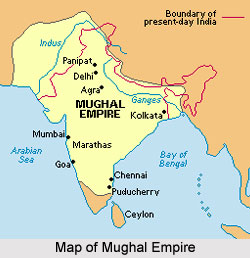
 The Mughal Empire, led by the imperial House of Babur, also known as the Gurkanis, governed India from approximately 1526 to 1857. Throughout their reign, the Mughal Dynasty made significant contributions to Indian history in terms of culture, tradition, ethnicity, and artistic achievements. Zahir-ud-Din Babur led the Mughal invasion of India, resulting in the decisive Battle of Panipat in 1526, where Babur emerged victorious against Ibrahim Lodhi, the last Sultan of India. This victory marked the establishment of a dynasty that endured for over three centuries. The Mughals` dominion spanned vast regions of India, stretching from Kabul to Assam and from Kashmir to Tanjore (Tamil Nadu) During the Mughal Era, they not only exercised political control but also fostered a golden age in Indian medieval history.
Origin of Mughal Empire
The Mughals trace their origins back to a branch of the Timurid dynasty from Central Asia, with additional lineage from the Borjigin clan, which ruled the Mongol Empire and its successor states. The dynasty`s founder, Babur, born in 1483, boasted direct descent from the renowned conqueror Timur (1336-1405) through his father, as well as from Mongol emperor Genghis Khan (died 1227) through his mother. The term "Mughal" itself derives from "Mongol" and highlights the Mongol heritage of the Mughal dynasty in Arabic and Persian languages.
History of Mughal Dynasty
The Mughal Empire, traditionally believed to have been established in 1526 by Babur, a Timurid prince hailing from Ferghana, present-day Uzbekistan. After losing his ancestral territories, Babur sought refuge in Kabul before venturing towards the Indian subcontinent. The rule of the Mughals was briefly interrupted for 16 years by the Suri Emperors during the reign of Humayun. It was Akbar the Great who laid the foundation of the Mughal imperial structure in the 1580s, which endured until the 1740s, shortly after the Battle of Karnal. The zenith of the Mughal dynasty in terms of territorial expansion, economic prosperity, military might, and cultural influence was reached during the reigns of Shah Jahan and Aurangzeb.
By 1700, the Mughal Empire reigned as the wealthiest in the world, boasting the largest military force on the planet. The Mughals commanded approximately 24 percent of the global economy and maintained a military comprising one million soldiers. At that time, their dominion encompassed nearly all of South Asia, with a population of 160 million subjects. However, the power of the dynasty underwent a rapid decline in the 18th century due to internal conflicts within the ruling family, the rise of incompatible monarchs, invasions by the Persians and Afghans, as well as uprisings led by the Marathas, Sikhs, Rajputs, and regional Nawabs. The authority of the last emperor was ultimately limited to the confines of the Walled City of Delhi.
Many members of the Mughal dynasty had significant ancestral ties to Indian Rajputs and Persians through matrimonial alliances, as they were born to Rajput and Persian princesses. The Mughals played a vital role in fostering the Ganga-Jamuni tehzeeb, an Indo-Islamic civilization characterized by cultural syncretism. They were also notable patrons of art, culture, literature, and architecture. Emperor Babur, Aurangzeb, and Shah Alam II were accomplished calligraphers, Jahangir excelled as a painter, Shah Jahan was renowned for his architectural achievements and Bahadur Shah II displayed exceptional talent as a poet in Urdu.
Rulers of Mughal Dynasty
Babur`s main contenders were the Rajputs and the Afghans. After death of Babur in 1530, his son Humayun ascended the throne. Humayun conducted his first campaign against Sher Shah Suri as he was expanding his territory in the east. In 1539, battle of Chausa took place between Humayun and Sher Khan Suri, the only Afghan ruler left at that time. Humayun escaped from the battlefield in 1540.
In 1544, Humayun reached Iran, where he received military support from Shah ?ahmasp. With this aid, he successfully seized control of Kandahar in 1545. Exploiting the internal conflicts among the successors of Sher Shah, Humayun triumphed in capturing Lahore in 1555, a year following the demise of Sher Shah Suri. His victory over Sikandar Sur, the rebellious Afghan governor of the Punjab, at Sirhind, allowed him to reclaim Delhi and Agra. Tragically, Humayun suffered a fatal injury after falling down the stairs of his library and eventually passed away in 1556.
After Humayun`s death he left behind his thirteen-year-old son Jalal-ud din Akbar as his heir. Akbar ascended the throne under the guardianship of regent Bairam Khan, as he was minor then. Akbar`s administrative policies were the backbone of the Mughal Empire for more than two hundred years. After Akbar, Jahangir ascended the throne in 1605. The Mughal Era under Jahangir and Shah Jahan was remembered for political stability, strong economic activity, monumental buildings and beautiful paintings. Jahangir built the famous garden after his name and spent much time relaxing. The Taj Mahal named after Shah Jahan`s Wife Mumtaz Mahal became one of the Seven Wonders of the World. The third son of Shah Jahan, Aurangzeb imprisoned him and ascended to the throne in 1658. Aurangzeb took the title `Alamgir`. During his reign the Mughal Empire reached to its highest peak in terms of military, art, and architecture.
After Aurangzeb, Prince Muazzam succeeded and took the title Bahadur Shah I. His reign was short and during that time he was engaged in fighting with Rajasthan and Punjab. Marathas constantly attacked Delhi. In 1759 Shah Alam II became the ruler. Shah Alam`s grandson Bahadur Shah Zafar II was the last emperor of Mughals. The glory of the Mughal Era was established in 1526 and ended in 1858.
Art and Architecture under Mughal Dynasty
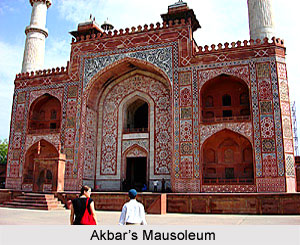
Art and architecture under the Mughals was a blend of Islamic, Persian and Indian architecture. Mughal architecture under Babur witnessed the construction of quite a few mosques around India, mostly taken from the desecrated Hindu temples. With the exception of a single inscribed mosque in Agra, no other surviving structure unquestionably had resulted from Humayun`s patronage. Mughal architecture during Akbar represents that unique blending of Persian architecture with the Indian style. The famous architectural groundings that belong to Akbar are the fortified Agra fort, Fatehpur Sikri in Agra, Jahangiri Mahal, Palace in Allahabad, Fort in Ajmer, Jodha Bai Palace, House of Birbal and his own magnificent tomb.
Jahangir patronised enthusiastically in the school of miniature painting in the Mughal regime. In Aurangzeb`s reign squared stone and marble gave way to brick or rubble with stucco ornament. He added his mark to the Lahore Fort. The most impressive building of Aurangzeb`s reign, is the Badshahi Mosque which was constructed in 1674.
Administration of Mughal Dynasty
Mughal emperors brought about certain elementary changes in the central administration structure in India. They accepted two primary duties for themselves, Jahanbani (protection of the state) and Jahangiri (extension of the empire). Jahangir and Shah Jahan followed Akbar`s policy in principle. Only Aurangzeb reversed the policy of Akbar. Akbar raised the structure of Mughal administration. It persisted till the reign of Aurangzeb with minor changes. The weak successors of Aurangzeb, however, could not maintain it.
The emperor was the head of the state. The muhtasib looked after the moral development of the subjects particularly it was his job that the Muslims observed Muslim laws. The Sadr-us-sadur advised the emperor on religious matters. He looked after the religious education, distribution of Jagirs to scholars and observance of the laws of the Islam by the Muslims.
Downfall of Mughal Dynasty
The Mughal Empire which gave Indian History an era of magnificent accomplishments and supreme power disintegrated into dust with the irreparable mistakes of emperors like Aurangzeb. Aurangzeb inherited a large empire, and instead of consolidating what he already had, he embarked an intolerant policy of annexation. His conflict with the Rajputs yielded serious consequences. Aurangzeb, blinded by religious discriminations withdrew himself from Rajput-loyalty and challenged their sovereignty. The Deccan invasion by the Mughals depleted the financial resources. The peace and order of the state was shattered at the very nerve-centre by the political uprisings of discontenting groups, namely, the Jats, the Satnamis and the Sikhs.
A final blow to the shaken constitution of the empire was given by the foreign invasions of Nadir Shah and Ahmed Shah. Finally the colonial conquest by the British led to the disintegration of the Mughal Dynasty.