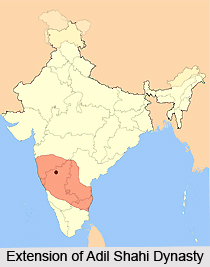
 The region of Bijapur is famous in history because of the Adil Shahi dynasty which ruler for nearly two hundred years. The Adil Shahi Dynasty of Bijapur was established by the governor of Bijapur, Yusuf Adil Shah who declared independence in 1489. It was Yusuf Adil Shah who waged war against Hindu empire of Vijayanagar, which lie to the south of the Tungabhadra River and the other neighboring Muslim kingdoms. During his rule the Portuguese commander captured that Adil Shahi`s favorite residence of Goa. In the 1510 A.D. Ismail Shah succeeded Adil Shah but being a minor in age he was assisted by Kamal Khan. But very soon he has to surrender to the inevitable truth of death due to an internal conspiracy and was succeeded by Ibrahim. The following successor of the Adil Shahi dynasty was Ali Adil Shah. In a matrimonial alliance he tied the knot with the daughter of Hussain Nizam Shah of Ahmednagar, Chand Bibi.
It was in the 1564 A.D. that the four sultans started hatching conspiracy against the Vijayanagar kingdom and the Battle of Talikota followed in 1565 A.D. The victory was not easy for the Muslim warriors but at last after a fierce battle the Vijayanagar territory was annexed to the kingdoms of Bijapur and Golkonda. Adil Shah was assassinated in the 1597 A.D. and the throne was passed on to Ibrahim Adil Shah II, who being a minor was looked by his mother Chand Bibi while the other ministers ruled the kingdom. At last the Adil Shahi dynasty collapsed like a house of cards in 1626 A.D. when Ibrahim Adil Shah was killed in a battle between Bijapur and Ahmednagar and the empire was annexed by the Mughal monarch Aurangzeb.
The Adil Shahi dynasty made a significant contribution to the arena of art and architecture, language, literature and music. The architectural grandeur of the age can be observed in the unfinished Jama Masjid which started in 1565 A.D. and has an arcaded prayer hall with fine aisles supported on massive piers and also has an impressive dome. The Dakhani language, which was an amalgamation of four languages including Gujarati, Persian-Arabic, Kannada and Marathi, developed into an independent spoken and literary language. During the reign of this dynasty many scholars, musicians, artists and Sufi saints flocked to India from far away lands like Iran, Iraq, Turkey, Turkistan and others. The religious tolerance of the monarchs of the Adil Shahi dynasty was also remarkable. The Adil Shahi kings were tolerant towards the Hindus and did not interfere in the matters of their religion. They also appointed Hindus to higher designations, especially in the field of administration and accounts which were maintained in the Marathi scriptures. The most famous among the officials of the Adil Shahi dynasty was the father of Shivaji, Shahaji. The book of the famous historian Muhammad Qasim Ferishta, Gulshane-Ibrahimi provides a detailed account of the Bahmani sultanate and the contemporary kingdoms of Adil Shahis.