


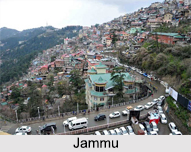
 Jammu is one of the three regions comprising the Indian state of Jammu and Kashmir. The Shiwalik Range comprises most of the region of Jammu. The Pir Panjal Range, the Trikuta Hills and the low-lying Tawi River basin adds the beauty and diversity to the terrain of Jammu. It is the largest city in the Jammu Division and the winter capital of state of Jammu and Kashmir. Jammu city is referred to as the ‘Gateway to Heaven’. Jammu is situated on the banks of the Tawi River. It is lying on the valley of Kashmir to the north. Jammu is one of the three regions comprising the Indian state of Jammu and Kashmir. The Shiwalik Range comprises most of the region of Jammu. The Pir Panjal Range, the Trikuta Hills and the low-lying Tawi River basin adds the beauty and diversity to the terrain of Jammu. It is the largest city in the Jammu Division and the winter capital of state of Jammu and Kashmir. Jammu city is referred to as the ‘Gateway to Heaven’. Jammu is situated on the banks of the Tawi River. It is lying on the valley of Kashmir to the north.
Geography of Jammu Jammu has an average elevation of 327 metres (1072 feet). Jammu and Kashmir comprises of three distinct climatic regions with vast variance due to a sharp rise of altitude from 1,000 feet to 28,250 feet above sea level within four degrees of latitude of the state. Demography of Jammu As of 2011 census, the population of Jammu city was 502,197 where males constituted 52.7 percent of the population and females constituted 47.3 percent of the population. Jammu had an average literacy rate of 89.66 percent. The chief languages spoken in Jammu are Dogri, Kashmiri, Hindi, Urdu and English. Climate of Jammu Jammu is a pleasant and cool area with a subtropical climate with excessive summer temperatures reaching up to 46 degree centigrade and in winter the temperatures occasionally fall below 4 degree centigrade. During winter, intense smog sources much difficulty and the temperature even drops to 2 degree centigrade. History of Jammu The ruler Raja Jambu Lochan came for hunting in this area on one occasion and witnessed an Asiatic lion and a lamb drinking water at a distance from each other on a lake. After satisfying their thirst, they went on their own ways. He was amazed with this and by expressing what he had seen, he called this place as a place of peace and tranquillity, where a lion and a lamb can drink water alongside. The Raja commanded to build a palace there and a city to be built at this place. Thus, the city in the name of Jambu Lochan was developed and was named as ‘Jambu-Nagar’ which later changed into ‘Jammu’. 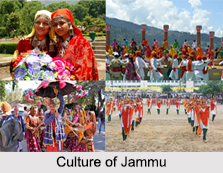 The city’s name figures in the ancient book ‘Mahabharata’. The name of Jammu is also found in the memories of ‘Timur’. The excavation of ‘Akhnoor’ provides the evidence that Jammu was once a part of the Harappan civilization. The city’s name figures in the ancient book ‘Mahabharata’. The name of Jammu is also found in the memories of ‘Timur’. The excavation of ‘Akhnoor’ provides the evidence that Jammu was once a part of the Harappan civilization.
Remains from the Maurya, Kushan, and Gupta periods have also been found here. The Dogra dynasty, founded by Raja Gulab Singh came and eventually he became the Maharaja of Jammu and Kashmir. The area witnessed the change of control from the invading Mughals and Sikhs before finally coming under the control of the British. After independence, it became a part of the Indian republic. Administration of Jammu Jammu city serves as the winter capital of Jammu And Kashmir State from November to April. Jammu was a municipal committee during 2001 census of India. From 5th September 2003, it has upgraded its status of a municipal corporation. Like all the states of India, Jammu and Kashmir has a multi-party democratic system of governance. Main political parties include the Jammu and Kashmir National Conference, the Indian National Congress and the Jammu and Kashmir People's Democratic Party (PDP). Economy of Jammu Jammu has a number of small industries. It has a number of wood grain mills. One of the most famous local Basmati Rice is produced here, which is then processed in rice mills. Some of the inhabitants of Jammu have settled down to agriculture, but the mainstream is primarily herdsmen. They farm maize beside the slopes of the mountains. Most of the populace of Jammu stay in villages and depend upon agriculture as their main work. Kashmiris residing in urban areas are effectively engaged in tourism industry, hotel management, silk industry, carpet and shawl making, wood work, other handicrafts and so on. Education in Jammu In the 2014–2015 General Budget of India, Arun Jaitley proposed an Indian Institute of Technology and an Indian Institute of Management for the division. Following are some educational institutions: People of Jammu Jammu is a land of grand ancient temples and beautiful palaces. It is a dwelling of numerous ethnic communities which pursue their individual traditional life-styles. 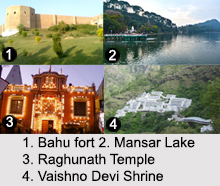 The ethnic groups residing in and around Jammu for centuries include ‘Kashmiris’, ‘Dards’, ‘Ladakhis’, ‘Dogras’, ‘Hanjis’, ‘Gujjars’, ‘Bakarwals’, ‘Chibali’, ‘Sudhan’, etc. Among these communities, the ‘Dogras’ represent the leading group. They are mostly live in the outer hill and outer plain zones covering Kathua, Udhampur and the lower parts of Rajouri district. The ethnic groups residing in and around Jammu for centuries include ‘Kashmiris’, ‘Dards’, ‘Ladakhis’, ‘Dogras’, ‘Hanjis’, ‘Gujjars’, ‘Bakarwals’, ‘Chibali’, ‘Sudhan’, etc. Among these communities, the ‘Dogras’ represent the leading group. They are mostly live in the outer hill and outer plain zones covering Kathua, Udhampur and the lower parts of Rajouri district.
Culture of Jammu The Pahari miniature paintings have reasonably become famous throughout India are the supreme examples of their artistic achievements. The music of Jammu is celebrated as ‘Sufiana Kalam’. The most popular folk music of Kashmir is called ‘Rabab’, ‘Geetru’ which is performed in the Dogra Pahari area of the Jammu Valley and ‘Rouff’ is chiefly performed in the month of Ramzan and the Eid festival. Festivals in Jammu The most notable festivals celebrated at Jammu consist of ‘Lohri’, ‘Baisakhi’, ‘Bahu Mela’, ‘Chaitre Chaudash’, ‘Purmandal Mela’, ‘Jhiri Mela’, ‘Jammu Festival’, ‘Shiv Khori’ Festival, ‘Chamliyal Mela’, ‘Mansar Food and Craft Mela’, ‘Tihar’, ‘Guru Ravi Das Jayanti’, ‘Holi’, ‘Navaratri’, ‘Ramnavami’, ‘Shivratri’, ‘Diwali’, ‘Id’, ‘Navroz’, ‘Buddha Jayanti’, ‘Mahavir Jayanti’, ‘Christmas’, ‘Kite Flying’ Festival, ‘Accession Day’, etc. Tourism in Jammu Jammu is a flourishing tourism heart of the state and the entrance to Srinagar and Katra. It is a prehistoric city of Northern India, boasting of its rich historical and cultural heritage. Some of the popular places of Jammu are as follows: Bagh-e-bahu Fort: It is situated only 5 kilometres from the central part of the city. It stands as tall and powerful on the left side of Tawi River. Raja Bahu Lochan constructed this wonderful fort over 3000 years ago, making it one of the oldest monuments in the city. Mubarak Mandi Palace: It is one of its most stunning places of Jammu. It houses the Dogra Art Museum which has numerous miniature paintings and Emperor Shah Jahan's golden bow and arrow with the other attractive things. 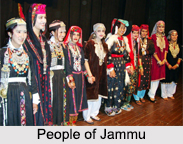
Mansar Lake: It is a very popular picnic spot and pilgrimage site. It shares the legend and holiness of Lake Mansarovar. It is also a home to the two temples, ‘Umapati Mahadev and Narasimha’ and ‘temple of Durga’. Raghunath Temple: It is a famous temple and tourist spot. It is also one of the biggest complexes in whole northern India and is brimming with devotees all time. Its presiding deity is Lord Rama, the eighth avatar of Lord Vishnu. Shivkhori: It a celestial shrine of an avatar of Lord Shiva. The 4 feet lingam was formed naturally in a cave. This self-manifested lingam of Lord Shiva is also known as ‘Swayambhu’ and is of great significance in Hindu religion. The shrine of Vaishno Devi is also famous all over the country and thousands of people visit here every day. Sehar baba waterfall, Amar Mahal Palace, Peer Kho Cave and Surinsar Lake are also the famous tourists’ spot of Jammu. Visiting Information of Jammu Jammu Airport is the closest domestic airport of Jammu that is well-connected to different cities like New Delhi, Srinagar and Leh. The other two nearest domestic airports are in Srinagar and Leh. The nearest rail junction in Jammu is situated in the city and is known as ‘Jammu Tawi’. This railhead is connected to the cities like Delhi, Chennai, Pune, Kolkata, Mumbai and Trivandrum. |
| |||



Jammu
| Jammu is one of the three regions comprising the Indian state of J and K and is one of the pilgrimage destinations in India. It is the largest city in the Jammu Division and the winter capital of state of Jammu and Kashmir in India. |
| ||||||||||||||||||||||||||||

