 Eid ul Zuha commemorates Hazrat Abraham`s sacrifice of his own son in obedience to a command of god. Eid ul Zuha is celebrated from the tenth to the twelfth day of `Zil Hijja` (Twelfth month of Islam). It is, also called Bakrid or Id-ul-Zuha and is a festival of great rejoices. It also marks the completion of Haj (pilgrimage to Mecca). The day also coincides with the day when the Holy Quran was declared complete.
Legend behind Eid ul Zuha
God had put Hazrat Abraham to a dreadful test. He was asked to sacrifice whatever was dearest to him and he decided to sacrifice the life of his son, Ismail. Thus, he blindfolded himself, so that his paternal affection should not interfere with his duty. He sacrificed his own son at Mina near Mecca. But, after opening his folds, he found his son alive and a slain ram at the altar. It was revealed to him that this was meant only to test his faith, and it was enough, if instead he sacrifices only a ram in the name of Allah. The term `Id` is obtained from the Arabic term `Iwd` which implies festival while `Zuha` is derived from the word `Uzhaiyya` which means sacrifice.
Rituals of Eid ul Zuha
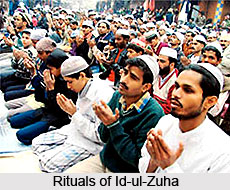
On Eid ul Zuha, the Muslims go to the mosques in the morning to offer prayers to Allah. On Eid ul Zuha, special `Dua` (prayer) is recited by thousands of Muslims for peace and prosperity. The wealthy are expected to sacrifice one animal per family and distribute two-thirds of the meat among poor. Those who cannot afford it, one animal per family can be offered. Very poor, seven or seventy families together offer one animal. A full-grown camel, cow, goat or sheep, free from disease, is considered the best offering. The sacrifice can be offered at any time before the afternoon of the third day. In India, too, goats and sheep are sacrificed all over the country and prayers are offered.
It is day for feasting. Special delicacies are prepared and served among family and friends on the occasion. People greet `Eid Mubarak` to each other on this day. Women apply `mehndi` (henna) and deck themselves out in their finest ornaments. Special prayers and exchange of greetings and gifts mark the Eid ul Zuha (Bakrid). Eid ul Zuha is a festival of sacrifice, celebrated with traditional fervour and gaiety in India. The animal sacrifices made during Bakri-Eid are mainly to provide food to the poor and to commemorate the noble act of Ibrahim. This spirit of sacrifice is what truly underlines the spirit of Eid ul Zuha.