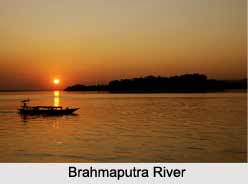
 The state of Assam is dominated by the mighty Brahmaputra River. It is situated between the great Himalayan foothills to the north and the plateau of Meghalaya to the south. The stunning grandeur of its dense tracts of tropical forests, interspersed with emerald patchwork quilts of paddy and verdant tea gardens showcase the life giving largesse of the mighty Brahmaputra.
The state covers an area of 30285 sq m and is bordered by Bhutan and Bangladesh. Today there are two names for Assam; the official English name Assam and the Assamese local name Oxom. The inhabitants of Assam comprises of the migrants from Burma and China who came from Punjab through Bihar and North Bengal. Assam presents a fusion of Mongol-Aryan culture.
History of Assam
The name Assam has been used for more than eight hundred years from the time the Tai people first came to Assam. In the Epics, Assam was known as `Kamarupa` or `Pragjyotish`. In Mahabharata, the Puranas, the Tantras there are references of the kingdom known as Kamrup. The renowned king Narakaxura ruled Kamrupa from his capital at Pragjyotishpura. The early history of Assam is believed to be of the Varman dynasty. Among the early sources there are references of the visit of Hiuen-tsang, who had visited the court of King Bhaskar Varman.
Geography of Assam
 Assam comprises an area of 78,523 square kilometers (30,318 square miles). Assam is composed of plains and river valleys. It can be divided into three principal geographical regions: the Brahmaputra Valley in the north, the Barak Plain in the south, and the Mikir and Cachar Hills that divide the two regions. The Brahmaputra Valley is the dominant feature of Assam. The river valley is studded with hills and ridges. The valley is surrounded on all sides except the West by mountains.
Demography of Assam
The esteemed population of Assam in 2011 is 30.57 million. The districts of Kamrup, Nagaon, Sonitpur, Barpeta, Dhubri, Darang and Cachar record the higher population. According to 2001 census the literacy rate of this state is 63.3%.the male literacy rate is 71.3% and the female literacy rate is 54.6%. In Assam forty five languages are spoken by different communities.
Culture of Assam
The culture of this state is a type of hybrid one originated due to the assimilation of the ethno cultural groups. This state is an intermixture of various racial stocks like Mongoloid, Indo-Burmese, Indo-Iranian and Aryans. Assam has a large number of tribes. The majority in Assam are the Vaishnavas. Other religions such as Buddhism, Christianity, Hinduism, Islam etc. are also found in Assam. Bihu is the national festival of Assam. It is celebrated in three parts during a year with great pomp and grandeur by all Assamese, irrespective of caste, creed or religion.
Education of Assam
 Assam is well known as a top educational destination at the state as well as the national level. Dispur in the largest city of Assam Guwahati is the capital of Assam is a popular destination for the students who like higher education. The Assam Valley School is considered as one of India`s best boarding school. There are numerous reputed schools, colleges and universities in this state. There are some notable universities, colleges and medical colleges in Assam. These are Gauhati University in the city Guwahati, Dibrugarh University in Dibrugarh, Tezpur University in Tezpur, K.K.Handique State Open University in Guwahati, Assam University in Silchar, Assam Agricultural University in Jorhat, Bodoland University in Kokrajhar, Don Bosco University, Assam Down Town University and Kaziranga University.
Administration of Assam
The current chief minister of Assam is Tarun Kumar Gogoi. He is elected in the year 2011 from the Indian National Congress. The legislative structure of Assam is unicameral and consists of 126 members. The members are elected for a period of 5 years.
Since the Indian Independence, Congress has been in power from 1947 to 1978. After which the Janata Party came to power but this government did not last for two years and again Congress came back to power and ruled till 1985. They were again succeeded by the AGP (Asom Gana Parishad). Since then (1985) the Congress and the AGP had been in power alternatively.
 Economy of Assam
The economy of Assam is mainly agricultural. There is a widespread practice of traditional farming techniques and low practice of modern techniques. About seventy five percent of the population depends on agriculture and sixty nine percent of the work force in the state is engaged in agricultural activities. Rice is the staple diet of the people. Most of the people are engaged in the cultivation of rice. Other agricultural products cultivated are pulses, jute, tea and fruits. Sugarcane, potatoes, cotton, oil seeds and coconut are also produced in large amount. One of India`s few oil regions; Assam produces more than half of the nation`s Tea. There are around right hundred tea estates in Assam.
Tourism in Assam
Assam comprises of many tourist places in and around it. Assam is considered as pilgrim`s paradise. Kamakhya temple in Guwahati is very popular pilgrimage. Kaziranga National park and Manas national Park are important wild life parks. In this state trekking, motorcycle tours and Brahmaputra cruise are some outdoor activities with which the travellers can indulge themselves.
Assam
Assam is an Indian State which is endowed with tea, petroleum, natural gas, coal, limestone and other minor minerals such as kaolin, clay, feldspar and so on.