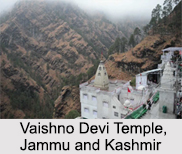
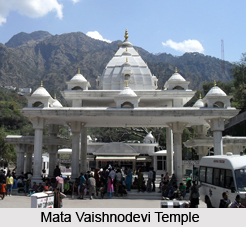
 Vaishno Devi, a Hindu Temple dedicated to Maa Durga or Goddess Durga, is situated in Katra at the Trikuta Mountains in Jammu and Kashmir. The temple is also known as Mata Rani, Trikuta or Vaishnavi Mandir. The temple is 13.5 km from Katra.
Architecture of Vaishnodevi Temple
While on the way to the Sanctum Sanctorum, one crosses a small patio type of structure on the right hand side of which, there is a cave opening. This is the original cave leading to the Holy Pindies. Earlier, the yatris used to reach the Sanctum Sanctorum through this cave only. Nowadays, this cave is kept closed for a large part of the year. Since this cave is quite narrow, it takes several minutes for a single person to cross it and reach the Sanctum Sanctorum. Considering the rush that the Holy Shrine normally witnesses, it is not possible to keep the original cave open except when the yatra is less than 8000 pilgrims per day.
Therefore, two new tunnels have been constructed to facilitate a larger number of pilgrims for darshans or visit. One tunnel is used for the entrance and leads directly to the Sanctum Sanctorum. The other tunnel is used for exit. The original cave is opened during the lean periods or on traditional festivals or for ritualistic occasions.
When one crosses the portion where the original Cave is located, one walks further through a corridor on which numerous bells stand suspended from the ceiling. After walking a few yards, one reaches a broad platform where statues of the Lions, the mount of the goddess and a life size statue of the goddess are enshrined. This is the entrance of the new tunnel. This tunnel is only 200 meters long.
The Holy Cave is around 98 feet long. With the Pindies there are other holy places inside the cave. It is believed that the 33 crore (330 million) Gods and Goddesses are present in the Holy Cave and are said to have worshipped the Maa Durga and have left their symbols inside. At the entrance to the Holy Cave, on the left hand side, is the symbol of Vakratund Ganesha. Adjacent to it are the symbols of Surya and Chandra Dev. Inside the cave one has to cross the torso of Bhairon Nath, which is 14 feet long. The head is said to have fallen atop the adjacent mountain, where a temple exists.
After the torso, there is the symbol of Lord Hanuman as Launkra Beer. Later Charan Ganga arrives, the legendary river flowing from the feet of Mata. Those going through the old Cave have to wade through water beyond this point. Around 23 feet beyond Launkra Beer, on the left upper hand one can see the weight of the entire cave seems to rest on the many heads of Shesh Nag. Immediate below this, there is a Havan Kund of Mataji and close to it is the symbols of Shankh, Chakra, Gada and Padam.
Almost touching the ceiling are the symbols representing the five Pandavas, the Sapta Rishis, the udders of the divine cow Kamdhenu, symbols of Brahma-Vishnu-Mahesh and Shiv-Parvati. Further on, one can see the khamba (pillar) that is gripped by the legendary worshipper Prahlad. Diagonally close to the water level is a yantra that has many mystical signs and symbols inscribed on it. 22 feet ahead is the paw marks of a lion - symbolizing the mount of the Mata Vaishno Devi. Six feet ahead, on the left side, are the symbols of Shankar and Gauri.
13 feet beyond are the Holy Pindies. To the right one can see the symbols of Lord Ganesha, Surya Dev, Chandra Dev and Goddess Annapurna. Slightly behind the Pindies, and on the right side is the symbol of a seated lion. A little ahead is the Varad Hast - the hand of Mata Rani, raised in granting boons. Immediately opposite of the Holy Pindies is the natural symbol of Lord Pashupati Nath. These sites can be seen only if one goes through the original cave. But due to the rush, the new tunnel is used.
There are other deities to visit in the Bhawan or temple area including a Shiva Linga cave, Mata Durga, Lord Shiva, Shri Rama with Sita and Lakshmana, Lord Hanuman etc; these temples are situated at different points. There are Yagyashalas in the Bhawan where yagyas and havans are performed round the year and especially during the Navratris. The main Yagyashala is situated at Saraswati Bhawan.