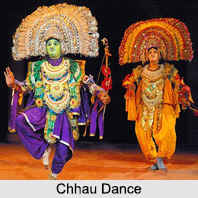
 Chhau Dance is a mask dance prevalent in Eastern India. A tribal martial dance of the Indian states of Odisha, Jharkhand and West Bengal, Chhau is known for its vigour and vitality. The dance form has three subtypes; namely Purulia Chhau, Mayurbhanj Chhau and Seraikella Chhau, named differently because of the place of their origin. Although there is not much difference between these dance forms at different geographic locations, some of the Chhau dances use stylized masks. Purulia Chhau Dance is listed on UNESCO"s world heritage list of dances. Chhau is a festival dance, performed on the occasion of the Gajan Festival and Sun Festival observed according to the Bengali calendar at the end of the month of Chaitra.
Origin of Chhau Dance
Chhau Dance has roots in the tribal rituals but also draws inspiration from martial arts, mock combat, semi-classical dance, acrobatics, athletics and story-telling. It is said that the word "Chhau" is derived from the Sanskrit word "Chhaya", which means shadow or image. The dance form was nurtured and developed under different royal patronage. Maharaja Krishna Chandra Bhanj Deo of Mayurbhanj was its greatest patron.
Themes of Chhau Dance
The Chhau dance is mythological, as it is mainly based on various episodes of the epics Ramayana and Mahabharata. Sometimes certain episodes of the Indian Puranas and other India Literature with religious themes found in Shaivism, Shaktism and Vaishnavism are also used. The individual dance items of Chhau dance of Mayurbhanj include solo, duet and group performances. Two Rasas are dominant in the performance - Vira and Rudra, and in the end, forces of evil are punished and the righteous triumphs.
 Music in Chhau Dance
Most of the tunes for Chhau Dance are traditional and folk which are played on Mahuri and various types of drums. The music appropriately reflects the moods which the dancers so impressively interpret. The use of the drum is an important part of Chhau performance. With the beating of drums an invocation to Lord Ganesha is given and the dance begins. As the singer completes the invocation song, a host of drummers and musicians start beating the Dhol and the Dhamsa. The musical part is an integral prelude to the actual dance performance. After this musical journey, the character of Lord Ganesha appears on the dancing ground followed in quick succession by other characters - Gods, demons, animals and birds.
Costumes of Chhau Dance
The costumes of the Chhau performers are of various colours and designs. It mainly comprises of Dhoti or Pyjamas in deep green or yellow or red shade that is worn by the artistes playing the role of Gods; whereas those playing the role of demons have on loose trousers of a deep black shade. Sometimes, stripes of contrasting colours are also used to make the costumes more attractive and different. The costumes for the upper part of the body is Kurta with full of various designs. Female dancers, or male dancers depicting female characters, are known to wear colourful sarees. A vast amount of costume jewellery is worn in the form of necklaces. The style and variety of the costume of the dancers largely depends on the characters being portrayed by them. Usually, there are three types of characters - Gods and Goddesses, Demons and Monsters, each with their distinct costumes and appearance.
Masks of Chhau Dance
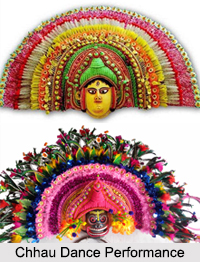
The masks worn during this performance are of vital importance as they are used to convey emotions and the nature of the character. The Chhau masks are generally made up from clay and paper.
Performance of Chhau Dance
Chhau Dance is mostly performed in the open space or ground field during the night. The dancers take a bath and do a Puja before performing this dance, in order to maintain the sacredness of dance as the characters in the dance are of Gods. Generally, fire poles called "Mashaal" surround the dance arena, for the purpose of light. In the performance of the Chhau, some of the characteristics of primitive ritualistic dances are noted. This is also seen through its vigour, style and musical accompaniment mainly with the drum.
As it is compulsory for all the characters in the Chhau dance to wear masks, various body movements, including movements of the peaks of the masks are used to illustrate different moods. The mask movements show anger, while shoulder and chest movements indicate joy, depression and courage etc. Jumping in the air is another movement, which serves as a gesture of attack during the enactment of a war scene.
Thus, Chhau Dance is not just a performance of dancers enacting religious epics; musicians play an extremely large role in making the recital come to life as well. The performers create a magical performance as audience sitting in a circle or a semi-circle around them to watch.