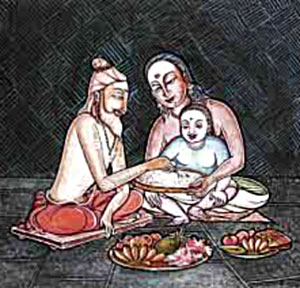
 The ceremony of Vidyarambha is performed in the fifth year of the child. This marks the start of child"s education. This is the tenth Samskara. The child traces letters in the sand or a tray of rice grains which is meant to call upon Goddess Saraswati who is considered as the Goddess of knowledge. However, each family performs it at different age. Some do it when the child is two or three years old. Others do it when the child is five and there are those who perform it annually on the Vijayadasami day of the Navaratri celebrations in a temple.
When the sun is in the northern hemisphere an auspicious day is fixed for Vidyarambha. The child is bathed and is dressed neatly. The Gods are worshipped and a Yajna is performed. This rite includes writing and reading. Saffron along with other substances are scattered on a silver plate and letters are written with an item of gold or with any pen suitable on rice. The phrases written are: "Salutation to Ganesha, Salutation to Saraswati, Salutation to family gods and goddesses, Salutation to Narayana and Lakshmi". This symbolizes that the child was introduced to education along the divinities worshipped by the family.
However, in temples the initiation mantra goes as follows:"Om Hari sri ganapataye Namah". This mantra is also written on the child"s tongue with gold after writing on the rice. Each of the writings has its own symbolism. Writing on sand signifies practice. Writing on grains signifies acquisition of knowledge leading one to prosperity. Writing on the tongue with gold raises the grace of Goddess Saraswati by which one attains the true knowledge.
This article is a stub. You can enrich by adding more information to it. Send your Write Up to content@indianetzone.com