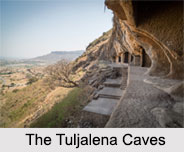
 The Tuljalena Caves in Junnar region, Maharashtra, are a group of 11 artificially manmade rock cut temples of the Buddhist religion that were made during the 1st - 3rd century AD. The Tuljalena Caves are located in the west of the Junnar region, where almost 200 rock-cut temples from the ancient period are found that extends over four hills. The Lenyadri Caves, Manmod Caves and Shivneri Caves are also in here. All the caves here belong to the "Hinayana" phase.
History of Tuljalena Caves
Buddhism reached here by the merchants and some of the primary Buddhist monasteries were founded along with the trade routes. Junnar was a significant trade hub in the 1st century AD and this town was situated on a trade way leading from Satavahana capital Paithan to the rich ports at Arabian Sea. Route was busy transporting carnelian and textiles to the Middle East and Roman Empire. This path was also regularly travelled by ancient Greek and Middle East traders. The caves were built in the 1st - 3rd century AD and thus they are roughly 2000 years old. Other values conserved up to this day are relics of ancient paintings in the shrine of Cave 2 and the extraordinary architecture of this cave. Present name of the hill stems from caves themselves and in Cave 3 there is a new sculpture of Hindu goddess Tulja.
Classification of Tuljalena Caves
The Tuljalena Caves are classified into different sub-groups depending upon the place of these digs. They are:
•Tulja Lena - situated in Tuljabai hill which is 5 kilometre west of Junnar.
•Manmodi - situated in Manmodi hill to the southwest of the town. There are an additional three different groups.
•Bhimashankar
•Amba-Ambika
•Bhutalinga
•Sivaneri
•Lenyadri
Depiction of Tuljalena Caves
The 11 caves in the group contain various artworks and shrines of the Buddhist religion. In cave 1, there is a "vihara" that consists of major hall and five cells. Front part has become distorted. Two cells are in the left wall of hall, one in the right wall and two in the back wall. In cave 2, the whole cave was painted and the patches of colour are still evident on the passageway roof and lower circle of dome. It consists of round room with a place of worship "dagoba" that is constructed in the centre. The shrine is enclosed by 12 octagonal pillars. Cave 3 has been turned into a place of worship of Hindu goddess "Tulja". Two cells in the back part have been combined into one room. Cave 4 has a row of three cells. Cave 5 has a small chamber with thin passage foremost to it.
Cave 6 has two small rooms separated by a wall. Cave 7 is partially combined with Cave 6. Doorway is decorated with horse shoe arch and ornamentation. Front wall and left wall is distorted and contains aid sculptures of people coming to shrine and some mythological beings. The cave 8 has two cells separated by a wall. Cave 9 has "vihara" and it contains two cells, each with mascot doorway over the entrance. Cave 10 has a dining hall with no front wall and the right wall contains a chamber. Cave 11 consists of a passage and a chamber in the left wall of way.