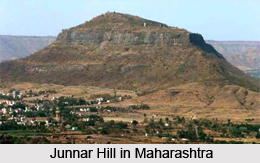
 The Lenyadri Caves, also called Ganesh Lena, are the most remarkable and striking in the Junnar region, Pune District, which contains around 200 ancient rock-cut caves. Lenyadri literally means mountain cave, and is made from the words Lena (meaning Cave in Marathi) and Adri (meaning stone or resistant in Sanskrit). The caves are situated on the southern part of the Sulaiman Pahar hillside that is on the north of Junnar. There are 40 rock-cut caves in Lenyadri which are mainly Buddhist temples, and contain ancient Buddhist art. These caves date back to the 1st - 3rd Century AD. There are numerous simple Buddhist paintings in the Caves 10, 11, 12, 13 and 17, but Cave 7 has been modified into a Hindu sacred place and decorated with paintings of the 19th century.
The Lenyadri contains are situated in a compact cluster and face southwards. The caves were made as Buddhist monastery, among which one was later transformed in a Hindu temple of Lord Ganesh. Almost 280 rock cut steps, set in ten flights, have to be crossed in order to reach the caves. These steps were made during the 19th century. The Lenyadri caves were created by Buddhists according to the Hinayana traditions. Amongst all the 40 caves, 30 of the caves contain 2 shrines, Chaitya Griha and another smaller shrine or chaitya. There were other caves also that served as lodging for monks or viharas. Most of these caves consist of a hallway, verandah and cells that are situated around the hallway. The caves are numbered, from the east to the west, just like most other Indian rock-cut caves. There are more caves along the hillside that are even older than the caves in the main site. In the entrance of one of the caves, which is a chaitya, there are inscribed decorations of lotus and other geometric patterns. There are shrines present in other caves as well.
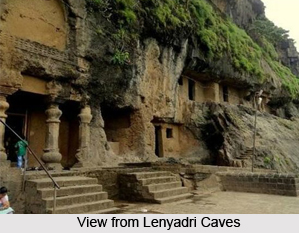 Description of Lenyadri Caves
Cave 1 has a reservoir in the front are, covered with mud. Cave 5 also has reservoir in the front, a verandah with inscriptions, and seven cells around the hallway. Cave 6 contains a chaitya griha which was the main Buddhist shrine in these caves and is created in the Hinayana tradition. There are verandahs with pillars, a main hallway and a stupa in the back. Cave 7 is the biggest vihara in the Lenyadri caves, which has been modified into a Hindu temple, although it was originally made as a Buddhist lodging for monks. There is a large hallway which contains small cells and a Verandah with 6 pillars. After the cave was converted into a Hindu temple, it was plastered and painted in the 19th century. Cave 14 is a monastery or chaitya griha and contains a Pillared verandah and a hallway with flat roof. There is a verandah with inscriptions and a stupa in the rear end.
Cave 17 contains of three lodging areas behind a verandah. There are remnants of Buddhist paintings in many cells. There are 5 containers around the front of the cave. Cave 18 is a mainly place for dining or bhojanamandapa, and there is a reservoir towards the left of the verandah. Cave 25 is rather incomplete due to unfavourable conditions and is moderately large. Cave 26 is basically a small shrine or chaitya. The Lenyadri caves in the Junnar region have been able to conserve traces of ancient cave paintings, artworks and inscriptions.