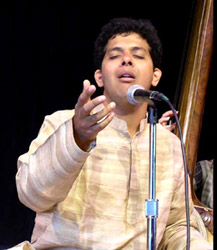
 Thumri, a captivating vocal genre in Indian music, derives its name from the Hindi verb "thumuknaa," meaning "to walk with a dancing gait in such a way that the ankle-bells tinkle." This delightful form of music is intricately connected with dance, dramatic gestures, mild eroticism, evocative love poetry, and folk songs, particularly hailing from Uttar Pradesh. While Thumri exhibits regional variations, it is predominantly characterized by sensuality and a flexible approach to raga.
Thumri is not only confined to its own form but also serves as a generic name for several other lighter forms, including Dadra, Hori, Kajari, Sawani, Jhoola, and Chaiti. Each of these forms possesses its own unique structure and content, either lyrical or musical, often drawing inspiration from folk literature and music.
Significance of Thumri in Indian Classical Music
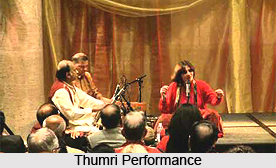
As the most important "light classical" genre of North Indian Classical music, Thumri holds a prominent position in various performance contexts. It finds expression in dance, vocal concert stages, and instrumental performances alike. Thumri is labeled as light classical due to several factors. Firstly, the melodies are not always composed in a strict Raaga, and they may even break the rules governing their rendition. Additionally, simpler talas and lighter raagas are often employed in Thumri. The absence of alap-type improvisation, which is considered the true test of musicianship, further contributes to its classification as light classical.
Moreover, traditional Thumri performances are accompanied by a harmonium, which, although adding to the charm, restricts melodic flexibility with its fixed pitches. Despite these distinctions, Thumri remains an enjoyable and soothing form of music, often serving as a delightful conclusion to vocal or instrumental concerts.
Romantic Essence of Thumri
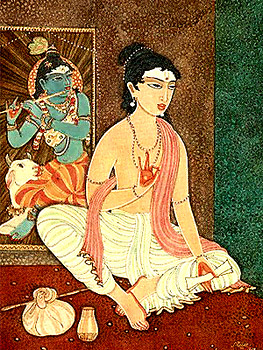
Thumri is distinguished by its romantic and devotional lyrical content, predominantly sung in the Uttar Pradesh dialects of Hindi known as Awadhi and Braj Bhasha. The essence of Thumri lies in its ability to evoke emotions through its expressive and poetic verses. While some compositions refer to Lord Krishna and his amorous escapades, others focus on the experiences of lovers, showcasing the various stages of love, including unison and separation.
Text and Structure of Thumri
Thumri emphasizes the importance of the text, with clear pronunciation of each word and the heartfelt expression of the underlying emotions. This distinguishes Thumri from Khayal, another vocal genre in Indian classical music.
A Thumri composition consists of a sthai (main phrase) and one or more antaras (additional phrases) with room for improvisation. While some Thumri compositions contain additional text set to the same antara melody, others comprise only the sthai and antara. Gradually, as the performance progresses, the improvisation on the sthai text intensifies, exploring the middle and upper registers. This segment of the performance resembles the medium-speed khayal style. The antara is introduced when the upper register has already been explored in the improvisation, and it is initially presented partially, akin to a Khayal antara.
A distinct feature of Thumri performances is the inclusion of a section where the singing momentarily ceases, allowing the accompanying harmonium to take the melodic lead. This section, known as "laggi," highlights the virtuosity of the tabla player. Following the laggi, the singing resumes at the same tempo as before, typically with a second antara. The performance concludes with a return to the sthai and a final rendition of the main verse. Unlike the accelerating pace found in Khayal, Thumri maintains a relatively constant speed, providing a soothing and enjoyable musical experience.
Musical Elements in Thumri
Thumri is predominantly performed in "lighter" raagas such as Khamaj, Kafi, Tilang, Desh, Piloo, and Bhairavi. These raags offer greater flexibility and allow for emotive improvisations, enabling the artist to infuse the composition with rich nuances and variations.
The tala most frequently used for thumri are dipchandi (14 counts), jat (16 counts), Panjabi (16 counts), kaharva (8 counts), and dadra (6 counts). (Dadra tal is usually associated with a light classical genre that is also called dadra.) The 16-count talas jat and Panjabi have the same structural subdivisions as 16-count tintal, but the thekas with which they are drummed are very different, They can easily be distinguished in performance because the drummer keeps primarily to the theka.
Dipchandi of 14 counts is the same as jat tal, with one count removed in each half of the cycle (as indicated by the boxes in Example 7-10) so that the structure is 3 + 4 + 3 + 4. Bracketed strokes are played in one count. Since this tala has such a brief cycle, the singers go through several cycles of it before singing a cadence. The principle of keeping the text at the same points in the tala cycle and singing the full sthai phrase for cadences is kept more consistently than it is in khayal mukhra.
Language and Subject Matter in Thumri
Thumri compositions predominantly employ regional dialects of Hindi such as Awadhi, Bhojpuri, and Mirzapuri. However, Thumri also encompasses compositions in other languages, including Rajasthani, Marathi, and Bengali. The language of Thumri allows for a deep connection with the audience, as the lyrics often touch upon universal themes of love, longing, and the human experience. The verses of Thumri are filled with poetic imagery, metaphors, and vivid descriptions, enhancing the emotional impact of the performance. The lyrical content, combined with the melodic and rhythmic elements, creates a mesmerizing and immersive musical experience.
Evolution and Modern Interpretations in Thumri
Thumri has evolved over time, adapting to changing musical tastes and incorporating influences from various regional styles and artists. Traditionally, Thumri was performed in a semi-classical manner, passed down through oral tradition from one generation to another. However, with the advent of recorded music and the influence of popular culture, Thumri has also found its way into contemporary adaptations.
Contemporary artists have experimented with blending Thumri with other genres like jazz, fusion, and world music, resulting in innovative and eclectic interpretations. These interpretations have not only expanded the reach of Thumri but also brought it to the attention of a wider audience. While purists may argue about the authenticity of such experiments, they have undoubtedly contributed to the preservation and revitalization of Thumri as an art form.
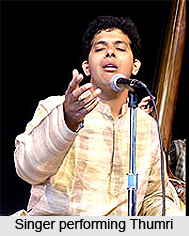 The first traces of thumri go back to the 15th century, known to have likenesses with the dance form Kathak. Thumri is a lively musical style, evoking a sense of sensuality and amorousness, aimed at the subtle feelings of the heart. However, historical records speak of a different version of thumri during the 19th century, bearing similarity with khayal and depending on the elaboration of ragas. Many are of the view that thumri is a derivation of the madhura bhakti treatises of the Mathura-Vrindavan, concerning about the love intrigues of Krishna and Radha. Yet again, facts speak about Nawab Wajid Ali Shah of Awadh and his court musician, Sadiq Ali Khan, to have a significant hand in the evolving of this form of classical music. They are responsible for thumri being what it is today, due to their soulful compositions, along with several other musicians of their time. They had the power to assimilate their acquired legacy and render it masterfully.
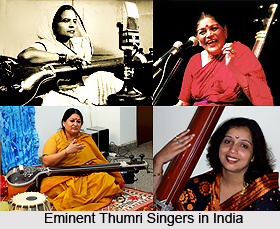 Though thumri is believed to have its roots in certain early genres of music, it is not until the middle of the 19th century that one notices it becoming enshrined as a form of classical music. The modern thumri is believed to be a `creation` of Nawab Wajid Ali Shah of Awadh (1822-87) and his court musician, Sadiq Ali Khan. Wajid Ali Shah also composed outstanding thumris under the pen name, `Akhtar Piya` which are widely sung in repertoires. Yet historical evidence would have one to believe that Wajid Ali Shah and Sadiq Ali Khan along with several composers and musicians, who lived during the latter part of the 19th century, enhanced and amended the acquired legacy and gave it the discernible structure seen today. Importantly, Wajid Ali Shah`s role as a composer, practitioner, patron and connoisseur of thumri was to have a far-reaching impact on its development and maturation during the 19th century.
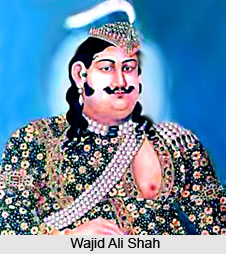 Styles of thumri have developed gradually along the course of the development of the art. Thumri has had a rather long tradition and can be traced right back to the age of classical Sanskrit plays and later to the Vaishnava Bhakti cult and the rasa natya. However, the Thumri as it is known today received great patronage, currency and shape during the days of Wajid Ali Shah when he was the Nawab of Lucknow, from 1847 to 1856. Its present tradition is also linked with Kathak dance and Thumri continues to be an essential feature of the Kathak nirtya. Thumri also evolved as a mode of vocal music without any recourse to the visual, i.e., acting or abhinaya, and aiming its expression only through music and words.
 Tala in
  Thumri is the most important "light classical" genre of
 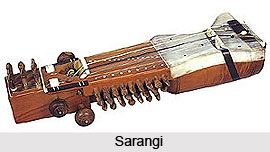 The thumri genre has had the most profound influence on the idiom of the sitar and the saroda, the two instruments that rose to prominence in eighteenth and nineteenth century Lucknow, the home of the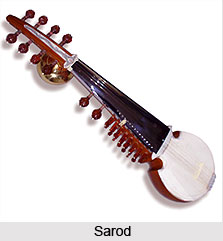
 Thumri has been an integral part of