 Theory of Avatar seems to have been influenced by the con caption of the former Buddhas, some of whom were worshipped in their own Stupas as early as the 3rd Century B.C. in the great epic of "Mahabharata", the theory of Avatar only presents a stage of development.
The Avatar Theory, which apparently underwent several stages of evolution, seems to be based on old tales of strange animals with mysterious powers of assistance. The Buddhist conception of the "Pratyeka-Buddhas" might have influenced the development of the theory.
An "Avatar" is a limited manifestation of the "Supreme", but the "Srimad Bhagwat Gita" seems to take it as the descent of the whole "God" into "Man". In a sense every individual human being is an "Avatar". It is enveloped in ignorance and is a disguised manifestation, whereas the "Divine Avatar" is none else but God, who limits himself for a definite purpose.
Different Avatars in Hinduism
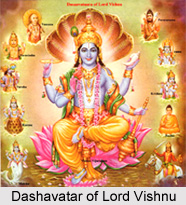
The theory of Avatar or incarnation is mentioned in the "Srimad Bhagwat Gita" which declares Krishna to be the "Purushottam" or Perfect Man. In a passage of the late Narayaniya section of the Mahabharata mention is made only of 4 Avatars, likely a "Boar", "Dwarf", "Man-Lion" and "Man" (Vasudeva-Krishna). In another passage of the same section, the sacred beings "Rama Bhargava" and "Rama Dasarathi" are added to the list making a total of 6 Avatars, while a 3rd passage gives the list of 10 incarnations, by adding "Harsha", "Kurma", "Matsya" and "Kalki", to the above 6.
"Matsya Purana" gives a list of 10 incarnations, there were 3 Divine Avatars, likely "Narayana", "Narasimha" and "Vamana", as well as 7 human Avatars, likely "Dattatreya", "Mandhatri", "Rama" son of Jamadagni, "Rama" son of Dasaratha, "Vedavyasa", "Buddha" and "Kalki". The same section occurs in the "Vayu Purana" with the substitution of "Krishna" for Buddha.
Gautama Buddha as an Avatar of Lord Vishnu
Lord Gautama Buddha is recognized as an avatar of Lord Vishnu in the "Dasavatara Charita" and "Gitagovinda" of the eastern India. "Varaha Purana" mentions ten incarnations and Buddha has been accepted as an Avatar in it. It is due to the large number of Buddhists were divulged into the fold of the Vaishnavas towards the close of the Hindu period. It is recommended that Lord Buddha was included in the list of Vishnu Avatars. In this manner the relation of Bhagvatism with other creeds continued and gradually the conception of the 10 Avatars of Lord Vishnu became prevailing.
Buddha Avatar is said to be one of the prominent Avatars of Lord Vishnu amongst the other 9 avatars. According to the scholars, the Buddha Avatar was to discriminate between right and wrong before the World. For this reason Lord Vishnu came as an incarnation of Lord Buddha. The Avatar of Lord Vishnu, Buddha later on addressed men all over the world to choose between two divine truths, "Paths" and "Principles". The decision of men should not merely be on the basis of sense but also on the basis of the reason and also the rational capacity which is granted only to the men in the world.
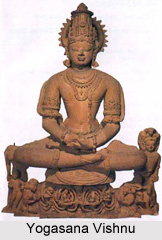
The Yogasana Vishnu images, found in Sagar district of Madhya Pradesh are the strong examples, to show the synchronization of Buddha and Vishnu. The Deity, seated in Padmasana pose on a lotus seat with the front hands placed in Dhyani Mudra, is known as "Yogeswara Vishnu" or Yoga-Narayana. This form of Vishnu is regarded as the composite form of Vishnu and Buddha.