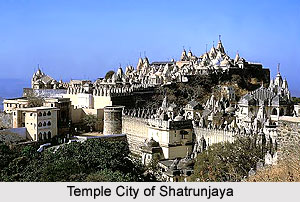
 The Temple City of Shatrunjaya is located at a distance of 48 kms from Bhavnagar and 29 kms from Sihor in Saurashtra. It is one of the most popular Jain pilgrimage centres. The sacred place has been visited by Bhagwan Rishabh Dev almost ninety nine times. Shatrunjaya Teerth is a city of temples and as defined and approved by the Agamas it is regarded as Siddhakshetra of all times. The temple city has been visited by twenty three Jain Tirthankaras, except Lord Neminath. All the Jain Tirthankaras had preached about the auspicious message of Jaina dharma. The principle deity of the temple is Shri Adishvara Bhagavan. The idol is white in colour and is seated on a lotus shaped seat.
Architecture of Shatrunjaya
The temple city of Shatrunjaya is situated on a mountain that is 1640 feet. It is spread over twenty acres and has nine hill-tops. It consists of 108 large temples and 872 small shrines. These have 7000 images of Shri Jina.
This temple town consists of north and south ridges with a valley in between. These clusters of temples are known as `tuk` which are surrounded by high walls. There are six tuks along the north ridge, which includes Kharataravasi Tuk. Motishah and Balabhai are cantered on the valley. A single tuk known as Vimalavasi Tuk is present in the entire south ridge.
Different size of temples has been erected on the main street on both sides of the Vimalavasi tuk on the southern ridge. The magnificent Adishwara temple is located at the end of the main street. The temple is tastefully decorated. Devotees visiting the temple gather and sing devotional songs here. However, the group of temples along the north ridge remains calm and quiet.
Most temples on the mountain are of "shikara style." The collection of large and small shikaras standing together is a pleasing sight.
The hipped roof of the mandapa (hall) is slanted 45 degrees, is called a "sambarana roof." It is covered with small decorative elements like bells that are turned upside down. It is believed that Adishwara temple was constructed in 960 and reconstructed in 1530.
According to history in ancient times Pundarikaswami, the Ganadhara of Bhagavan Rishabha Deva renounced the world to attain nirvana at this holy place. The mountain is therefore named as Pundarikagiri after him. In the Avasarpini period this great Tirtha consisting of 108 names, was repaired as many as sixteen times. It is believed that a pilgrimage to this Teertha is equivalent to 100 pilgrimages. The temple is visited by thousands of devotees every year. The road leading to the top from the valley is 2 1/4 miles in length and has 3750 steps.
The temple has been renovated and reconstructed several times under the guidance of different people:
* First Renovation: By Chakravarti Bharat, the son of Bhagawan Adinath.
* Second Renovation: By the King named Dandavirya.
* Third Renovation: By Shri Ishaneshvar in the interim period between the times of the first and the second Tirthankaras.
* Fourth Renovation: By Mahendra of the fourth upper world
* Fifth Renovation: By Brahmendra of the fifth upper world.
* Sixth Renovation: By Chamarendra, Indra of Bhavanapatis.
* Seventh Renovation: By Sagar Chakravarti, the second Chakravarti of the times of Lord Ajitnath.
* Eighth Renovation: By Vyantarendra in the times of Lord Abhinandannatha.
* Ninth Renovation: By King Chandrayasha in the times of Lord Chandraprabha.
* Tenth Renovation: By Chakradhar, the son of Lord Shantinath in the times of Lord Shantinath.
* Eleventh Renovation: By Ramchandraji and Lakshamanji in the times of Munisuvrat Swami.
* Twelfth Renovation: By the five Pandavas in the times of Lord Neminath.
* Thirteenth Renovation: By Sheth Javed Shah of Mahuva in the year 108 of the Vikram Samvat era.
* Fourteenth Renovation: By the advisor Bahud in the times of Kumarpal in the year 1213 of the Vikram Samvat Era.
* Fifteenth Renovation: By Shri Samara Shah in the year 1371 of the Vikram Samvat era.
* Sixteenth Renovation: By Shri Karama Shah of Chitod on the auspicious sixth day of the dark half of the month of Vaishakh in the year 1587 of the Vikram Samvat era.