
 Arthashastra which has been treated as the most authoritative treatise of Hindu polity includes an in depth and scientific study of Statecraft with distinctive diplomatic policies and war strategies. As one of the authentic treatise the book Arthashastra basically means subsistence of mankind in terms of Artha or wealth, which also means earth which contains the mankind; and the science which treats the means of acquiring and maintaining the earth is Arthashastra, the Science of Polity. The book Arthashastra has been further divided into 15 Books, 150 chapters, 180 sections, and 6000 slokas. Each section includes a logical discussion on the needs of the state and its origin; forms of government etc. This had been the initial parameter of Book I. The second Book deals with the duties and frights of various government officers; the third and the fourth section deals with the judiciary and code of conduct ; while the fifth section includes description of the duties and responsibilities of the king`s servants; the sixth section gives a description of the seventh organ of the State called the `Saptanga` theory. The remaining sections are concerned with the `Mandal` theory, external affairs, War and Peace theories, and strategies of diplomacy.
Arthashastra
Arthashastra which has been one of the pioneering contributions of Kautilya to statecraft and war strategies which should be followed to reach victory came into existence in 320 to 322 BC during the Maurya Empire.
Introduction
Arthashastra which has been treated as the most authoritative treatise of Hindu polity includes an in depth and scientific study of Statecraft with distinctive diplomatic policies and war strategies. As one of the authentic treatise the book Arthashastra basically means subsistence of mankind in terms of Artha or wealth, which also means earth which contains the mankind; and the science which treats the means of acquiring and maintaining the earth is Arthashastra, the Science of Polity. The book Arthashastra has been further divided into 15 Books, 150 chapters, 180 sections, and 6000 slokas. Each section includes a logical discussion on the needs of the state and its origin; forms of government etc. This had been the initial parameter of Book I. The second Book deals with the duties and frights of various government officers; the third and the fourth section deals with the judiciary and code of conduct ; while the fifth section includes description of the duties and responsibilities of the king`s servants; the sixth section gives a description of the seventh organ of the State called the `Saptanga` theory. The remaining sections are concerned with the `Mandal` theory, external affairs, War and Peace theories, and strategies of diplomacy.Origin of Arthashastra
 Generally subjects like Dharma, Artha and Kama were treated in a single epic but specialized schools on these subjects might have led to the origin of Arthashastra. In older system these were combined subjects as parts of Dharma in the wider sense. The Dharma sutras deal with royal duties, capitals and countries, officials, taxes and military preparations, justice as well as list the authorities of the science of kings.
Brhadaranyaka Upanishad shows that a wide knowledge of love was prevalent in Brahmanical circles. Gradually schools might have sprung up who studied Artha and Kama in themselves. This has been confirmed by the Smritis and the epics.
The Mahabharata reveals that Brahman, the creator was the author of a work in 100,000 sections on the three topics. Shiva as Vishalaksa reduced it to 10, due to the terseness in life. Indra brought it down to 5,000 called Bdhudantaka. It was reduced by Brihaspati to 3,000 and by Ushanas to 1,000. Kautilya`s Arthashastra states that Brihaspati, Bahudantiputra, Vishalaksa and Ushanas are authorities. The Kama sutra attributes Dharma to Manu, Artha to Brihaspati and Kama to Nandin.
The epic contains sections which deal with polity. One may find traces of actual use of Arthashastra in one or two passages. The Smritis of Manu, Yajnavalkya and Lord Vishnu made use of texts of this type in compiling their contents. It has been seen that Dharma texts are ideal as compared to the Arthashastra. The texts of Dharma deal with duty and morality as the foundation of law. The Arthashastra deals with profit and shows no concern for religion or duty. It can use the former to advance the interest of the prince. The latter is good policy to win popular affection. Nevertheless Arthashastra or as called Nitishastra, science of conduct, Rajniti, conduct of kings, or Dandaniti, policy of punishment, was respected by all poets who lived in royal courts.
Bhasa in his Pratijndyaugandhard-yana and Pratitnandtaka, Kalidasa, Bharavi, Magha, and their followers show their ability in Niti as in Kama. Brhaspati in the epic is the founder of the science. Bhasa cites a Barhaspatya Arthashastra as an entity of study by Brahmins.
Content of Arthashastra
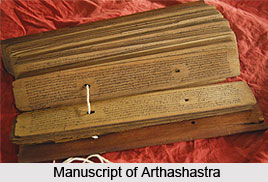 The content of Arthashastra has been divided into fifteen sections or Adhikaranas. It also has 180 subdivisions or Prakaranas. However this division is crossed by Adhyayas, which are marked by the insertion of verses that sum up the doctrine developed. The Adhikarana deals with the bringing up and education of a price. Arthashastra accepts the Brahmanical theory of the caste and their duties -economics, agriculture, pastoral pursuits, trade and industry and polity and Dandaniti.
Structure of Arthashastra : The ministers of the king, his council, his spies, the princes of his house who, the humble people; his emissaries abroad are all described. The duties of a King are enumerated. His harem has also been elaborately described. The duties of army thereby discussing on the detailed control of administration exercised in an Indian state has also been touched upon. In the third Book III law is discussed. In book iv oppression of evil-doers by police action and heavy penalties; cheating doctors, prevent artificial increase of prices, adulteration, use of false weights have been clearly described. Book v is informative as it explains how a king can rid himself of a minister of whom he is tired. The means of extorting money was not less cleverness.
In Book VI the seven elements of politics: the king, minister, land, fort, treasure, army, and ally are described. This is followed by a formal analysis of inter-state relations carried. Book vii deals with nine probable causes of action, peace, war, neutrality, preparation to march out alliance as well as doubtful attitude. Book viii speaks about the evils that may arise from a king`s addiction to hunting, gambling, women, and drink, and the misfortunes which fire, water, or other cause may bring on a land. In Books ix and x the topic of war is dealt with, the king is provided with several tricks in order to avoid fair fight. In book xi how the king can sow disagreement in and destroy the unity of the opponent. In book xii it is mentioned how a weak king can enhance himself by keeping spies, secret agents, or with the help of women poison the food of enemy king and so on. In chapter xiii how a king can capture a fortified city.
Book fourteen is an end of the Aupanisadika, or secret part that consists of recipes to enable one to murder or cause blindness and so on. A man is taught how to make himself invisible, to see in the dark, to fast for a month and so on. How can he be unharmed through fire, to change his colour are also described. The last book speaks about the plan of the work.
Arthashastra has often been considered as a treatise on political philosophy. Throughout the author writes based on Brahmanical belief. Arthashastra accepts the existence of the three aims of life, Dharma, Artha, and Kama. According to Arthashastra Artha is the most important. However in Arthashastra the doctrine supported is that for maintenance of a firm rule, the means employed are justified. As far as means to secure obedience and to defeat enemies are concerned the Arthashastra is ruthless.
It lacks the positive quality. However Arthashastra gives us names of kings who were grieved through some way or the other. It recognizes the risks run by a king from court intrigues, military factions, false ministers and unruly heads of gilds. It recognizes him as a servant of the state.
The form of the work is a prose Sutra with Bhashya. It is a commentary. The headings of chapters are small to form the Sutra. Thus the work is a blending into one of the two elements. Verses are used occasionally though at times Tristubha are inserted and the text ends with a few verses summarizing its effect. The dryness of mere description in dogmatic form is broken here.
The language of the text is apt for the text. There are rare words that are drawn from technical science thereby the meaning is often obscure. There is shrewd effective expression and the author appears is advantageous in pithy verses.
Saptanga Theory in Arthashastra
 Saptanga Theory which has been mentioned in Arthashastra includes all the seven organs of the state which has been separately elaborated among the various volumes of Arthashastra. It explains the role of the king who has been treated as the life of the state and who shall be the defender of Dharma, who is supposed to be Dharmic, enthusiastic, powerful, aggressive, decisive, fearless and free from self indulgence. Along with this, the other organs include the Amatya or the ministers who shall occupy the next position in the hierarchy just after the king who shall be the top most public official responsible for carrying out the public relations and representing the kingdom in the absence of the king. The third element of the state is the Janapad which comprises of the territory and the people, the mountains, rivers, forests etc which are included in the territory of the kingdom. Forts form the fourth element of the state which defines the construction of the forts and their security which has been elaborated in the Construction of Forts in Book II of Arthashastra. Treasury formed the fifth element of the state which is supposed to be enriched with all the sources of taxes and collection of revenue to be deposited in state treasury. This also includes the Army which is responsible for securing the boundaries of the kingdom; this brings us closer to the friend who shall be the biggest ally of the conqueror in confronting the enemy. Arthashastra lays down a number of features for selecting an ideal friend who shall have royal birth and will be available at times of crisis. Alongwith this Shastra also includes a list of Council of Ministers who shall assist the Amatya or the prime minister.
Thus the Saptanga theory mainly includes all those who shall carry out the internal administration of the state for the king.
Books of Arthashastra
Arthashastra includes 15 books that deal with several subjects related to state administration. It includes certain unique theories of Saptanga theory in which Kautilya propounded that a state usually exists with the Matsya Nyaya which means the bigger fish shall swallow the smaller fish and only the fittest shall exist. Overall a state includes seven organs which include a Rajan (king), Amatya(minister), Janapada(territory), Fort, Treasury, Army, and Friends. While he discusses them at length which forms the internal administration of the kingdom; another theory known as Mandal theory discusses foreign policy of the king, his relations with other neighbouring rulers, with the enemy, and enemy`s allies and his allies. As such it forms the core of Kautilya`s policy of Diplomacy. Along with this the book gives a detailed description regarding the role of the Envoys and the then Local Government which existed within the Maurya Empire. The local government shall be administered by a parishad of 30 members which introduced the new methods of administration which continues even now.
Mandal theory forms the base of international system which prevailed at the time. Book II to Book XVIII has discussed the relations which the state is supposed to develop with its neighbouring states. The Mandal Theory further includes the diplomacy policy of the kingdom. This includes the relationship which exist within the surrounding states which has been included as the Circle of State, which further discusses the relationship of the conqueror or the Vijigishu who desires in expansion of his territory; Ari or the enemy who surrounds the conquerors state; the madhyama king and the udasin king or the neutral king who are included in the Circle of States. This further includes the policy of diplomacy which includes the role of the Envoys, spies, and messengers or Dootas. Kautilya lays a lot of stress on the role of the envoys who are represent their state in abroad as the present day ambassadors do. Thus, they should be given ministerial status on whom will depend the foreign relations of the conqueror.
Mandal theory forms the base of international system which prevailed at the time. Book II to Book XVIII has discussed the relations which the state is supposed to develop with its neighbouring states. The Mandal Theory further includes the diplomacy policy of the kingdom. This includes the relationship which exist within the surrounding states which has been included as the Circle of State, which further discusses the relationship of the conqueror or the Vijigishu who desires in expansion of his territory; Ari or the enemy who surrounds the conquerors state; the madhyama king and the udasin king or the neutral king who are included in the Circle of States. This further includes the policy of diplomacy which includes the role of the Envoys, spies, and messengers or Dootas. Kautilya lays a lot of stress on the role of the envoys who are represent their state in abroad as the present day ambassadors do. Thus, they should be given ministerial status on whom will depend the foreign relations of the conqueror.
Recently updated articles in History of India
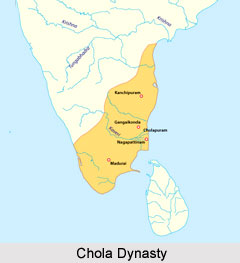
Chola Dynasty
Chola Dynasty is a Tamil dynasty and had longest duration of ruling in parts of South India. Chola dynasty had ruled South India successfully for a ex...
Suhungmung
Suhungmung was the fourteenth ruler of the Ahom dynasty who ruled from the period 1497 to 1539 AD. His reign was significant in terms of expansion of...
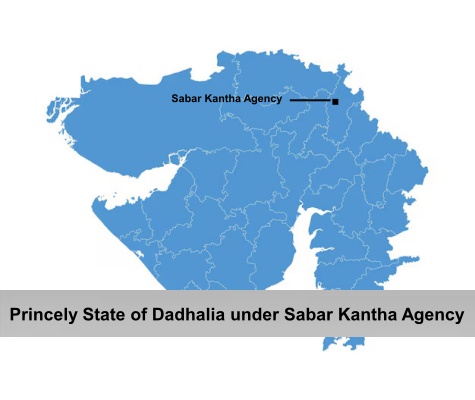
Princely State of Dadhalia
Princely State of Dadhalia was located in the present state of Gujarat. The state covered a total area of 28 sq miles and comprised of 15 villages. Th...
Princely State of Rupal
Princely State of Rupal was a part of the Baroda Agency, a sub division of Western India States Agency. It was under the administrative control of the...
Archaeological Sites of West Bengal
Archaeological sites of West Bengal reveal several aspects of ancient India. Excavations by the Archaeological Survey of India have furnished artefact...
Related articles in History of India

Mughal Architecture during Babur
Mughal architecture during Babur marked the foundation of a new architectural era in India, blending Timurid, Persian, and local influences. His reign...

Architecture during Sayyid and Lodi Dynasty
Architectures during the Sayyid and Lodi dynasty were mainly the tombs and monuments for the dead rulers. It were carefully designed and meticulously...

Brahmanical Sources of Ancient History
Brahmanical Sources of ancient history are contained in the Vedas and they constitute one of the most important literary sources of information about...

Coins of Chola Empire
Coins of Chola Empire were issued in gold, silver and copper and carried the Chola emblem.

Coins of Khilji Dynasty
Coins of Khilji Dynasty had an influential feature that was followed by the other dynasties.