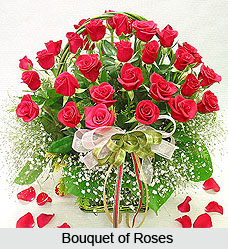
 Rose, the most beautiful flower, carries some important functional values. Rose is a perennial flower shrub, belongs to the Rosaceae family and is botanically named Rosa alba Linn. According to the variations in the species of the rose, the botanical name changes too. Roses are named differently in Indian languages like it is called Gulab in Hindi and Urdu, Golap or Sheuti in Bengali, Seboti in Gujarati, Gulap in Meitei, Satapatri, Suman, Sumana in Sanskrit.
As on today, Rose or Gulab perhaps is the most popular and sought after flower in India. It is known for its beauty and for its aroma as well. The ancient history has several evidences about the existence of the flower in India. According to the history, Emperor Shahjahan, the famed Mughal ruler of India, was symbolised with red rose. It is largely believed that this plant did not originate or existed in India and was introduced by Muslims for which many of the conservative Hindu priests do not allow this flower as part of offerings to deities. But the fact that there are references about this flower in ancient Indian texts as Satapatri or Suman was not only described as best offerings to Gods and deities but also as herb. This evidences that it existed in India during pre-Vedic period. Bhisma pitamaha in his deathbed in Mahabharata, advised Pandavas to offer this flower to Gods and deities being the best offering. While describing the beauty of ancient beauty Damayanti, her face was compared with rose. All these only establish that the flower existed in ancient India. Since ancient days rose was considered as herb with medicinal virtues. It has been elaborately discussed in various scripture like Samhitas and Nighuntas. It was considered bitter in taste, coolant at time astringent, expectorant and good for Pitta and Vayu. Unani treatment of medicine also supports these observations.
Apart from the Hindu mythology and scripture, the rose was considered sacred to a number of goddesses including Isis and Aphrodite, and is often used as a symbol of the Virgin Mary. Roses are bred by crossing old garden roses with more modern roses to achieve the superb fragrance, delicacy and charm of the old-style blooms combined with the repeat flowering characteristics and wide color range of modern roses. There are some places where roses are grown in extensive variety and colours. Karnataka, Tamil Nadu, West Bengal, Andhra Pradesh and Maharashtra are states in India where roses are found in abundance and here roses are cultured with the application of latest fertilisers, plant foods and manures.
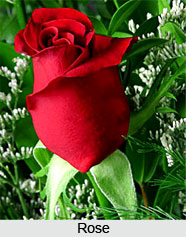 There are some basic groups or types of roses that include Shrub roses, Hybrid Tea and Grandiflora, Climbing roses and Floribunda roses. The records for different species of roses demonstrate that there are about 100 to 150 species for roses. But according to the botanists it`s more likely to be approximately 100 species. The species of roses include Alba Roses(old roses), Bourbon Roses(old roses), Canadian Roses(modern roses), Centifolia Roses(old roses), China Roses(old roses), Damask Roses(old roses), English Roses(modern roses), Floribunda Roses(modern roses), Gallica Roses(old roses), Grandiflora Roses(modern roses), Hybrid Musk Roses(modern roses), Hybrid Perpetual Roses(old roses), Hybrid Tea Roses(modern roses), Lady Banks Rose(climber), Landscape Roses(modern roses), Large-Flowered Climbing Roses(modern roses), Miniature Roses(modern roses), Moss Roses(old roses), Polyantha Roses(modern roses), Portland Rose(old rose), Rambler Roses(climber), Red leaf Rose(bush), Rugosa Rose, Shrub Roses(modern roses), Tree Roses(modern roses). Among them very popular species of roses are Cherokee Roses, Dog Roses, Gallic Roses, French Roses and Red leaf Roses and among the many old garden roses, the popular types include China, Tea, Moss, Damask, Bourbon, Hybrid and Perpetual roses. Modern Roses include Hybrid tea, Floribunda, and Grandiflora.
Some English varieties are extra vigorous in warm areas as very large shrubs and some may want to become semi-climbers. Old Garden roses are the predecessors of today`s English roses. Rose petals were used liberally in ancient civilisations by the wealthy at celebrations and rituals. Rose perfume was coveted by the very rich people of the middle ages. The composition of the rose flower includes essential oil, 1% ketone, a bitter principle, 23% tannin, fatty oil and organic acids. The essential oil of this species yields 45.51% centronellol and geraniol. Out of all types of roses the essential oil of this species is supposed to be the best having yield of around 0.05%. The red coloring matter consists of 9 to 10% cyanine, quecitrin and dye stuff. Pollen from the flower of this species contains 0.76 mg/100 gram of carotene, 1% sugar and 1.5% chlorogenic acid. Rosa centifolia Linn is a weak rose shrub, which does not develop fully. This yields less quantity of buds. Essential oil yield in this variety of rose is 0.011 to 0.43%, particularly those cultivated in Italy and France. Fresh flowers of Rosa indica Linn yields 0.013 to 0.15% essential oil. Composition of this essential oil is 22.10% stearoptenas, 16.36% phenethyl alcohol, 12.78% geraniol and 23.39% citronellol. Fruits of Rosa multiflora Thumb and Rosa polyantha Sieb & Zuce yield 9.4% fatty oil. Fruit pericarp yields phytosterol, quercetin, triterpenoid, beta-carotene and multiflorin, a flavinic glucoside having weak cathartic effects. These flowers also yield essential oil.
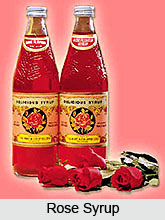 Rose is used in various purposes apart from its use in ceremonies and rituals. Rose is extensively used in making perfumes, essential oils, domestic products as well as some cosmetics products use roses as important ingredient. India prepares essential oil from rose in two ways and this has a good commercial value in the domestic market. According to global demand and for the purpose of need in domestic market for products of modern taste, essential oil of concentrated form need to be extracted by steam distillation as basic perfume. This product has demand as intermediate product as both perfume and flavor. The second way is to follow traditional route of water extraction to produce `Rose Water` popular in India traditionally used for flavoring food dishes and even drinking water. It is also used medically for washing eyes. Dhaka, now in Bangladesh, Lucknow and Kanauj both in Uttar Pradesh was traditionally known for production of quality Rose Water. The third product of identical in nature is production of Rose Attars, produced by distilling Rose Water. In this case too Kanauj is well known. Attars are used as perfume, room fresheners and various other purposes. Rose Water is added to various sweet dishes like `kheer`, `rabdi`, `barfi` and `sandesh`. It is also added to rice preparations like Biriyanis and fried rice. Rose petals are preserved and added to various sweet dishes too.
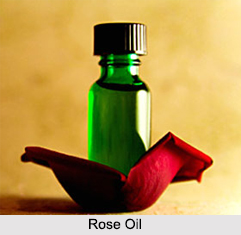
Moreover, another product made out of rose is `Gulkand` which is another famous product prepared by drying a homogenous mixture of crushed rose flowers and sugar. It is usually sun dried. This sweetened paste of rose is commercially popular in India. It is consumed as tonic, medicine for various ailments and as mouth fresheners. It is produced in mass scale in Rajasthan, particularly around Haldighati, where the famous war between Maharana Pratap and Emperor Akbar took place. `Gulkand` is popular almost all over India and now even branded `Gulkand` is available in the market. In addition to these, rose hips are sometimes considered of having vitamin C content. They are usually pressed and filtered to make rose-hip syrup, as the fine hairs surrounding the seeds are unpleasant to eat (resembling itching powder). They can also be used to make herbal tea, jam, jelly and marmalade. Rose perfumes are also made from attar of roses or rose oil, which is a mixture of volatile essential oils, obtained by steam-distilling the crushed petals of roses.
Rose is considered important of having immense value not only for its beauty but also for its usage in making cosmetics products and some other products that are used in making sweets and other culinary purposes. Apart from these, rose is extensively used for decorating purpose. It is one of the most important flowers to deck up the bride for the special day.
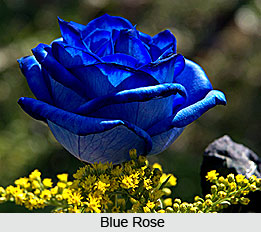 The beautiful flower rose are of different types and can speak many languages of relation. Different colours of roses represent different relations. Roses are of different colours that vary from red, yellow, White, pink, Dark Pink, Light Pink, Yellow with Red Tips, Orange, Burgundy, Blue, Green, Black and Purple. There are different types of roses that include Hybrid Teas, Grandifloras, Floribundas, Polyanthas, Miniatures, Shrubs, Wild Roses, Climbers, and Old Garden Roses.
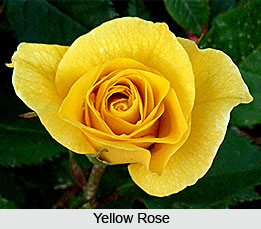 There are different types of roses that are different in colour and are flourished in different times. There are a variety of Old Garden roses that include the types like Alba, Gallica , Damask, Centifolia or Provence, Moss, China roses, Portland roses, Bourbon, Noisette roses, Tea roses, Hybrid Perpetual roses, Hybrid Musk roses, Bermuda "Mystery" roses, Hybrid Rugosa. Apart from these Old Garden roses there are some other smaller classes like Scots, Sweet Brier; climbing classes of old roses like Ayrshire, Climbing China, Laevigata, Sempervirens, Boursault, Climbing Tea, and Climbing Bourbon can be named. Another type of rose is Modern Garden Roses that include Hybrid Tea roses, Polyantha, Floribunda, Grandiflora, Miniature roses like Meillandine. Other roses that are generally called Shrub roses include English or David Austin rose, Canadian Hardy Roses etc.
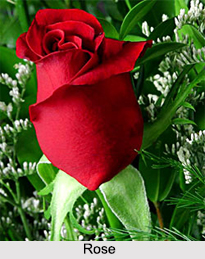 Uses of rose are multifaceted and spread across different aspects like
 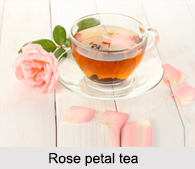 Rose Petals in Tea : Rose Petal Tea is very useful and healthy. It grants relieve from pain and heavy
  Ornamental Uses of Rose : The majority of roses are used to decorate gardens, rooms, and ceremony halls etc. They are used for such ornamental purposes owing to their aesthetic grandeur and breathtaking visual appeal. Usually roses are grown for attractive and scented foliage, ornamental thorns or for their ostentatious fruit. A few species and hybrids are grown for non-floral ornamental use. Ornamental roses have been cultivated since long ago, with the earliest known