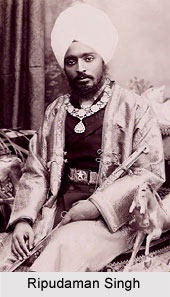
 Ripudaman Singh, also known as Maharaja Gurcharan Singh and later as Sardar Gurcharan Singh, was the ruler or the Maharaja of Nabha, from the year 1911 and 1928, when he was overthrown by the British Government. At a later period, he became a well known Sikh revolutionary. Maharaja Ripudaman Singh. Singh was born on March 4th, 1883 at Nabha in the present Patiala district, in the state of Punjab. He was the heir and only son of Maharaja Sir Hira Singh. During the period 1906 to 1908, Ripudaman Singh was a member of the Imperial Legislative Council and he spoke for the benefit and interest of the Sikh people and also initiated reformist legislation. Singh represented the region of Nabha in the year 1911 at the coronation of George V.
Rule of Ripudaman Singh
After Maharaja Sir Hira Singh died, Ripudaman Singh ascended the gadi or the throne of Nabha. He continued his concentration in legal affairs and reformed the state judiciary and implemented several pieces of progressive legislation as well. Singh also founded a legislature and formed also established a legislature and an executive council to administer and supervise Nabha. In 1919, the Amritsar Massacre appalled him and thus he publicly contested and resisted the British Government. This resulted in a clash with one of Ripudaman Singh`s cousin Bhupinder Singh of Patiala, who was an ardent sponsor of British rule in India. Although the Maharaja of Nabha was granted a local salute of 15 guns in the year 1921, but he did not continue to favour the British for much longer.
Later in the year 1923, Maharaja Ripudaman Singh was compelled to resign and surrender control of Nabha to the British administration. This was done after he was alleged of kidnapping and attempted murder by poisoning.
Later Life of Ripudaman Singh
Ripudaman Singh of Nabha gave consent to leave his territory in the year 1923 and settled at Dehradun. For his compliance, the British East India Company granted him a huge allowance. But he unrelentingly continued to scheme and attempt to recoup and reclaim control of Nabha to some degree. Singh went on pilgrimage to Sri Abichal Nagar Hazur Sahib later in 1927 and retook the initiation rites of Khalsa. There he adopted the name Gurcharan Singh. In the year 1928, Ripudaman Singh was officially deposed by the British administration for treason. He was then succeeded by Pratap Singh, who was his eldest son.
Ripudaman Singh or Gurcharan Singh was stripped of his titles and rank and was exiled to Kodaikanal in the Madras Presidency. After that, Singh was formally known as Sardar Gurcharan Singh. He died at the age of 59 on December 12th, 1942 at Kodaikanal.
Personal Life of Ripudaman Singh
Maharaja Ripudaman Singh of Nabha was married for 3 times, once morganatically and twice to royal descendants. His first wife was Her Highness Maharani Bibi Jagdish Kaur Sahiba, with whom he was married in the year 1901 at Nabha. The couple had a daughter, Maharajkumari Bibiji Amar Kaur Sahiba. Singh was married for the second time with Maharani Sarojni Devi Sahiba on October 10th, 1918 at Nabha. The royal couple had 5 children, Sri Tikka Sahib Pratap Singh, Maharajkumar Shri Kharak Singh, Maharajkumar Shri Gurbaksh Singh, Maharajkumari Bibiji Kamla Devi Sahiba and Maharajkumari Bibiji Vimla Devi Sahiba. Sri Tikka Sahib Pratap Singh succeeded Ripudaman Singh as Maharaja of Nabha in 1928.
Maharaja Ripudaman Singh was married for the third time to Sardarni Gurcharan Kaur and fathered 7 children, namely, Raja Shri Narinder Singh, Raja Shri Fateh Singh, Rajkumar Shri Jasmer Singh, Rajkumar Shri Shamsher Singh, Rajkumari Shri Vijay Kaur, Rajkumari Shri Charanjeet Kaur and Rajkumari Shri Nandhem Kaur.
Titles of Ripudaman Singh
Maharaja Ripudaman Singh of Nabha held various titles, such as-
* Sri Tikka Sahib Ripudaman Singh (1883- 1911)
* His Highness Farzand-i-Arjumand, Aqidat-Paiwand-i-Daulat-i-Inglishia, Barar Bans Sarmur, Raja-i-Rajagan, Maharaja Shri Ripudaman Singh Malvendra Bahadur, Maharaja of Nabha (1911- 1927)
* His Highness Farzand-i-Arjumand, Aqidat-Paiwand-i-Daulat-i-Inglishia, Barar Bans Sarmur, Raja-i-Rajagan, Maharaja Shri Gurcharan Singh Malvendra Bahadur, Maharaja of Nabha (1927- 1928)
* Sardar Gurcharan Singh (1928- 1942)
Honours of Ripudaman Singh
Some of the honours he received mentioned below-
* Fellow of the Royal Geographical Society (FRGS)
* Delhi Durbar Medal (1903)
* King George V Coronation Medal- Delhi Durbar Clasp (1911)