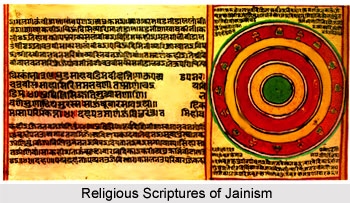
 The religious scripture of the Jains are known as Agama. These are also known as Jain Shrut. Jains however, have many other scriptures too. The teachings of the twenty four Tirthankaras were first composed in fourteen Purvas and later in twelve Ang-Pravishtha-Agams (an `Ang` being a `limb`) by Ganadhars themselves. These teachings were preached by the Tirthankaras to enlighten their principal followers who were known as Ganadharas.
All Purvas are included in one part of the twelfth Ang, called Drastivad. The composition of scripture has a specific objective of showing the listener the path of everlasting bliss and nirvana. The Agam Sutras also preach about the everlasting truth about behaviour, equanimity, universal affection and friendship. It also reflects about the everlasting truths on thinking, namely, the principle of relativity, principle of non-one-sidedness. It teaches about divine things including great reverence for all forms of life, soul, karma, cosmos, strict codes of asceticism, and rules for householders, compassion, ahimsa, and non-possessiveness.
Apart from the twelve Ang-pravishtha works that have been composed by the Ganadhars, the Stathviras or elder monks had also composed another canonical literature (Ang-bahya-Agams) that are which also included as part of the Jain Agams.
The Jain Agams consisted of (1) 14 Purvas, (2) 12 Ang-pravishtha-Agams and (3) Ang-bahya-Agams (34 for Shwetambara Murtipujak, 21 for Shwetambara Sthanakvasi and 14 for Digambara). The Agam (Canonical) literature is divided into two groups:
Ang-agams or Ang-pravistha-agams: These texts contain the direct preaching of Lord Mahavira. The teachings were compiled by the Ganadharas, his principal followers.
Ang-bahya-agams (outside of Ang-agams): These texts have been expanded from Ang-agams. They were complied by Srut-kewalis.
Agam Literature
The teachings of Lord Mahavira`s had been methodically compiled by his devotees into many texts. These texts are collectively known as Agams that form the sacred texts of the Jain religious faith. Thus the Jains do not have one sacred text but it has many texts complied by many devotees.
Ang-agams
The Ganadharas orally compiled the direct preaching of Lord Mahavira into twelve main texts (sutras) which are known as Ang-agams. The Ganadharas are the immediate followers of Lord Mahavira. All Ganadharas possessed ideal knowledge (Kewal-Gyan). The Ang-agams are thus the oldest religious scriptures and the back bone of Jain literature.
The twelfth Ang-agam is called Drastivad. The Drastivad consists of fourteen Purva texts. These are also known as Purvas or Purva-agams. Amongst Ang-agams, Purvas were the oldest sacred texts. According to all Jain denominations knowledge of the Purvas (Drastivad) began missing two hundred years after Lord Mahavira`s nirvana (death). However, several other Jain Holy Scriptures and literature have taken its reference from the subject matter of the Purvas.
Ang-bahya-agams
Monks who had knowledge of a minimum of ten Purvas were known as Srut-kevlis. The Srut-kevlis wrote many texts (sutras) expanding the subject matter defined in the Ang-agams. These texts are collectively known as Ang-bahya-agams meaning outside of Ang-agams. The different Jain denominations accept different numbers of Ang-bahya texts.
Classification of Ang-bahya-agams
The Swetambara Sect has divided Ang-bahya-agams into the following categories:
Upang-agams: There are 12 Upang-agams that have been accepted by all Shvetambara denominations. The scriptures which provide further explanation of Ang-agams are called Upang-agams.
Chhed-sutras: The subject matter that has been described in Chhed-sutras is only for monks and nuns. It is not meant for lay persons. It tells about the conduct and behaviour of monks and nuns. The sutra explains about the different methods of repenting for their sins and errors. The Shvetambara Murtipujak denomination accepts 6 Chhed-sutra texts while the Sthanakvasi and Terapanthi denominations accept only 4 texts.
Mool-sutras: The scriptures that are required to be studied by the monks and nuns in the earlier stages of their monkhood are called Mool-sutras. The Shvetambara Murtipujak denomination accepts 4 Mool-sutras texts but the Sthanakvasi and Terapanthi denominations accept only 3 texts.
Chulika-Sutras: The scriptures which enhance or decorate the Ang-agams are known as Chulika-sutras or Sutras. There are 2 Chulika-sutras accepted by all members of the Shvetambara Sect.
Prakirna-agams: Prakirna-sutra is the scriptures which describe independent or miscellaneous subjects of the Jain religious faith. The Shvetambara Murtipujak denomination accepts 10 Prakirna-agams texts but the Sthanakvasi and Terapanthi denominations do not accept any of them.