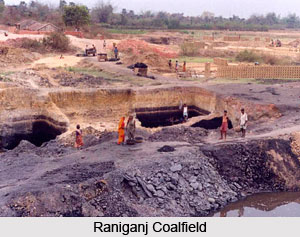
 Raniganj Coalfield is situated in Bardhaman district, West Bengal, mainly in Durgapur and Asansol subdivisions. The coalfield however also spans over the neighbouring districts like Bankura, Dhanbad, Birbhum and Purulia. It covers a vast area of 443.50 square kilometres and possesses coal reserves of several million tonnes. In terms of coal reserves, it is considered as the second largest coalfield of India.
In India, coalmining was initiated in the Raniganj Coalfield. In 1774, coal was found near Ethora, which is presently known as Salanpur community development block, by Suetonius Grant Heatly and John Sumner of the British East India Company. Back then, exploration and mining activities were done quite haphazardly. In 1820, regular mining activity was commenced by Alexander & Co, an agency house. Later in the year 1835 the collieries were brought and led by Carr and Tagore Co. which belonged to Prince Dwarkanath Tagore. Raniganj Coalfield served as the main coal producer of the country throughout the 19th century and in the major part of 20th century.
In 1843, on the request of William Princep, Carr and Tagore Co. collaborated with Gilmore Hombray and Co. and began coal mining venture. The headquarters was situated at Sanctoria. In the course of time, Raniganj Coalfield was owned by a number of companies which carried out mining activities in the field. In 1975, a subsidiary of Coal India Limited, known as Eastern Coalfields Limited, was formed, which over took all the private collieries of Raniganj Coalfield.
Coal seams of Raniganj Coalfield can be categorized into two blocks viz. Barakar measures and Raniganj measures. Raniganj measures covers the areas of Raniganj-Pandaveswar, Jhanjra, Kenda, Kajora, Bankola, Kunustoria, Sripur, Satgram, Salanpur, Sodepur whereas Barakar measures covers Mugma and Salanpur.
Raniganj Coalfield is famous for producing the best type of non-coking coal in the country. Several heat intensive industries including Refractories, Ceramic, Forging, Glass etc are dependent on Raniganj Coalfield. A major portion of coal reserves of this field are exported to foreign countries. It is also a vast reservoir of iron ore in the form of nodules. Apart from this fire clay, pottery clays, brick clays are also found in the coalfield. Manganese, calcium carbonate, laterite and bauxite are also common in Raniganj Coalfield.