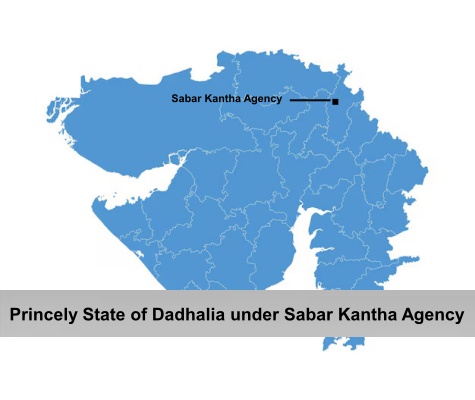
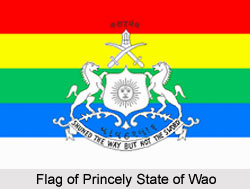
 The Princely State of Wao, also known as Vav, was one of the prominent princely states of India that were administered by native rulers or Indian princes under the indirect control of the British Government of India. The state covered a total area of 759 sq miles and comprised of a total population of 24,673 in the year 1941. The state of Wao was located in the Banas Division of the Sabar Kantha Agency and included around 58 villages. The territory was primarily a vast sandy tract bordered by Jodhpur (Rajputana) in the north; by Tharad in the south and the east; by Suigam in the southwest; and by Kutch in the northwest. Wao state contained a single major block of territory and 4 small islands, which were intertwined with Deodar I, Tharada, Deodar II and the Thanas of Suigam and Deodar.
The erstwhile princely state of Wao was incorporated as a part of the Baroda Agency, which was a sub division of Western India States Agency. Later the region became a part of the Indian state of Gujarat. The region was also a part of the Sabar Kantha Agency and the Division of Banas.
History of Princely State of Wao
The Nadola family of Chauhan Rajputs was the ruling family of the princely state of Wao. The family established itself in the region during the 10th century. The son of the dispossessed Rana Punajaji of Tharad, named Vajaji Parmar (Vajoji), founded the state in the year 1244. The territory was named after the Vav or well that was constructed by Vajaji Parmar. He became a fugitive and escaped the Mughal forces after Tharad was seized around 1200. Later he spread his reign over several of the smaller holdings and formed a rather influential chiefdom.
The native ruler of the princely state of Wao, who held the title of Thakor, belonged to the Third Class and exercised substantial civil and criminal jurisdictional authority. Wao state was ranked 36th in order of precedence amongst the states of Western India. Jurisdiction over the Bhayati estates which were under the Thana Wao was reinstated to the State on 1st April 1917 and the thana was abolished. The Princely State of Wao did not pay any annual tribute to any state. Wao state was one of the original constituent members of the Chamber of Princes, a number of smaller states indirectly represented by 12 princes who they elected periodically.
According to the Attachment Scheme of 1943, the princely state of Wao was attached to the princely state of Baroda. The native ruler of the state held the title of Thakor and also the traditional title of Rana.
After the withdrawal of the British and the independence of India on 15th August 1947, the native ruler of Wao acceded his state to the newly formed Union of India, also known as the Dominion of India.