Introduction
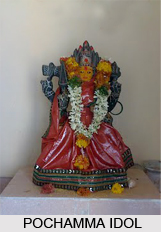
Goddess Pochamma is revered as a mother goddess, primarily worshiped by the people of Telangana and Andhra Pradesh. Pochamma is a village deity who is known for warding off evils and protecting the village. Pochamma’s idol has some affinity with the idol of Goddess Kali. She is also known for creating problems and difficulties for people if any disloyalty is shown towards her. She creates diseases like measles, smallpox and rashes on the body of people who has been dishonest to her. Small pox changes the complexion of the person. The most significant festival dedicated to her is the Bonalu festival, celebrated during the months of July and August.
Legend of Devi Pochamma
In Adilabad district, Pochamma is known as Gajjelamma. The idol is made of wood and is placed near a neem tree. She usually wears a white saree and sometimes yellow. The devotees make small idols of her and place them in the temple. The husband of Pochamma devi, known as Adavi Mahamuni, is regarded as the guardian of all animals, insects and trees in the forest. He used to start on his journey on Thursday and reach his wife on Friday. In her next birth, she is called Mutyalamma.
There are two kinds of Pochammas, one is Karri Pochamma or Black Pochamma, and the other is Yerra Pochamma or Red Pochamma. Karri Pochamma is believed to be more powerful than Yerra Pochamma.
Worship of Devi Pochamma
The festival of Bonala Panduga and Pochamma Panduga are
performed in villages. Baineedlu recite the story of Pochamma. During the
festival men dress in female attire and perform the puja. There are many things
that are required during the festival. Few of them are Dappu, Jamidika,
white sarees, jackets with mirrors, goats, cocks,
Kudukalu, shells, nuts, date fruits,, and Iripala biyyam. In any such festival,
the feast is followed by toddy. It is believed that if the goddess is provided
with these items, it makes her happy and transforms herself from being a
malicious goddess into a benevolent one. If children are attacked by any
disease it is known as Balaposamma and if elders are afflicted, it is called
Pedda Posamma.
There is no particular day for her worshipping Pochamma. However, people worship
her on Sunday. The devotees have to do ‘Jogu’ in five houses and perform puja.
They also take ‘Bonalu’ and perform `Arati` to the idols and go around the
temple. The Bonalu is then kept in front of the temple by the devotees. The
idols are adorned with white and yellow sarees and incense sticks are also
burnt. The eyes of the goddess are prepared with silver or aluminium. The Dappu
is played to create a festival atmosphere. Devotees perform puja and
Abhishekham, decorate the temple with flowers, and offer fruits and food items
such as sundal and mixed rice to the deity, which are later distributed among
the participants after the completion of the puja.
The festival of ‘Oradipanduga’ is celebrated with much enthusiasm by the
Pochamma devotees in Adilabad district. This festival is meant to ward off any
calamity in the surrounding areas. Though she doesn’t prefers, animal sacrifice
is also done in this temple, in order to please the divine mother. They feed
the buffalo which is to be sacrificed and, in the evening, it is sacrificed to
the goddess.
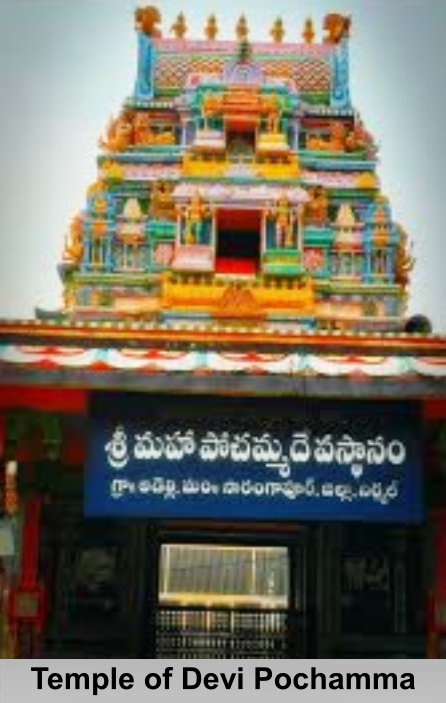
Temple of Devi Pochamma
The Adelli Pochamma
Temple is located in Adelli village of Sarangapur mandal in Nirmal
district of Telangana. The goddess, carved from a single rock, is depicted with
four hands holding a trident, a dharma, and an akshayapatra, with her right
foot placed on a demon. Worshipped along with her seven sisters, Adelli
Pochamma accepts Perugannam as an offering and is believed to fulfill the
wishes of devotees. Pilgrims from Telangana, Andhra Pradesh, Madhya Pradesh, Odisha, and Maharashtra visit
the temple to have her darshan. After offering prayers, devotees cook and share
a Pankti meal in the areas surrounding the temple.

Unlike other temples in the country, the sanctum sanctorum
houses the idols of the seven daughters of Shiva and Parvati, namely Brahmani,
Maheshwari, Kaumari,
Vaishnavi,
Varahi, Indrani, and Chamundi.
Parvati, regarded
here as the mother of Pochamma, is believed to be especially fond of
Perugannam. Devotees prepare rice using water from the Koneti, mix it with
curd, and offer it to Pochamma as a sacred offering.
Legend of Devi Pochamma Temple
In ancient times, the Adelli region experienced a severe
famine, and many people died from diseases caused by the lack of food, turning
the villages into cremation grounds. When the people prayed to Lord Shiva
for protection, he sent his daughter Pochamma to the region as their protector.
According to local legend, Pochamma, who came on her father’s orders, remained
in the forest and continued to fulfill the wishes of the devotees.
Fairs and Festivals at Devi Pochamma Temple
Every year, the Ganga Neel Jatara is held at the temple during the nights of Devi Sharanavara. The festival takes place on the Saturdays and Sundays following the new moon (Amavasya) before Dussehra. As part of the celebrations, special pujas are performed on Saturdays for the idol of Pochamma in the sanctum sanctorum. Accompanied by Bhajabhajantri, Dappu instruments, and Pothuraj dances, the ornaments worn by the goddess are taken in a procession that travels about 35 kilometers through the villages of Sarangapur, Yakarpalli, Godisera, Vanjar, Piyaramur, Malki, Dilawarpur, and Kanjar, eventually reaching the banks of the Godavari River near Sangvi.
The ornaments remain there overnight, and on Sunday morning they are purified in the waters of the Godavari. The sacred water is then collected in a special silver vessel and brought back to the temple in the evening. At dusk, Devi Pochamma is anointed with Ganga water and a sacred ceremony is performed. Devotees attending the Jatara first visit the goddess, perform pujas, receive the offerings of the Tirtha, and then participate in the Jatara before returning home.
Role of Pochamma Devi in Local Culture
Pochamma Devi represents a deeply rooted local tradition
that emphasizes community health, protection, and agricultural fertility. Her
worship brings villagers together for communal celebrations and offerings,
ensuring the spiritual and physical well-being of the community.