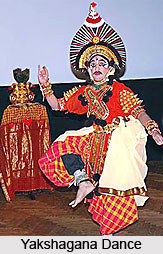
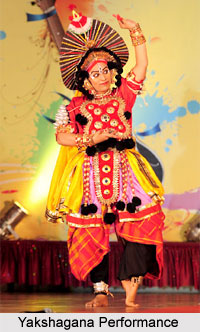
 Yakshagana has been embedded in the history and culture of Karnataka for the past thousand years. This is a classical folk art, which has its roots in the mythologies and holy texts. Literally Yakshagana means songs of the Yakshas. According to Hindu mythology Yakshas are demi gods and the attendants of Kubera. In this dance drama the performers wear specific kinds of costumes and play several roles directly lifted from Holy Scriptures. In Indian dance forms costumes and make up play an important part. Intense make up and bright costumes makes the performances more interesting to watch out for. Traditionally Yakshagana was performed at night. Uttara Kannada, Shimoga, Udupi, Dakshina Kannada are some of the places in Karnataka where this form of performing arts is quite popular.
As the performance commences one would first come across Himmela or the background musicians. They are essential to every opera or dance drama. Then there is the Mummela or the dance troupe. These are the performers who will enact tales form the ancient culture and portray them to the audience. In earlier times such art forms were successful in educating the masses with the tales from holy books. They worked as fables with a moral ending. Yakshagana, thus, served a dual purpose of education and entertainment. Even in the contemporary Indian society they serve similar purpose. The difference is that they are now performed in theatres with few people interested to watch this dance form.
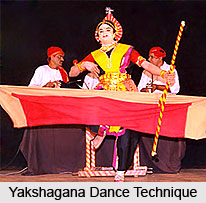
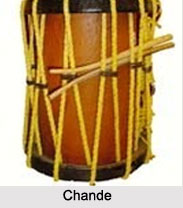
Yakshagana comprise of Bhagwata or the singer and percussion instruments, such as, Maddale, Mrudange, Harmonium and Chande (drums). The music used in Yakshagana is heavily drawn from folk music. The performance begins way before the actors get themselves on stage. Yakshagana generally commences during twilight with heavy beating of the drums. These are fixed compositions known as called Abbara or Peetike. This instrumental performance continues for an hour before the audience could see the actors on the stage. As the actors enter the stage one would find them in vibrant attires and heavy make up. Each character will have a different set of costume and make up. For instance the entire get-up of a king will be completely different from that of another character. For art lovers Yakshagana is a treat to watch.
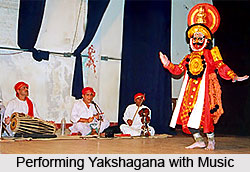
There is a narrator who would help the audience to comprehend the story and other developments. He sings pre-composed dialogues with the help from background musicians. On stage the actors` dance to the tunes of the traditional folk music portraying whatever is conveyed by the song. The entire is narrated in this way. The dance drama of Karnataka is improvised from time to time depending on the capability of the actor. The stage where Yakshagana is performed is rectangular in shape built with four wooden poles. These poles are installed on four corners and then covered by palm leaves. The greenroom is called the chowki. The audience is supposed to sit on the three sides of the stage. For the purpose of comic relief there is the Vidushaka or the jester. This role too is played by the narrator.
Although it is difficult to point out the exact origin of this art form it is at times thought to originate from the Bhakti Movement (Vaishnavism). This movement popularized religion through tales from epics in a simple form. Yakshagana is supposed to originate from here. This dance drama was popular by the time of a renowned Yakshagana poet Parthisubba. He rewrote Ramayana in this form of art. It is believed that he was the Bhagawata himself and established a dance group for the performance. He is also presumed to be the founder of Tenkuthittu of the art.
The first Yakshgana play was in Telugu & was written in the 16th century by Peda Kempa Gaudan and was called as Ganga Gauri Vilasam. Then came the renaissance period, followed by the 17th century, which was the time when the Yakshgana form developed in Karnataka, Andhra Pradesh and Tamil Nadu. From the 15th century, in Andhra Pradesh, this folk art is performed both as a narrative song and as a dance drama. The form was also related to the Prabandha natak, which originated in a slightly later period. However, Yakshgana as a theatrical form regained popularity only in the 18th century. Till that time the written plays were created but mainly as scripts for presentations. Yakshgana emerged as a full-fledged theatre form in south Kannada at a time of great political unrest and social disturbances.
Yakshagana is widely performed in the districts of Dakshina Kannada, Uttara Kannada, Dharwad, Mysore and Hassan. Based Yakshagana can be classified into `Mudalapaya` (the custom of the East) and `Paduvalapaya` (the custom of the West). Mudalapaya is widely practiced in places like Tumkur, Bangalore, Kolar, Mandya, Mysore, Hassan,
 Chitradurga, Bellary, Dharwad, Bijapur, Gulbarga, Raichur, Bidar and Belgaum. Paduvalapaya is well known in Karki, Keladi, Ikkeri, Sagar, Kolluru, Maranakatt, Sankuru, Coondapur, Kotesvara, Kota, Udupi, Dharmasthala, Mangalore, Brahmavara, Suratkal and Saligrama.
The unique feature of Yakshagana is that the female roles are portrayed by male actors. They dress up in female attires to enact the roles of Yakshagana rakshasas. Traditionally folklores were adapted into performances as these were popular amongst the masses. Hence the work of spreading a message became easier. The tradition still continues today.
The original form of Yakshgana involves the use of recitative modes of poetry, melodies of music, rhythm and dance techniques, colourful costumes and graceful make up. It distinctly differs in many ways from the norms of the Sanskrit stage, as it does not contain a highly elaborate language of hand and eye-gestures, but it is closely related to developments in literature in the adjoining states of Andhra Pradesh and Tamil Nadu and has some affinities to literary forms.
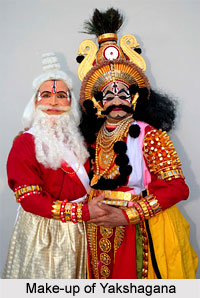 Costumes and make-up of Yakshagana form an essential part of the
 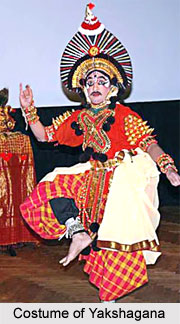 Over the Kavacha, the tight upper banian and Challana, the tight trousers, every performer wears a full sleeved upper garment usually in green or red, and a veeragacche (hero`s girdle, a way of wearing the
 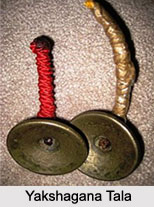 Music and instruments used in Yakshagana helps to enhance the art in a major way. This is a
  In the 19th century, Yakshagana began to move away from the severe conventional forms. Yakshagana defies simple arrangement into categories such as
  Performance of Yakshagana, in its final form, takes place in open air. On the evening of the performance Chande is beaten to convey the news and to invite the neighbouring villages. The sound of Chande, sharp and penetrating, easily reaches a village of even six to eight miles away if the wind is favourable. On the evening people assemble near and about the platform, generally in front of the village temple. The platform is about 16 feet square with bamboo poles fixed at the four corners. The top is covered by a mat made of palm leaves and the entire arena is decorated with flowers, mango leaves and also young plantain-trees tied to the poles on either side in the traditional way. On the three sides of the platform sit the audience spreading their own mats, while to the rear of the platform the Bhagavata (in plain clothes) with cymbals or gong in hand takes his place with his accompanists: the players of Maddale or
 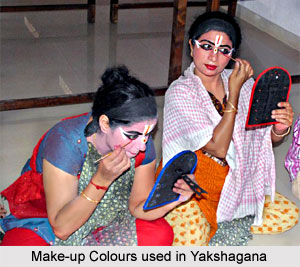 Yakshagana does not present two similarly made up and dressed characters unless warranted by a situation requiring two roles with identical innate qualities. Colours used for painting the face will be chosen with care. Gods are usually painted in reddish soft white, while roles like Yama, Bali and even
 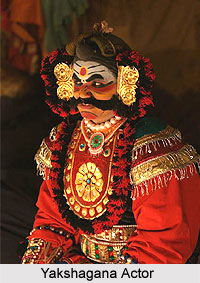 Actors of Yaksagana have satisfied the tastes of the audiences. They are completely aware of the delicate touches of gestures and speed, helped by the make-up artists, the property man and even the prompter. The Yakshagana artist is at once a make-up expert, a dancer, and an effective actor with convincing declamatory powers. He, at the outset, should be strong physically; for the costumes of
 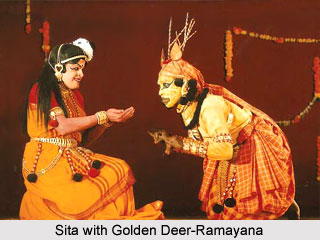 Themes of Yakshagana mainly deal with the mythological superhuman personalities, gods, demons and dream lands.