
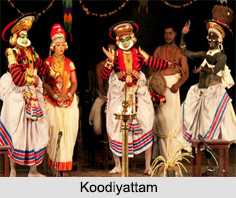
 Koodiyattam is the traditional Sanskrit theatre art form performed in the state of Kerala. Also transliterated as Kutiyattam, it is performed in the Sanskrit and Dravidian languages in Hindu temples and is the oldest classical dance forms in Kerala. The only surviving specimen of the ancient Sanskrit theatre, Koodiyattam has been recognised by the UNESCO as a Masterpiece of the Oral and Intangible Heritage of Humanity in 2001. The temples in which Koodiyattam was performed were specially designed temples called "Koothambalams".
Koodiyattam
Koodiyattam is the oldest existing classical theatre form of the world. It has been recognised by UNESCO as a Human Heritage Art.
Introduction
Koodiyattam is the traditional Sanskrit theatre art form performed in the state of Kerala. Also transliterated as Kutiyattam, it is performed in the Sanskrit and Dravidian languages in Hindu temples and is the oldest classical dance forms in Kerala. The only surviving specimen of the ancient Sanskrit theatre, Koodiyattam has been recognised by the UNESCO as a Masterpiece of the Oral and Intangible Heritage of Humanity in 2001. The temples in which Koodiyattam was performed were specially designed temples called "Koothambalams".Etymology of Koodiyattam
The name "Koodiyattam" literally means playing or performing together. It is thought to refer to the presence of more actors on stage who act in consonance with the beats of the Mizhavu drummers. Alternatively, it may also be a reference to a common practice in Sanskrit drama where a single actor who has performed solo for several nights is joined by another.
Origin of Koodiyattam
 Koodiyattam is believed to have originated 2,000 years before. This dance-drama form finds its mention along with dramatised dance form Chakyar Koothu, in the ancient Sangam literature of south as well as in certain ancient epigraphs. It is believed that Kulasekhara Varman Cheraman Perumal, an ancient king of the Tamil Chera dynasty, reformed Koodiyattam by introducing the local language for Vidhushaka as well as structured the presentation of the play to well-defined units.
Performance of Koodiyattam
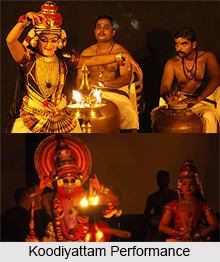 The performance of Koodiyattam, the oldest surviving Sanskrit theatre art form, comprises of a single act at a time, usually lasting several days with the enacting in the original form of a single act stretching up to 41 days. Koodiyattam blends ritual, sacred traditional precepts and rehearsed elements with creative improvisation. It will begin at 9 p.m. after the close of rituals in the sanctum sanctorum of the temple, and continue till midnight, sometimes till 3 a.m., before the commencement of the morning rituals.
Enactment of Koodiyattam
The long and drawn out Koodiyattam performances are preceded by the initial invocatory rituals, which take place on the first day. These are followed by the Purappudu, or preliminaries, in which the actor performs certain abstract notes of movement behind a curtain. There is as such no acting in the performance of the first day that possibly ends with these movements. Thereafter is the phase of Nirvahana, a practice unique to Koodiyattam in which the character introduces himself by presenting his personal history that might also include his previous life. The actor can choose any legend which he wishes to emphasize, associated with his character. This allows him to explore the character to a degree unusual in Indian theatre. The first few days are entirely devoted to character introductions as well as incidents from their lives.
The entire play from beginning to end is performed on the last day. However, the entire written text is not enacted. Although the play`s text is considered as sacred, it serves only as a nucleus, with the actor augmenting the text by building upon its structure with improvised real and fantastic associations. A play becomes often motionless while the actor through his eyes, face and body explores a variety of emotions.
Each verse of the play is interpreted thrice. First, it is recited and expressed in Abhinaya, which is the dramatic form using stage conventions to render meaning. Thereafter it is slowly chanted with the meaning of each word explicated in greater depth. Following this is the longer and freer improvisation based on key words and ideas. This elucidation of verses gives immediate relevance to the audience, thus evoking introspection in addition to entertaining.
Role Playing in Koodiyattam
Koodiyattam is a dramatic presentation in Sanskrit, with the exception of the Vidushaka, who is the only character speaking in Malayalam. It is enacted inside the temple theatre known as Koothambalam, with two or more characters on stage at the same time. Role playing in Koodiyattam includes stylized form of vocal recitation coupled with a complete hand-gesture language and highly evocative facial expressions. The "vidushaka" or Jester plays the pivotal role. A figure parallel to the Fool in Shakespearean plays, Vidushaka serves as a bridge between the actors and the audience. He translates the Sanskrit version into colloquial Malayalam language, also giving a live image of the characters in the minds of spectators. The obscure passages are explained with the help of humorous commentary. He makes Koodiyattam relevant for audiences who do not understand Sanskrit and enacts his role with the liberty to criticize anyone without fear.
The performers of Koodiyattam must be skilled in the four main Abhinayas or arts of expressions, as described in the Natyashastra, namely "angika" (movement of the body), "vachika" (speech), "aharya" (external accessories such as costumes, props, ornaments and lighting) and "sattvika", which is an actor"s expression of real natural emotion, achieved by identifying and correlating with some personal experience. Koodiyattam uses a stylized, highly evolved mime language that emphasizes facial expressions and hand gestures. Such complicated gesture language, chanting and the amplified expressions of the face and eyes are complemented by elaborate headdresses and makeup.
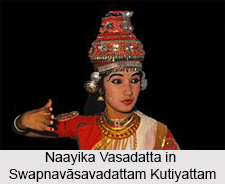
Makeup and Costumes in Koodiyattam
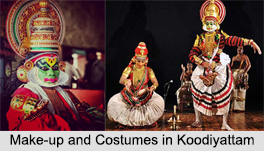
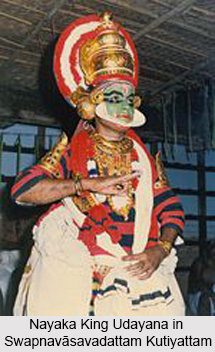
The ritual application of Aharya Abhinaya (makeup) is used to create an outward expression of each character`s complex inner qualities. The symbolic use of colour is carefully calculated to make a statement. The makeup of most characters contains both black, representing "evil" and "paccha" (green) which roughly translates as "good", in different proportions. Heroic characters are distinguished by the green colour and the small curved paper frame on their face. The costumes have a blend of vibrant colours, predominantly red, black and white. The costume of the "vidushaka" (jester) sets him apart from the rest. He has specialised makeup, small headgears and costume that vividly display his clownish facets.
Musical Elements and Orchestration in Koodiyattam
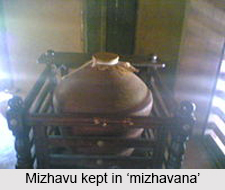 The musical accompaniment chiefly encompasses the use of Mizhavu drums, which are large percussion instruments made of either clay or copper, with a narrow mouth covered by leather and played by both hands by the Nambiars, who sit at the rear of the stage. These huge drums have a great symbolic significance, setting the mood for the play and heightening its drama. The Nambiars also keep the "talam", which is the rhythmic pattern. They are accompanied by the Nangyaramma (women of the Nambiar caste) who play the Kuzhitalam, a type of cymbal, and sing the main verses of the drama in Sanskrit. Further accompaniments may be made by the Etakka, an hour-glass shaped drum that lends "bhava" and "laya" for a vivid portrayal of the soft sentiments of both male and female characters in Koodiyattam, the "kuzhal" which is an oboe-like wind instrument and the "shankha" (conch shell).
The staging of the entire act lasts three to five nights. The exposition of a single verse can take up to around two hours of acting while a whole play may require forty days for total presentation.
Plays of Koodiyattam
Earlier, plays like "Subhadraharana" and "Tapatisamvarana" were staged. Along with these, the plays that are presented nowadays include "Ascaryacudamani" of Saktibhadra, "Kalyanasaugandhika" of Nilakantha, "Bhagavadajjuka" of Bodhayana, "Nagananda" of Harsa and many other plays which are accredited to Sanskrit playwright Bhasa, including Abhiseka and Pratima.
Musical Instruments in Koodiyattam
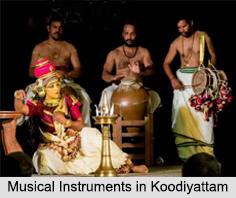 The traditional musical instruments used in Koodiyattam are Mizhavu, Kuzhitalam, Etakka, Kurumkuzhal and Sankhu. The prominent instrument Mizhavu is a percussion instrument that is played by a person of the Ambalavas Nambiar caste. It is accompanied by the Nangyaramma playing the Kuzhithalam, which is a metallic musical instrument resembling a miniature pair of cymbals.
Make-up and Costumes in Koodiyattam
The costumes and make-up in Koodiyattam is quite elaborate. The costumes are a combination of bright colours mainly black, white and red which stand out. The face and eye make-up is quite dramatic. Heroic characters wear green colour paint and a small curved paper frame on their face. The Vidhushaka is dressed differently to set him apart from the rest of the artists. He has a different make-up with small head gear and his costume displays a clownish feature.
Performing Masters of Koodiyattam
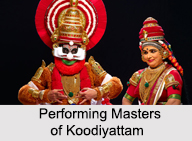 Performing Masters of Koodiyattam has been a major force in popularizing Koodiyattam by taking it out of the Hindu temples. The most important exponent of Koodiyattam is Ammannur Madhava Chakyar. He has received Padma Bhushan Award and in the 1980s, he became one of the first Koodiyattam performers to present this art to an international audience. Several plays such as Balivadham, Thoranayudham, Asokavanikankam, Hanumaddutam, Jatayuvadham, Surpanakhangam, Thoranayudham and Ankuliyankam are greatly popularised through the art form of Koodiyattam.
Koodiyattam is recognized by the UNESCO as one of the masterpieces of the oral and intangible heritage of humanity. It is a comprehensive theatre form that has existed since before the 10th century AD and is India"s oldest theatre to have been continuously performed.
Performing Masters of Koodiyattam
Some of the famous Masters of Koodiyattam are as follows:
• Kalamandalam Girija
• Margi Madhu
• Ammannur Rajaneesh Chakyar
• Moozhikulam Kochukuttan Chakyar
• Ammannur Madhava Chakyar
• Mani Damodara Chakyar
• Painkulam Damodara Chakyar
• Kalamandalam Sivan Namboodiri
• Painkulam Rama Chakyar
Famous Artists of Koodiyattam
Koodiyattam was an art form enacted only by Chakyar till the 1950s. Late Natyacharya Vidushakaratnam Padma Shri Guru Mani Madhava Chakyar is the most notable and recognised artist of Koodiyattam and was known for Rasa Abhinaya. The other most important exponent of Koodiyattam is Padma Bhushan Ammannur Madhava Chakyar. Mani Madhava Chakyar"s disciple and nephew Mani Damodara Chakyar is also a Koodiyattam performer. Ammannur Rajaneesh Chakyar is another Koodiyattam artist from Thrissur in Kerala. Sangeet Natak Akademi Award, the highest award was given to Koodiyattam artists like Kalamandalam Sivan Namboodiri in 2007, Painkulam Raman Chakyar in 2010 and Painkulam Damodara Chakyar in 2012.
Decline of Koodiyattam
Koodiyattam, having traditionally been an exclusive art form performed in special venues, the Koothambalams in Hindu temples, and its access having been highly restricted to only Hindus, is a dying art form in the current scenario. Also the fact that performances are lengthy taking as much as 40 days to complete is another reason for the art form"s decline. The collapse of the feudal order in the 19th century in Kerala led to a curtailment in the patronage extended to Koodiyattam artistes, and they faced serious financial difficulties.
Following a revival in the early 20th century, Koodiyattam is once again facing a lack of funding, leading to a severe crisis in the profession. The Margi Theatre Group in Thiruvananthapuram is a notable organisation dedicated to the revival of Koodiyattam in Kerala.
Following a revival in the early 20th century, Koodiyattam is once again facing a lack of funding, leading to a severe crisis in the profession. The Margi Theatre Group in Thiruvananthapuram is a notable organisation dedicated to the revival of Koodiyattam in Kerala.
Recently updated articles in Indian Drama & Theatre
Amateur Theatre
Development of Amateur Theatre has been responsible for useful innovations in theatre culture of Karnataka.
Surendranath Ghosh
Surendranath Ghosh or Dani Babu was a Bengali thespian active during the mid-20th century. He was mostly known for his contributions to Bengal’s moder...
Gondhal Dance
Gondhal is a religious folk dance of Maharashtra. It is performed on special days like when there is a newborn in a family or marriage. Dedicated to g...

Pravritti in Natyashastra
Pravritti in Natyashastra refers to specific human behaviour varying from region to region. There are four types of Pravritti namely, dakshinatya, ava...
Padma Bhushan Awardees (2010-2019)
Padma Bhushan Awardees (2010-2019)
Related articles in Indian Drama & Theatre
Gondhal Dance
Gondhal is a religious folk dance of Maharashtra. It is performed on special days like when there is a newborn in a family or marriage. Dedicated to g...
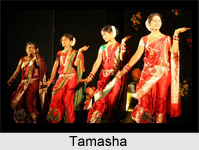
Tamasha Folk Dance
Tamasha is a folk art, which includes the love songs, which are traditional lavanis and dance along with the music.
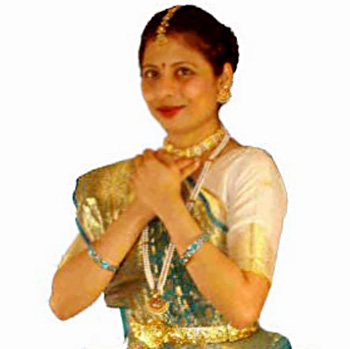
Sringara Rasa
Sringara Rasa is mentioned in Natyashastra as one of the important rasas. The Sthayi bhava in Sringara rasa is Rati or love.
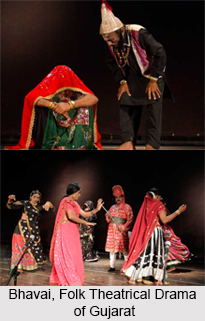
Bhavai - Folk Theatre of Gujarat
Bhavai is a popular folk theatre form of Gujarat that belongs to the tradition of theatre of entertainment.
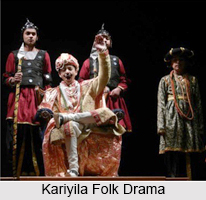
Kariyila Folk Dance
Kariyila is one of the most appealing and popular folk drama forms of Himachal Pradesh, portraying social satire with the accompaniment of folk dance...