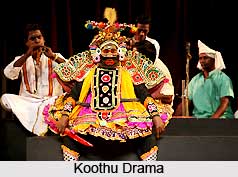
 Koothu is a presentation of various tales from Sanskrit epics that is performed in Koothambalams. This is a playhouse that is attached to temples. Koothu involves solo storytelling. In Kuttu, the actor enlivens the narrative by impersonating through mime and gesture. This is traditionally performed by the Chakkyar caste. Therefore it is also known as Chakkyarkoothu. The performer brings several references in Malayalam to contemporary social and political events. He also criticizes satirically people`s shortcomings.
It is dramatic in word and action. He represents the storyteller of ancient times and appears in special outfits with headgear and make-up. A Nambiar man plays the all-important mizhavu and a Nangiyar i.e. woman of the Nambiar caste the kuzhitalam or bronze cymbals. The mizhavu is a unique instrument, a big 1 m-high copper pot. Its mouth covered tightly with hide, fixed on a wooden stand called the mizhavana placed at the rear of the acting area. Behind this the Nambiyar sits on a stool and plays the mizhavu with his palms. Edakka i.e. an hourglass-shaped drum, kuzhal i.e. double-reed pipe, and sankhu i.e. conch are also added at times, giving the ensemble the name of panchavadyam i.e. `five instruments`.
The raised stage that is not fully enclosed is always without curtains or sets. This is decorated with fruit-bearing plantains, bunches of tender coconuts, a measure full of paddy, among other things. A tall bronze oil lamp is ceremoniously lit in front. In the beginning the Nambiar plays and recites the invocation, followed by arangutali, the sprinkling of water on die stage as a purificatory ritual by the sutradhara or stage manager. Then the main character is introduced. The Chakkyars perform many acts from his Ascaryacudamani i.e. wondrous Crest-Jewel, based on the Ramayana. Other important plays in the repertoire include Subhadra-Dhananjaya i.e. Subhadra and Dhananjaya and Tapati-Samvarana i.e. `Tapati and Samvarana`, both by the king Kulasekhara.
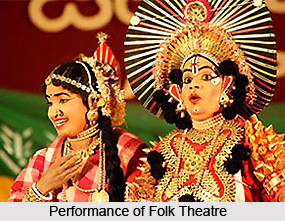
The acting preserves the fourfold conventional aspects of abhinaya. This can be mentioned as vacika or vocal, angika or physical, sattvika or psychological, and aharya i.e. decorative. Footwork and choreography are rhythmic, to the beat of percussion. For the vocal delivery of the text, the Chakkyar actors evolved a stylized method using tonal variations to express emotions, indebted to the traditional rendering of the Vedas by the Nambudiri Brahmans in developing their dramatic articulation. Verse is delivered in musical modes suited to the respective sentiments. The elaborate make-up, along with flowery crown and various ornaments, uses a colour scheme symbolizing the characters` basic qualities. The Chakkyars preserve detailed attaprakaras i.e. acting manuals and kramadipikas i.e. literally `light on procedure`, or production guides for their scripts. Before their first stage appearance, the actors undergo years of long and rigorous training in precise techniques of subtle physical movements fully utilizing the body`s expressive potential. The vidushaka has a prominent role, entrusted with the responsibility of adding rich humour through improvisation and contemporary allusion. Despite cultural pressures in the twentieth century, the community produced exemplary hereditary actors who kept the tradition alive, including the legendary Ammannur Chachu Chakyar, Painkulam or Koyappa Rama Chakyar, Mani Madhava `Chakiar, Ammannur Madhava Chakyar, and Moozhikulam Kochukuttan Chakyar. Of late, performers from other castes also learn the art.