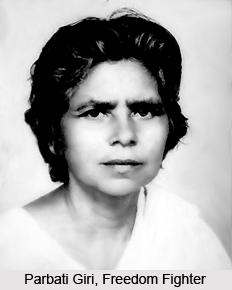
 Parbati Giri was popularly known as `Mother Teresa of Western Odisha` and a renowned freedom fighter hailing from the eastern Indian state of Odisha. It is said that the women freedom fighters of this part of India were prominent historical figures in the Indian independence movement against the British Raj. She had been imprisoned by British government for her involvement in anti-British movements and agitations, particularly her active participation in the Quit India Movement. Giri was known for her efforts at implementing the tribal rights in the country.
Early Life of Parbati Giri
Parbati Giri was born on 19th January, 1926 in Samlaipadar village, to Dhananjay Giri which lies close to Bijepur that corresponds to current-day Bargarh District and also undivided Sambalpur District. At a tender age of 16, Parbati Giri joined the Quit India Movement, 1942, inspired by Mahatma Gandhi and therefore came to the forefront of the main conflict against British Raj in India. Ramchandra Giri was her uncle who was closely associated with freedom fighters including Fakira Behera, Bhagirathi Pattanayak, Durga Prasad Guru, Laxminarayan Mishra, Jambobati Pattnayak who was the wife of Bhagirathi Pattanayak. Political discussions took place in front of Parbati Giri which motivated the young girl to a great extent, to dedicate her life for the cause of her nation. She received education till the third standard and then dropped out voluntarily to campaign for the Congress. She started her travels across several villages for this purpose, campaign ceaselessly for the Congress.
When he attained the age of 12, during 1938, senior Congress leaders requested Parbati Giri`s father to allow her to deliver her services for the Congress to which he readily agreed. Thereafter, Parbati was permitted to visit Bari Ashram, Jajpur administered by Rama Devi. Accompanied by a widow named Prabhavati Devi, Parbati Giri travelled all the way till Bari Ashram calmly. She imbibed certain skills like manufacturing handicrafts and other skills which required self assistance. Giri wandered to Ghens, Panimara, Padampur, Sambalpur, Bargarh, etc. in the year 1940 and trained the local villagers in weaving the `Khadi` and also spinning. She extensively campaigned for Quit India Movement from 1942 onwards, which got her arrested though the police was unable to retain her inside the prison her as she was a minor.
However when she stormed into the SDO`s office at Bargarh, sat in his chair and asked her comrades to bring the SDO towards her, bound in ropes. For this action, she was punished with two years` rigorous imprisonment at Sambalpur Jail. She arranged an agitation at Bargarh Court to inspire the lawyers to boycott the court, defying the British. The lawyers who refused to cease their services were given bangles which signified the ultimate insult to their manhood. In the year 1950, she finally finished her schooling from Prayag Mahila Vidyapitha, Allahabad after independence.
Works of Parbati Giri
Parbati Giri joined Rama Devi in 1954. Even following the Indian independence in 1947, Parbati Giri continued her social work and established an orphanage at Paikal village and spent the remaining part of her life serving the poor orphans. In order to enhance the living conditions and health of the inhabitants of Sambalpur District, Parbati Giri lent her efforts towards an American project. She founded an ashram for the orphans and women, known as Kasturba Gandhi Matruniketan at Nrusinghanath and yet another residence for the destitute called Dr. Santra Bal Niketan at Birasingh Gar, located at Jujomura block, Sambalpur District. Her work included leprosy education and improvement of jails. She was awarded a prize in the year 1984 by the Department of Social Welfare of the government of India.