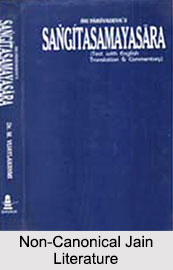
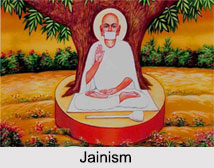
 Non-Canonical Jain Literature is of prime importance to those who study Jainism and to those who are followers of Jainism. They are different from the Canonical Literature of the Jains. Works on grammar, lexicography, mathematics, politics, arts and science are part of the Non-Canonical Literature of the Jains. Non-Canonical Literature has been divided into Digambara texts and Swetambara texts.
Subjects of Non-Canonical Jain Literature
Theological and Scientific works also form an important part of the Non-Canonical Literature. Theological works of the Jains have explained the Karma theory and has also thrown light on various philosophical systems. Like Swetambaras, Digambaras have also worked with great enthusiasm in the field of dogmatism and the related disciplines. The numbers of scientific works written on Jain philosophy in modern Indian language are many.
Jain Sanskrit grammarians closely resemble the Brahmanic Grammar of Panini. The most famous are the so called "Jainendra Vyakarana" of Pujyapada Devanandi and "Sakatdyana Vyakarana" of Sakatayana. Since Prakrit language is also the language of the Jains, they have worked upon this subject also in other respects. They have also contributed excellently to the field of grammar of modern India. Jains have also made name by dictionaries and similar works.
 Jains have also dealt with the theoretical foundations of poetry. Jains were active even in the field of music theory as is evident from Parsvadeva"s "Sangitasamayasara" and "Sangitaratnakara". Jain scholars have written separate books on politics and law for Jain kings. Besides, there are many works dealing with cosmography, geography and astronomy treating these subjects briefly or extensively. Bhadrabahu and Kalalkacharya among others are considered as great authorities in the field of astronomy. Knowledge of Mathematics was also an important aspect of the Jains. The doctrine of atoms and living beings was several times depicted by theologians and philosophers. There are detailed references on temple structure and production of cult images in the textbooks on rituals. It can be presumed that Jains wrote works on architecture and sculpture.
A vastness of work in Jain literature makes it evident that Jains were literarily active in several fields and there was hardly any realm of Indian culture in which the Jains have not worked.