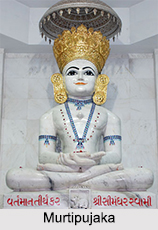
 Murtipujakas are the sub-sect of Swetambara Sect, those practitioners who worship images in temples. They are also known as "Deravasis", "Caityavasis", "Mandira Margis" or "Pujeras". They make a ritual offering to idols with rice, sweets items, fruits, incense sticks, saffron paste, and flowers adorn them with rich clothes and jewelled ornaments. Worshippers cover their mouth while washing, anointing or touching the idols. Aarti is also performed among this sub-sect. Murtipujaka Swetambaras reside in all parts of India, especially in larger urban centers where they are engaged in modern business. Larger numbers of Murtipujakas are found in Gujarat, Maharashtra and Rajasthan.
Minor Divisions of the Murtipujakas
Murtipujakas are the sub-sect of Swetambara Sect, those practitioners who worship images in temples. They are also known as "Deravasis", "Caityavasis", "Mandira Margis" or "Pujeras". They make a ritual offering to idols with rice, sweets items, fruits, incense sticks, saffron paste, and flowers adorn them with rich clothes and jewelled ornaments. Worshippers cover their mouth while washing, anointing or touching the idols. Aarti is also performed among this sub-sect. Murtipujaka Swetambaras reside in all parts of India, especially in larger urban centers where they are engaged in modern business. Larger numbers of Murtipujakas are found in Gujarat, Maharashtra and Rajasthan.
Minor Divisions of the Murtipujakas
In the Murtipujaka sect there are 4 minor divisions. They are as follows:
•Tapa Gaccha: Acharya Tapachand Suri had earned the title "Tapa" in 1228CE from King Jaitrasinha of Mewar for his sever austerities. Therefore his disciples and followers have been called Tapa Gaccha. This is the largest gaccha of the Murtipujakas and its followers are found all over India but largely in Gujarat, Rajasthan, Maharashtra, Punjab and Haryana.
•Khartara Gaccha: This sect was formed before 1090 CE. One legend claims that Acharya Jineswara Suri defeated a temple dwelling ascetic in a religious debate at the court of King Durlabharya of Anahilvada in 1022 CE, thereby gaining the title of Khartara i.e. "bold character". Another legend claims that this sect was started by Jindatta Suri in 1147 CE. It is known for establishing socio-religious institutions called "Dadawadis" in India.
•Ancala Gaccha: The ascetics belonging to this group use a small piece of cloth in place of a full Muhapatti to cover their mouth at the time of their daily rituals, thus they take the name Ancala Gaccha. They are also known as the upholders of scared rituals. This sect is said to be formed in 1156CE probably by Aryaraksita Suri in North India.
In spite of these divisions, they all believe in the same philosophy and principles. They celebrate major functions together and prompt the teachings of Mahavira. Some difference, however, remain between the Swetambara and Digambara Murtipujaka groups, largely concerned with the ownership of certain temples and places of pilgrimages.