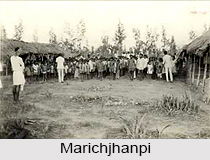
 Marichjhanpi, which has an alternative name of Marichjhapi is an island in West Bengal. Earlier, Marichjhanpi was the settlement of people of East Pakistan (now Bangladesh).
Location of Marichjhanpi
Marichjhanpi is located in the delta zone of Bay of Bengal. It is located in West Bengal in the midst of Sunderbans Forest Region.
History of Marichjhanpi
This small island in West Bengal is considered as the safest place for the immigrants of Bangladesh, who came to India in 1971 war, that is before the Independence of Bangladesh from Pakistan. In the year 1947, after the Transfer of Power and The Partition of India, in eastern India, the Bengali immigrants from Bangladesh, came here to settle. But due to the political turmoil in West Bengal, when the Communist Party of India, Marxist (CPI M) government of West Bengal evicted thousands of Bengali refugees from this area. The Partition of India in the year 1947 split the large eastern province of Bengal into two halves, along religious lines. One half became West Bengal, a Hindu-majority province in the new independent state of India. The other half became East Pakistan, the Muslim-majority eastern half of Pakistan, and later the independent country of Bangladesh.
 This made the unrest in the India- Bangladesh Border and also in the hemisphere of Indian and South Asian political world along with the South Asian and Pan Asian international affairs. Also it causes the massive unrest in regional and national political situation in the post war situation in India and the rest of West Bengal.
Settlement of Marichjhanpi
Marichjhanpi is a place in West Bengal, where most of settlements are the people who came from Bangladesh in 1947 and 1971 split.
Inspiration from Marichjhanpi
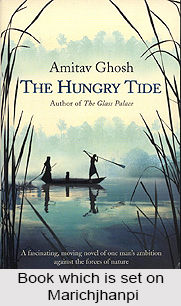
Post modern fiction writer Amitav Ghosh is influenced from the mass murder at Marichjhanpi and wrote a book "The Hungry Tide" on the life and culture of the people of Marichjhanpi, who came from Bangaldesh after the splitting of the nations in 1978- 1979.
Attacks of Tigers
Marichjhanpi is place where one can see the tidal floods and the tigers from Sunderbans Mangrove Forests, now conceptualised as Sunderban National Park to maintain the difference among the animals and the human settlements of Marichjhanpi.