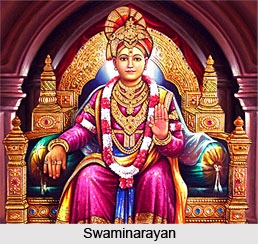
 The Swaminayarana movement was established by Sahajanand Swami or popularly known as Swaminarayan. His original name was Ghanashyam Pande. Swaminayarana was born into a Brahmin family at Chapaiya in Uttar Pradesh in 1781 to father Hariprasad Pande also known as Dharmadev and mother Premvati Pande also known as Bhaktimata. He was born on the Hindu festival of Rama Navami that celebrates the birth of Lord Rama. In the fortnight of waxing moon in the ninth lunar day of the month of Chaitra is considered as observed as both Rama Navami and Swaminarayan Jayanti by Swaminarayan followers. This day also marks the beginning of a ritual calendar for the followers. Swaminarayan had an elder brother, Rampratap Pande, and a younger brother, Ichcharam Pande. He showed great spiritual inclinations from an early age. He had mastered Hindu scriptures including the Vedas, the Upanishads, the Puranas, the Ramayana, and the Mahabharata by the age of seven.
At the age of 11 he went on a seven year holy pilgrimage travelling from one place to another and seeking spiritual answers to the questions that concerned him. During his pilgrimage tour he received the opportunity of meeting Ramanand Swami. He got Swaminarayan admitted in his ascetic order known as Uddhav Sampraday and gave him a spiritual name Sahajanand Swami. In 1802 when Ramanand Swami died, he became the leader of the sect. Swaminayarana`s through his devotion well established the sect and drew many through his charming appeal, inner purity, personal touch and wisdom. His disciples considered him as their god in human form. They addressed him as Bhagawan Swaminarayan and the ascetic order he was heading as Swaminarayan sect. The sect drew many followers from various parts of Gujarat, Saurashtra and Rajasthan. Inspired by his teachings, people from various castes and different backgrounds joined it. Within the faith, Swaminarayan was associated with the Supreme Being, Purushottama, or is revered as an incarnation of Narayana from the Nara-Narayana deity pair.
Swaminarayan attempted to reform Hinduism in a lot of ways. He remained compassionate towards widows and the socially under privilege. He preached people against superstition, violence, animal sacrifices, caste discrimination, female infanticide and sati. He moralized people on the path of ancient Vedic traditions and pure Vaishnava dharma. He stressed on devotion and even encouraged people to worship images and idols of their personal gods and goddesses. He strongly approved on segregating of sexes, and emphasized on the importance of virtuous living and adhering to self discipline. To establish a tradition of temple centric image worship and devotion to God, he undertook the construction of nine temples in various parts of western India installing images of Narnarayan, Lakshminarayan, Radha, Lord Krishna and other divinities.
Swaminarayan has also left a record of his teachings in the form of two works which is considered as a sacred literature of the sect. One is the work is Sikshapatri which is a compilation of his commandments for his disciples to abide by. The other is known as Vachanamrit. It is a collection of the speeches that Swaminarayan has delivered at various places during his life time.