
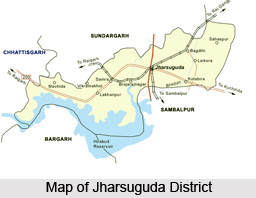
 Jharsuguda District, an administrative district of Orissa, was formed in the year 1994. With a total area of 2,081 sq kms and an average population of 514853, Jharsuguda District is rich in economically important mineral, especially coal. Jharsuguda Town is the headquarters of the newly formed district. However, the consolidated region of Jharsuguda has a rich history, which dates back far to the epoch of the Chauhan kings.
Jharsuguda District
Jharsuguda District, rich in mineral wealth is considered as the industrial hub of Orissa. Jharsuguda District came into existence in 1994.
Introduction
Jharsuguda District, an administrative district of Orissa, was formed in the year 1994. With a total area of 2,081 sq kms and an average population of 514853, Jharsuguda District is rich in economically important mineral, especially coal. Jharsuguda Town is the headquarters of the newly formed district. However, the consolidated region of Jharsuguda has a rich history, which dates back far to the epoch of the Chauhan kings.History of Jharsuguda district
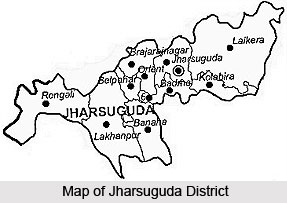 The documented history of Jharsuguda is coded from the time when the present district of Jharsuguda was known as "Jharguda", which was simply a part of the kingdom of Sambalpur. The history of Jharsuguda is synonymous with the sovereignty of the Chauhan kings in Sambalpur, who came in power far back at 16th century, when Balaram Dev of Chauhan dynasty established the Kingdom of Sambalpur. The kingdom of Sambalpur was under the Chauhans for long and has witnessed several upheavals.
As the available historical records point out, that during the reign of Chhattrasai Dev the 7th King of this dynasty (1656-1688), Jharguda was a small settlement surrounded by dense forest infested with a man-eating tiger, ravaging the people of this area. Siva Singh, the grandson of Chhattrasai Dev, mightily killed the tiger and in recognition of his might the king Chhattrasai Dev awarded him the area and conferred him with the title `Bhrutti` or `Jageri`.
As the folklores runs, the kishans from the Jharkhand state actually established the kingdom of Jharsuguda with Jharkishan as the head of the tribe. The original village consisting of the settlement of 12 kishan families was named Jharguda. Siva Singha, because of having the royal kinship was given the power of 12 jaigirdars including 12 villages namely Jharsuguda, Badheimunda, Debadihi, Kumdapali, Kureibaga, Banjari, Dalki, Balijori, Beheramal, Ekatali, Buromal, & Sarbahal, which originally was the kingdom of the tribal head Jharkishan. Following the historical records of the Jharsuguda, the descendants of Siva Singha were at the helm of the administration un-interruptedly from 16th Century till the end of the 18th Century.
At the closing of the 18th century the, history of Jharsuguda was marked by the aggression & occupation of Sambalpur by the Marahattas Bhonsle. Since the Maratha occupation, Orissa was a part of their empire till the period, when the history of Orissa was vitiated with the British influence. In 1818, when the British occupied the Sambalpur State, Maharaja Sai was made the nominal king, but the British carried out the actual administration. When Maharaja Sai died in 1826, the British declared his widow Mohankumari as the ruler of the Sambalpur. Claiming himself to be the rightful heir of the throne of Sambalpur, thereby challenging the decision of the British, the zamindar of Jharsuguda, Govind Singh launched an armed rebellion against the British. Besides being supported by a number of native chiefs, quite a good number of Gond tribals joined the rebellion. The rebellion of Govind singh continued for a long period of 3 years and in a decisive battle in 1833 between the British and Govind Singh on the vast field adjoining the Jhadeswar, the British defeated Govind singh and sentenced him to life imprisonment. Another claimant to the throne of Sambalpur Surendra Sai, Jamindar of Khinda, when launched armed rebellion against the British was arrested on the charge of dacoity & manslaughter because of his armed attack on the Jamindar of Rampur. Thus the British come up in the political scenario of Sambalpur.
As the history of Jharsuguda depicts, the revolutionary activities in Sambalpur calmed down when the diplomatic British Government released the former zamindar Govind Singh from jail, with the prior condition that he will withdraw his claim from the throne of Sambalpur. However the British supremacy in Jharsuguda has brought about socio-economic genesis in the district. During 1884, the Bengal Nagpur Railway (BNR) was commissioned between Calcutta and Nagpur and a Railway Station was established at Jharsuguda. A post office and a police station were established at Jharsuguda in 1895. In 1905, Jharsuguda ceased to be a part of the Central province and merged with Orissa. The history of Jharsuguda demonstrates that the district appears to be a significant part of Orissa`s politics after being attached to the Orissa province. In 1882 with the enactment of the local self-government Act, a Sanitation committee was formed for Jharsuguda in 1884. In 1951, according to the Orissa Government Notification No.5124/21851, the Jharsuguda Union Board was replaced by Jharsuguda Municipality, which was comprised of 13 wards. On 5th November 1952, the then Mafidar of Sambalpur was elected as the first Chairman of Jharsuguda Municipality on 5th October 1952. Originally Jharsuguda survived as the Sardar sub division of Sambalpur till 1979 and the Sub-Division with its 5 component blocks namely Jharsuguda, Kolabira, Laikera, Kirmira and Lakhanpur became a district on 1.1.94 following the G.O.No.56413.
Culture of Jharsuguda District
The rich and diversified cultural heritage of the Jharsuguda district is evident from the fairs and festivals of the observed round the year for centuries. People belonging to various castes and religion have been its inhabitant for centuries but Jharsuguda retains its essential cultural trait, which exhibits unity in diversity. In spite of having a distinct color and aroma in every cultural festivals of the Jharsuguda district, the fundamental unity can be perceived in that.
The Chauhan king Balaram Dev in the capital town of Sambalpur and in vassal states and Zamidaries of Sambalpur inaugurated Ranjta Festival. This festival is observed every year on the night of 10th day of Suklapaksha of the month of Aswin associated with the `Patakhanda` or (Royal sword). In the Ranjta festival, the family deity of the Chauhan kings is still worshipped. The common people also take part in the festival and they demonstrate the martial skills learnt from the erstwhile soldiers of the Jamindars, to the sound of the martial drum beating. Thousands of people assemble to join the festival, which exhibits the racial indiscrimination as the key feature of the cultural trait of Jharsuguda.
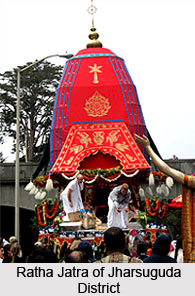
The famous Rathajatra of Puri, the traditional culture of Utkal, reflects the Hindu Culture as an important cultural characteristic of Jharsuguda. The festival centers round the Puri Shri Jagannath Temple. This cultural festival of Jharsuguda has a religious flavor which demonstrates the religious fervor of the Hindu as their cultural trait. Following the epical story Lord Jagannath, Lord Balabhadra & Devi Subhadra visit the house of their aunt (Mousimaa) in the respective Chariots namely Nadighosa, Taladwhaja & Darpadalana through the `Badadhanda` on the 2nd day of the bright lunar fort night of the month of "Asdha" and return to Shree Mandir on the 10th day of the bright lunar fortnight. This festival is popularized as the Rathajatra in Jharsuguda.
The Gokulastami Jatra reveals the agrarian culture of Jharsuguda district. Gokulastami Jatra is observed by pomp and grandeur, from the time of the Jamindar of Rajpur who were the descendent of `Madhukar Sai` the king of Sambalpur. The festival signifies the agrarian culture representing the welfare of cattle and other domestic animals used in agriculture. The farmers of Rajpur observed this festival 8th day of bright fortnight in the month of Margasira focusing the Jagannath Temple.
On the occasion of Makar Sankranti the man committee of the Jagannath temple organizes `Sabita Rathajatra`. A colorful fair takes place centering the occasion of "Sabita Rathajatra". The Sabita Rathajatra is associated with the religious beliefs and ideas of the Hindus.
The festivals of Jharsuguda, though distinct in character, represent Hinduism as the basic trait of their culture.
The Chauhan king Balaram Dev in the capital town of Sambalpur and in vassal states and Zamidaries of Sambalpur inaugurated Ranjta Festival. This festival is observed every year on the night of 10th day of Suklapaksha of the month of Aswin associated with the `Patakhanda` or (Royal sword). In the Ranjta festival, the family deity of the Chauhan kings is still worshipped. The common people also take part in the festival and they demonstrate the martial skills learnt from the erstwhile soldiers of the Jamindars, to the sound of the martial drum beating. Thousands of people assemble to join the festival, which exhibits the racial indiscrimination as the key feature of the cultural trait of Jharsuguda.
The famous Rathajatra of Puri, the traditional culture of Utkal, reflects the Hindu Culture as an important cultural characteristic of Jharsuguda. The festival centers round the Puri Shri Jagannath Temple. This cultural festival of Jharsuguda has a religious flavor which demonstrates the religious fervor of the Hindu as their cultural trait. Following the epical story Lord Jagannath, Lord Balabhadra & Devi Subhadra visit the house of their aunt (Mousimaa) in the respective Chariots namely Nadighosa, Taladwhaja & Darpadalana through the `Badadhanda` on the 2nd day of the bright lunar fort night of the month of "Asdha" and return to Shree Mandir on the 10th day of the bright lunar fortnight. This festival is popularized as the Rathajatra in Jharsuguda.
The Gokulastami Jatra reveals the agrarian culture of Jharsuguda district. Gokulastami Jatra is observed by pomp and grandeur, from the time of the Jamindar of Rajpur who were the descendent of `Madhukar Sai` the king of Sambalpur. The festival signifies the agrarian culture representing the welfare of cattle and other domestic animals used in agriculture. The farmers of Rajpur observed this festival 8th day of bright fortnight in the month of Margasira focusing the Jagannath Temple.
On the occasion of Makar Sankranti the man committee of the Jagannath temple organizes `Sabita Rathajatra`. A colorful fair takes place centering the occasion of "Sabita Rathajatra". The Sabita Rathajatra is associated with the religious beliefs and ideas of the Hindus.
The festivals of Jharsuguda, though distinct in character, represent Hinduism as the basic trait of their culture.
Fairs and Festivals of Jharsuguda District
 Fairs and festivals of Jharsuguda District, Odisha present an excellent spectacle of cultural heritage and religious richness and have been celebrated over several centuries. There are certain fairs and religious festivals which are observed in many other portions of this eastern-Indian state, however a few fairs and festive events are celebrated only in this part of Odisha. Makar Rathajatra of Belpahar, Ratha Jatra of Kukurjunga, Ranjta Festival and Gokulastami Jatra are amongst the famous festivals observed in Jharsuguda District. Innumerable travellers and pilgrims pay a visit to this Indian district to participate readily in these religious and social occasions or Odisha.
Ranjta Festival of Jharsuguda District
Ranjta Festival is a significant regional festival of Jharsuguda which commenced during the regime of Chauhan rulers in Sambalpur and the Zamindaris of Sambalpur. Every year Ranjta Festival is celebrated during the night of the 10th day of `Suklapaksha`, in the month of `Aswin`. The royal sword or `Patakhanda` is carried by the descendants of the yesteryear Zamindars who wander around the entire village in a long procession. The Zamindar as well as his subjects conducts a parade throughout the village, carrying bows and arrows, muskets, spears and a sword. On this occasion the family deity of the Zamindars is also worshipped. The common masses assemble to view the activities of this festival and participate in displaying martial skills imbibed from the erstwhile soldiers who served the Zamindars. Martial arts are exhibited accompanied by the sound of drum -beats.
Ratha Jatra of Jharsuguda District
According to the `Utkal` tradition, the deities of Lord Jagannath Temple at Puri, namely Lord Balabhadra, Lord Jagannath and Devi Subhadra visit the abode of their aunt or `Mousimaa` in their chariots which are referred to as `Taladwhaja`, `Nadighosa` and `Darpadalana` during the 2nd day of the month of `Asdha`. They return to the Shree Mandir on the 10th day of this month, as per ancient ritualistic beliefs. This divine procession is termed as `Ratha Jatra` and celebrated in numerable parts of Odisha. At the village of Kukurjanga, which is situated at a distance of nearly 7 kms away from Jharsuguda, some additional rites are followed in this festival which falls on the 2nd day of `Ashada`. The Jagannath Temple of Kukurjanga had been erected during the 17th century and Ratha Jatra has been organized here from that time onwards, supervised by the Managing Committee. Kukurjanga`s Ratha possesses 16 wheels.
Gokulastami Jatra of Jharsuguda District
The festival of Gokulastami Jatra has been organized with great enthusiasm ever since the ages of the Zamindars of Rajpur who were the descendants of the king of Sambalpur named `Madhukar Sai`. Agricultural theme is the dominant idea of the beautiful folk ceremony which is a part of Gokulastami Jatra. The well-being of domestic animals and cattle is also emphasized through this local festival which is observed by Rajpur`s farmers particularly during the 8th day of the month of `Margasira`. The Jagannath Temple based in front of the palace of the Zamindar of Rajpur plays a key role in all the festivities of Gokulastami Jatra. A figure of Lord Krishna is created from the 7th day of Margasira, which is portrayed as carrying `Goverdhan` and this idol is worshipped by the regional inhabitants of Jharsuguda amidst loud `bhajans` and `kirtans`. The village bazaars, shops and streets are marvellously adorned and cultural performances are arranged at every nook and corner of Rajpur village. Gokulastami festival begins the very next morning and continues till the night. The cattle are taken out to the fields for grazing since the time of dawn. Cooked food is offered by the villagers, on top of leaves and left near the road, which is consumed by the cattle.
Sabita Ratha Jatra of Jharsuguda District
The `Sabita Ratha Jatra` of Lord Jagannath at Belpahar is another popular festival of Jharsuguda District which is observed during `Makar Sankranti`. It is arranged by the Man Committee of the Jagannath Temple of `Gumadera` of Belpahar which is about 22 kms away from Jharsuguda town. It is believed that during this day, the Sun or `Sabita` resides in `Makara Rasi` and therefore the Ratha of Lord Jagannath is called the `Sun Chariot` or `Sabita Rath`. Three deities of Jagannath Temple ride this chariot at 10 am and travel to their Mousimaa`s home, witnessed by a sea of devotees and tourists. All these festivities are accompanied by graceful dancing and the singing of Bhajans and Kirtans. A grand fair is hosted at the area of Gumadera during Sabita Ratha Jatra.
Economy of Jharsuguda
The economy of Jharsuguda is solely an industrial economy. Due to the concentration of economically important minerals, especially coal, in the district, quite a good number of small and large-scale industries have found a conducive environment for their growth and development. However the thriving prosperity of the industries in Jharsuguda is the corollary of the plans adopted by the Government right from the commencement of the financial years.
To prop up the economic development the District Industries Center (DIC), Jharsuguda has started functioning independently for Jharsuguda Revenue District from January 2000. Prior to this all the industrial activities of the district were looked after by the District Industries Center, Sambalpur. Primarily a promotional agency, the DIC at the beginning identified the project and entrepreneur for setting up of small Scale Industry (S.S.I.) units, issued provisional Registration Certificate to prospective entrepreneurs and recommend for loan/allotment of shed/allotment of raw material etc. for S.S.I. units. The SSI units thus set up at the basic level provide support to the hitherto shattered economy of Jharsuguda. The SSI units provide employment to a large number of inhabitants, which serve the domestic economy of Jharsuguda. Finally recommending various incentives and providing marketing assistance to the SSI units, the scope of the SSI units in the economy of Jharsuguda has been extended. However the implementation of PMRY scheme for providing self-employment to unemployed youth of Jharsuguda District and implementation of special Employment Programmes under village industries scheme for providing self-employment to rural youths of Jharsuguda District has initiated a sustainable rate of the economic development in the Jharsuguda District.
The economic genesis in Jharsuguda district has brought about by the growth of the large-scale industries centering the Mahanadi coalfields. Since its invention the Mahanadi coal belt has been serving the domestic industries by providing raw materials and at the same time involve a vast chunk of native workforce. Prior to nationalization, three underground mines were operational. In the post nationalization era the IB valley Opencast Mines were opened, which supports the operational underground mines, thereby serving the economy of Jharsuguda district. Presently the IB Valley area consists of three Opencast Mines namely Lajkura Opencast mine, Samleswari Opencast mine and Lilari Opencast mine. The underground and the opencast mines centering the Mahanadi belt contribute the major section of the Net National Income of the State.
To prop up the economic development the District Industries Center (DIC), Jharsuguda has started functioning independently for Jharsuguda Revenue District from January 2000. Prior to this all the industrial activities of the district were looked after by the District Industries Center, Sambalpur. Primarily a promotional agency, the DIC at the beginning identified the project and entrepreneur for setting up of small Scale Industry (S.S.I.) units, issued provisional Registration Certificate to prospective entrepreneurs and recommend for loan/allotment of shed/allotment of raw material etc. for S.S.I. units. The SSI units thus set up at the basic level provide support to the hitherto shattered economy of Jharsuguda. The SSI units provide employment to a large number of inhabitants, which serve the domestic economy of Jharsuguda. Finally recommending various incentives and providing marketing assistance to the SSI units, the scope of the SSI units in the economy of Jharsuguda has been extended. However the implementation of PMRY scheme for providing self-employment to unemployed youth of Jharsuguda District and implementation of special Employment Programmes under village industries scheme for providing self-employment to rural youths of Jharsuguda District has initiated a sustainable rate of the economic development in the Jharsuguda District.
The economic genesis in Jharsuguda district has brought about by the growth of the large-scale industries centering the Mahanadi coalfields. Since its invention the Mahanadi coal belt has been serving the domestic industries by providing raw materials and at the same time involve a vast chunk of native workforce. Prior to nationalization, three underground mines were operational. In the post nationalization era the IB valley Opencast Mines were opened, which supports the operational underground mines, thereby serving the economy of Jharsuguda district. Presently the IB Valley area consists of three Opencast Mines namely Lajkura Opencast mine, Samleswari Opencast mine and Lilari Opencast mine. The underground and the opencast mines centering the Mahanadi belt contribute the major section of the Net National Income of the State.
Tourism in Jharsuguda District
 Since Jharsuguda is a historical district, the tourism of Jharsuguda is developed centering the rock edicts, architectural remnants and various temples and rock carvings.
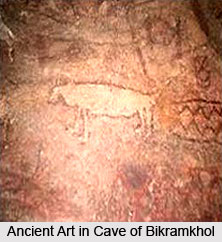
The ancient cave of Bikramkhol in the village known as Banjari bears the testimony of the evolution of human civilization and a script developed by them, far back in the 4000 B.C. The village of Banjari is an important name in the tourism of Jharsuguda owing to its antiquity. The ancient symbols engraved on the walls of the cave of Bikramkhol, paintings of animals, circular holes dug in the wall where weapons, dress and other articles of use were being kept suspended, the floors, where circular holes have been dug to pound the grains etc are the key interest about the Bikramkhol cave. At the same time this architectural carvings depict the forms and style of art of the contemporary people. The tourism industry of Jharsuguda has a lot to offer to the lovers of ancient culture and tradition. Bikramkhol is the recognized tourist spot of the Central Government in Orissa, which attracts tourists even from abroad.
In the vicinity of the village Lajkura, which is in close proximity of Jharsuguda there is a hill known as "Maheswar Pahad", which is famous in the tourism industry of Jharsuguda because of the remains of an old holy fort attracting the attention of historians, researchers and tourists. At the lap of the Maheswar Pahad, the village of Ulap is situated, where the ruins of Ulapgarh constitute to be the key attraction for the tourists. The eroded ruins of the Ulapgarh fort constitute to be the chief attraction of the village. The Siva lingam at the entrance of the fort, encompassing a huge corridor meant for the worship adds charm to the immaculate splendor of the fort. On the stone floor, there are many square holes and 70 round holes, which are designed to support super structures for living room, store room, arsenals, kitchen, sleeping room etc. Apart from the structural pattern of the Ulapgarh fort, the legendary significance of the fort draws importance in the tourism industry of Jharsuguda. It is believed that Ulapgarh was being used as a residential fort by some kings of "Naja" Dynasty.
Padampur, adjacent to Jharsuguda is famous in the tourism industry of Jharsuguda because of the historical significance that it is the birthplace of famous Sanskrit dramatist "Bhabahbhoti". The place is at the same time important because the "Bajrajan` Tantra marg of Buddhism was originated here. The place is the confluence of both the Hinduism and Buddhism. The temple of "Padmashini`, the presiding deity of the natives constructed in 7th century A.D, testimonies the Chalukyan art. The original temple was decayed and was believed to be reconstructed by the Chauhan king of Sambalpur in 16th century. "Jagmohan` of original temple reveals striking resemblance with architecture of the Chalukyan age. The stone statue of goddess Padmashini bears striking resemblances with the style of the Chalukyan period. Being a replica of Chalukyan art and architecture, the Padmashini Temple it is an important center, attracting the tourists.
The ancient Shaktipitha, Ramchandi shares an important position in the tourism industry and all its interest concentrates on the worship of Devi Ramchandi, the presiding deity of Rampur region. Many pilgrims and devotees come to the Rampur cave from far and near to visit and to offer their worship to the goddess Ramchandi.
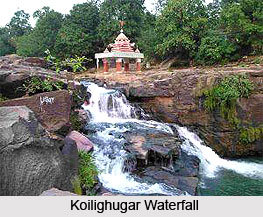
The Koilighugar waterfall, with its exquisite scenic beauty, steeped in an untamed background fetches a vast chunk of tourist. A rivulet named `Ahiraj` takes origin from the `Chhuikhanch` forest and while flowing through its rocky belt, falls from a height of 200 ft. creating the waterfall of Koilighugar. The major attraction of the Koilighugar waterfall is the Shivalingam known as `Maheswarnath`. The lingam is inundated in water and not ordinarily visible. If somebody tries to see it from inside the water in winter and summer the lingam is visible under the reflected sunlight, hence for the benefit of the pilgrims another Siva lingam has been created outside the waterfall. The snow-caped Shiva lingam submerged in the waterfall in a sylvan backdrop provides the special interest for the tourist in Jharsuguda.
Apart from these temples, there are a number of eroded ruins of the other temples dotted over the district of Jharsuguda are invested with profound interest because of their antiquity and the exquisite fabrications around the temple walls, which bear the testimony of the contemporary art and culture.
Jharsuguda
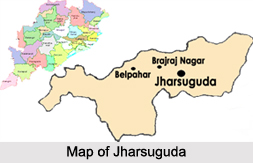 Jharsuguda is the district and administrative headquarters of Jharsuguda district of Odisha. Jharsuguda is an industrial hub, consisting mainly of metallurgical industries.
Location of Jharsuguda : Jharsuguda is located at 21.85 degree North to 84.03 degree East. It has an average elevation of 218 metres (715 ft).
Geography of Jharsuguda : Jharsuguda is located in Western Odisha State Highway 10 and National highway 200 pass through Jharsuguda. The Ib River flows along the Western side of Jharsuguda town and the river Bheden flows in the south. The area of the town is 70.47 km2, and has a population of 579,499. Jharsuguda is located at a height of 700-750 feet above mean sea level.
Climate in Jharsuguda : The highest temperature in Jharsuguda recorded in summer is 48.0 degree Celsius and it has an average rain fall of 1527 mm.
Visiting Information : Jharsuguda is well connected to all major cities of India through the rail network. It is popularly known as the power house of Odisha due to a large number of thermal power plants located nearby. Jharsugud had a relatively developed transportation network. The main mode of transport is cycle and rickshaw. However, in the last few years, auto rickshaws, savaris, vans, buses have also started as a means of local transport. The Jharsuguda Airport is under expansion at Durlaga. It has an airstrip since the British times, which is currently upgrading to a full-fledged airport. Jharsuguda is an important railway junction on the Tatanagar-Bilaspur section of Howrah-Nagpur-Mumbai line and Jharsuguda-Vizianagaram line. The railway station comes under South Eastern Railway. Jharsuguda is connected to various towns of the states by State Highway 10 and National Highway.
Recently updated articles in States of India
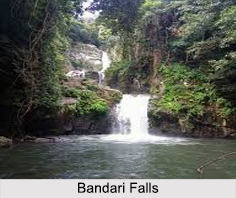
Bandare Waterfalls, Meghalaya
Bandare Waterfalls in South Garo Hills, Meghalaya, is a secluded natural attraction surrounded by dense subtropical forests and rugged mountain terrai...
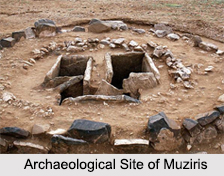
History of Thissur District
Early History of Thissur District explains flourishing of the port cities. Now these port cities are transformed into archaeological sites.
Tippi Orchid Research Centre, Arunachal Pradesh
Tippi Orchid Research Centre in Arunachal Pradesh is renowned for its rich collection of exotic and endangered orchids. Surrounded by lush rainforest...
Tourism in Nashik District
Pilgrimage tourism in Nashik district involves visiting the various places of Hindu and Jain worship located here. Some of the holiest sites for Hind...
Mangadu, Kerala
Mangadu in Kerala’s Kollam district is a significant megalithic site known for its urn burials, cist burials, menhirs, and stone circles. Excavations...
Related articles in States of India
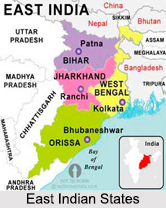
East Indian States
East Indian States comprises of Bihar, Jharkhand, West Bengal, Odisha and also the Union Territory of Andaman and Nicobar Islands. It defines the cult...
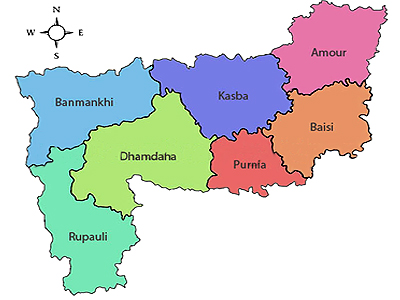
Purnia District in Bihar
Purnia District is located in Bihar and extends from River Ganga to Nepal. The district has a rich Hindu history and glorious past.
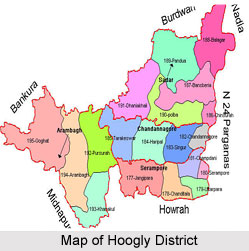
Hooghly district
Hooghly District along the bank of the river Hooghly is one of the principal trading ports of West Bengal.
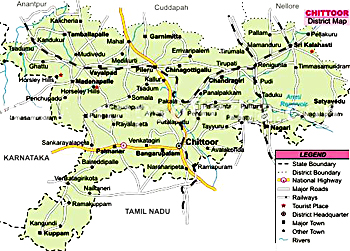
Geography Of Chittoor District
Geography of Chittoor district is spread along the topography of the land which is divided into two natural divisions; Chittoor has a dry and healthy...
Districts of West Bihar
Districts of West Bihar is comprised of medieval monuments that were built by the different governors of Mughal era.