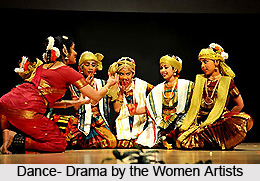
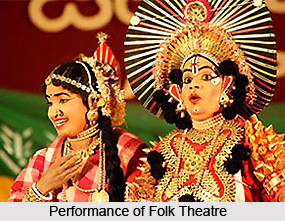
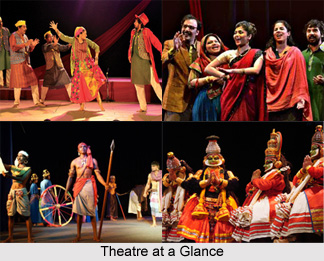
 The history of Indian theatre is the saga of changing tradition and an account of changing ritualism. Indian theatre is an effort of intensifying the social pattern in perhaps the most aesthetic way. Whether to reflect the very "unedited realities" of the society or to illustrate the divine edifying aspects of life, theatre in India definitely played a major role. The rich timeline of Indian theatre has therefore gone through a number of periods. These different periods were actually caused by the different rulers who invaded India time and time again.
Indian tradition ascribes a rather earlier date to dancing than to painting and sculpture. Historians believe that man must have learnt dancing much before and stepped into the "era of theatres". The history of Indian theatre is in fact the history of origin of the elements of drama which came together and weaved the rich fabric of Indian drama of which dance indeed formed the major part. Dance, the primeval unit of Indian theatre is portrayed in the prehistoric picture galleries, dotted throughout the country. Various enchanting dance formations depicted on rock surfaces points towards the fact that in the long gone days of the ancient times dance was the first `shrinkhala`(chain) as well as the "gulma" (cluster) of the Indian theatre which gradually evolved from the dance form. All the necessary ingredients of Indian theatre were present in primitive dancing hence the history of Indian theatre starts with dance. In those days the actor used masks, costumes, gestures, verbal sound to communicate and entertain and thus initiated the legacy of a dramatic art form, Indian theatre.
Over the centuries, the cave dwellers static civilisation has been still preserved amidst rich history of Indian theatre whilst giving a clue to the process of development of Indian theatre from its sheer rudimentary form.
The history of Indian theatre which started with the cave dwellers gained a rather realistic contour in the second century BC, with the introduction of the Sanskrit theatre. Realistically, Sanskrit theatre has been recognized as the very first representation of Indian theatre. Beginning in the long gone era of the second century BC, Sanskrit theatre was then the only medium of illustrating the religious and aristocratic Indian fervor. Theatre , as Bharata Muni says was then " the imitation of men and their doings (loka-vritti)" Natya Shastra seems to be the first attempt to develop the technique or rather art, of drama in a systematic manner. Sanskrit theatre remained to be a popular form of expression till the seventeenth Century. During the Eighteenth century, Sanskrit theatre slowly evolved as one of the eminent art form and was then popularly known as the "Indian Classical Dance Drama". Classical Indian theatre later witnessed a number of alterations to gain the modish shape. Based on the phases of the development of Indian theatre, the history of Indian theatre can actually be classified into three stages: Theatre in ancient India, Theatre in medieval India and the Modern Indian Theatre.
Theatre in ancient India of course played a major role in the over all enrichment of Indian tradition, culture, artistry and creativity since the remote past. The origin of theatre in ancient India has been marked as the result of the religious ritualism of the "Vedic Aryans". According to ancient Indian tradition Indian theatre was a life size art; practically nothing was left out of its scope. Theatre in ancient India was just not an artform but the systematic representation of " trividho shilpam nrutyam gitam vaditam cha" (dancing, singing an playing on musical instrument). Literature in Sanskrit started with the Vedic era and the rich history of Indian theatre holds the fact that Sanskrit plays were the first recognized representation of the Indian theatre. Illustrations of daily events, rituals, tradition, dance and music laced the Sanskrit plays while making the plays as one of the classical representation of applied art form in ancient India. Although indeed in a much crude manner the Sanskrit theatre did originate in India somewhat about 3500 years ago, yet its artistic glory never faded away with time.
Theatre in medieval India gradually became quite a thriving personification and of course a refined embodiment of the realities of life through dance, music and poise. During the middle ages the Indian subcontinent witnessed a number of invasions. And what came out as an immediate result is the grand fusion with the invaders from the Middle East and Central Asia, shaping Indian heritage and culture whilst offering it a whole new facet. . The over theatrical pattern of the ancient drama gained a rather rational rhythm in the style and pattern of theatres in the medieval India. The introduction of "Loknatya" during the mid 16th and late 16th century again added a whole fresh enunciation to Indian theatre during the medieval period.
The modern Indian theatre focused in portraying the change of the political set up in the country. The Indian theatrical culture was influenced by the British rule in India. During those 200 years of the British rule in the country, the Indian theatre came into the direct contact with the western theatre and this influence turned a new chapter in the history of Indian theatre while giving birth to the modern Indian theatre. It was the beginning of the nineteenth century when music, timber, song, dance, dialogue and emotion all were for the first time incorporated in the Indian theatre to offer it a modern facet. Not only in the acting pattern, changes were observed even in the designing of the theatre hall during this time. The theatres then incorporated huge orchestra pits and the seating arrangements were also then divided by metal bars. The overdramatic aspects were rationalized; gone are the days of witnessing the heroic deeds of the historical characters; modern Indian drama of the late 19th and early 20th century focused mainly towards a rather naturalistic and realistic presentation. Common man, daily life, social problem, health and economical problem were nicely manifested in modern theatres.
The rich chronicle of Indian theatre unveils the verity that theatre in India was always an important part of the rich Indian culture and tradition and is still the same. In the recent era Indian theatre has acquired that tinge of contemporary attribute in order to befit the modish requirement of the Indian society.
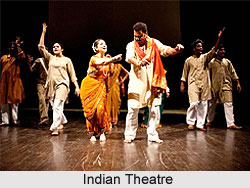 Contemporary Indian theatre has evolved a great deal from the days of inception. Theatre has always been a mirror for man, and
 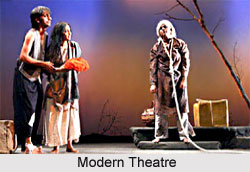 There are spaces that actually go beyond language and region, and they are the ones which are most useful. These are, as a matter of fact, more of ideological spaces and the whole purpose of making them is to come closer to the identity of India, its root and culture, rather than to create further hostile divisions. India as a nation has enough of such material. The three spaces in the context of Contemporary Indian Theatre can be described as the traditional, continual and radical respectively and none of these spaces are mutually exclusive.
 Indian theatre after independence gained a colossal maturity with the introduction of regional theatres. Bengali theatre, Hindi and Marathi theatre made their presence felt in quite a large way to manifest the social, political and economical condition of Independent India.
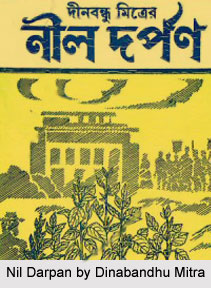 History of modern Indian theatre depicts one of the productive phase in Indian theatre. Modernity of Indian theatre reached on the coattails of the British Raj in the mid-nineteenth century. As a result there were sweeping changes in theatre stages of India over the next hundred years, until 1947 and perhaps the subsequent decade, so that the only accurate adjectives for the following fifty years up till now can be post-modern, postcolonial or even contemporary. It is somewhat easy to determine the beginnings of modernism in Indian theatre, because the shift from pre-modern forms to modern ones here is so clearly distinguishable. Chronologically, too, it seems to nearly coincide with that turning point in Indian history, 1857, the First War of Indian Independence. However, modernism in theatres took some time to reach some theatre regions, as late as the mid-twentieth century - in alphabetical order,
 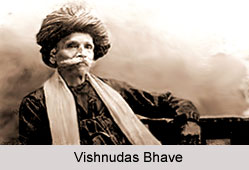 In Kolkata, the
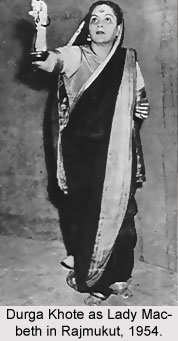
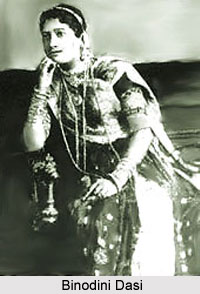
  Women in modern Indian theatre have been depicted in various shades. The question of gender has remained almost unaddressed in performance of modern Indian theatre. It has been seen that, in most of the studies done by scholars, works of modern theatre personalities attempts to destabilize regressive notions of tradition and to undo the sutures that have been put in place to hold together the idea of a composite Indian identity. In the recent years, people have become increasingly attentive to gender issues, interrogating the relationship of women to nationalism and modernity in the dramatic sphere, on the stage and in print culture, through thematic representations of women in theatre and through their contribution as actors, directors, and writers of plays.
 In all India theatre movement, which is known as