 The Indian Order of Merit was a military and civilian decoration of the Provinces and Presidencies in British India. The decoration was awarded to native citizens serving in the armed forces and civilians (civilian division). The Indian Order of Merit was founded in the year 1837 by the East India Company. After the Indian independence and the Partition of India, the decoration was discontinued. Later a separate honours system was established by the Government of independent India. The Indian Order of Merit was considered as the highest decoration for Indian native personnel in the British Indian Army. Initially the decoration comprised of 3 divisions. But it was modified in the year 1911 after native soldiers in the British Indian Army became eligible for the Victoria Cross. A civilian division of the Indian Order of Merit also existed from 1902 and 1939.
History of Indian Order of Merit
The Indian Order of Merit was founded by the Honourable British East India Company in the year 1837. It later came under the administrative control of the British Empire in India in 1858, after the Sepoy Mutiny of 1857. The medal was the only gallantry award presented to Indian members in the army between the years 1837 and 1907, before the introduction of the Indian Distinguished Service Medal. The medal was initially introduced in three classes, namely first class, second class and third class. However, it was decreased to two classes after Indian soldiers became eligible for other military decorations. The first class of the Indian Order of Merit was replaced by the Victoria Cross in 1911. Later in the year 1944, the medal was reduced to a single class.
Medals of Indian Order of Merit
The recipient of the Indian Order of Merit had to achieve the lower class medals before being presented with a higher class decoration. However, the recipients were directly honoured with a higher class medal if they provided exceptional and valiant services. The recipients of the Indian Order of Merit were also granted with increased salary and pension allowances. Moreover, they were held in high regard.
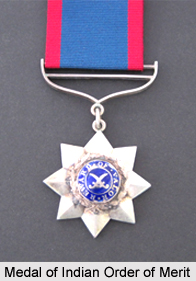
The first class medal had an 8 pointed gold star with blue circle which was bounded by gold laurels in the middle. It also included crossed swords and the words "Awarded for Gallantry". The second medal of the Indian Order of Merit consisted of an 8 pointed shiny silver star with blue circle and encircled with gold laurels in the centre. The medal also had crossed swords and included the words "Awarded for Gallantry. The words "Awarded for Valour" were used in the decoration before the year 1944. The third class medal had an eight pointed dull silver star with blue circle. It was bordered by silver laurels in the centre and included crossed swords. The medal also had the words "Awarded for Gallantry" inscribed in it after 1944. The Indian Order of Merit medal contained a dark blue ribbon flanked by 2 red stripes.
The civil division of the Indian Order of Merit was awarded in 2 different classes from the year 1902. Later in 1939, it was reduced to only a single class medal. The civil medal of the decoration was presented rarely. After the country achieved independence from the British administration, all the divisions of the Indian Order of Merit were discounted.