 The Indian Distinguished Service Medal (IDSM) was a military medal and decoration that was bestowed by the British Government of India to the Indian citizens who served in the British Indian armed forces and police. The medal was instituted in the year 1907 and was the 2nd highest award granted to Indians, right behind the Indian Order of Merit. The Indian Distinguished Service Medal became 3rd highest in the order of precedence in the year 1911, after the eligibility for the Victoria Cross was extended to include all Commonwealth subjects. The British military decoration was established in order to identify and honour acts of courage and bravery which did not meet the standards that were required of the IOM. After the withdrawal of the British administration and the Partition of India in the year 1947, the authorities decided to discontinue the Indian Distinguished Service Medal (IDSM) award.
After its institution, the Indian Distinguished Service Medal the medal was solely available to members of the British Indian Army, Indian State Forces, militias and levies. But after the year 1917, it was available to non-combatant followers as well, including grooms and carriers. In 1929, the eligibility for the British military medal was extended to the Royal Indian Marine and later in the year1940, it was granted to the Indian Air Force.
The Indian Distinguished Service Medal (IDSM) had 4 distinctive versions and the sole distinction was the depiction of the monarch in the obverse. These medals were bestowed either with the impressed or engraved details of the recipient and also included name, service number and regiment. The medal was considered rather rare and only around 6,000 units were granted, including bars. During the World War I, around 3,200 medals were granted and from the commencement of the World War II upto 1947, about 1,200 medals were awarded. The rest of the 1,600 medals awarded between the wars during fighting in the border line; as well as other inter-war campaigns, like the Iraq campaign during the years 1919 and 1920.
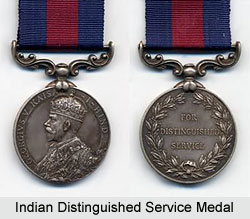
The Indian Distinguished Service Medal (IDSM) was mainly awarded for providing distinguished service. It was circular silver medallion and contained a red and blue coloured ribbon. The obverse on the medal contained the profile of reigning monarch and the reverse had an inscription of "For distinguished service", which was surrounded by a laurel. The prestigious medal did not contain any claps. After the Indian independence on 15th August 1947, the medal was discontinued.