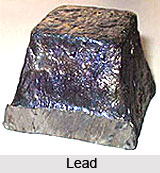
 Lead is a soft, heavy, dull gray metal with low tensile strength.The organic lead compound tetraethyl lead, Pb (C2H5) 4, was widely used as a gasoline additive to prevent knock in automobile until concern about lead toxicity caused that use to be discontinued.
Lead forms a thin surface layer of oxide in air, which slowly changes to a basic carbonate. Hard water forms a similar coating on lead, which protects the water from further contamination with soluble lead compounds. Soft water dissolves appreciable amounts of lead, which is poisonous.
Heating lead in air makes lead monoxide, PbO, called litharge. It is a yellow powder or yellowish-red crystalline material, which is used in making lead glass. Heating lead in oxygen can make red lead, Pb3O4. It is used in glass making and for making a red paint for protecting iron and steel structures. Lead dioxide, PbO2, is widely used in Lead storage batteries. The mineral form of lead dioxide is called plattnerite.
White lead is a basic carbonate of lead, Pb3 (OH) 2(CO3) 2, which was widely used as a white pigment in paint until concerns about lead toxicity brought a halt to most such uses. Lead carbonate, PbCO3, in mineral form is called cerussite. Lead chromate, PbCrO4, is also used as a pigment under the name chrome yellow. A brilliant red-orange color is exhibited by the mineral crocoite, a mineral form of PbCrO4. Lead in its metallic form is widely used for radiation shielding because of its high absorption constant for x-rays and gamma rays.
Lead occurs naturally in the sulfide mineral galena (PbS) and occurs with vanadium in vanadinite. A carbonate form of lead is phosgenite. Lead sulfate, PbSO4, in the mineral form c1 is sometimes of gem quality. Lead forms an oxide mineral with titanium, iron and manganese called senaite. Lead forms a sulfide with antimony and iron called Jamesonite and sulfides with antimony called zinkenite, plagionite, semseyite and boulangerite.
Dufrenoysite and gratonite are sulfides of lead with arsenic. A sulfide formed with antimony and arsenic is called jordanite. A sulfide formed with tin, iron and antimony is called cylindrite. Bournonite is a sulfide with copper, lead and antimony. Lead is found in the mineral nagyagite, a sulfide, along with gold, iron, antimony, and tellurium. Silver joins with lead and antimony in the sulfide andorite, AgPbSb3S6. Lead, copper and iron join in the sulfide betekhtinite. In the sulfide mineral hutchinsonite, (Tl, Pb) 2As5S9 , lead joins with arsenic and thallium. One mineral form of selenium is the compound with lead, clausthalite, PbSe. Lead is one of the few elements, which can be found in nature in pure form.