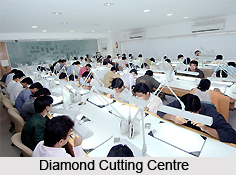
 Indian Diamond Industry is mainly involved with cutting, polishing and exporting diamonds. Diamonds cut and polished in India are universally prized, and India has emerged as the largest diamond-cutting centre in the world. Although India pioneered in the cutting of small diamonds yet today, its craftsmen are equally skilled at cutting all shapes and sizes of stones, and even at faceting coloured diamonds. Mumbai, Surat, Ahmedabad, Bhavnagar and many small towns in Gujarat are the main polishing centres of the country. The industry employs one million people, accounting for 95 per cent of the workforce of the world`s diamond industry.
India is precursor in the gem industry and a world leader in the manufacturing of cut and refined diamonds. The Indian diamond industry today is a result of perseverance and hard work. After India became independent in 1947, for several years, the nation`s economy was in the depression. Several views for business and commerce opened up as new policies came into place, journey towards progress and development also began for the diamond industry.
The Indian diamond industry was a scattered cottage industry only three decades ago. Now the industry has gradually evolved into a modern, mechanised, large-scale operation. Today, with state of the art laser machines, lathes and diamond-impregnated scaives, most of the medium and large sized diamond factories are well operational. In the world of jewellery industry, this structured and rapid growth of the Indian diamond industry has a long-lasting impact. The Indian exports of diamonds increased and in turn it reflected greater than before in the export of designed jewellery. There is an evident fact that the Indian jewellery designs have, for centuries; spell bounded everyone, from the Indian Maharajas to the monarchs of faraway lands.
Indian jewellery was made scrupulously by hand and was traditionally crafted by family jewellers skilled in a particular style. Large exports directed to the establishment of factories, which prepared with the latest modern machinery and technology. State-of-the-art techniques and recently developed methods in the manufacturing process were employed. India`s artisans along with their traditional skills dominated contemporary techniques to provide the world with jewellery that conformed to international standards. There is a new generation of young designers dominating the world market, apart from a host of established houses that design the fashion jewellery. Today across India there are several jewellery design institutes, encouraging fresh ideas and talent.
The Gem and Jewellery Export Promotion Council (GJEPC) is the zenith body of this dazzling and growing industry. In 1966, the council was set up under the patronage of the Ministry of Commerce and has helped to form a better understanding between the diamond industry and the Government. The chief function of the council is to develop and promote the export of gems and jewellery from India and to contribute towards establishing a code of ethics to ensure that fair trade practices are followed in the jewellery arena.
The Indian diamond industry is again at the doorstep of expansion. In order to enable diamonds to be brought into the country to be sold, the Government has legitimated the setting up of bonded warehouses. The unsold diamonds can then be exported without any duty or tax. The Government is also constantly slackening its policies. Creating the Export Promotion Zones (EPZ) and Special Economic Zones (SEZ) in order to help and promote the export of gems and jewellery from the country is undoubtedly a new step for the betterment of the industry.