
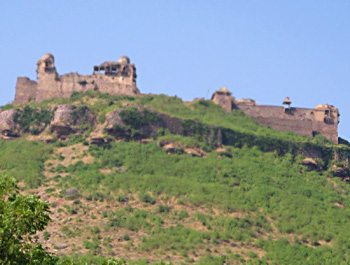
 Raisen district got its name from massive Fort. This fort is made on a sandstone hill, at the foot of which is the district. The name of this district is probably a corruption of Rajavasini or Rajasayan, the royal residence. The district of Raisen is situated in the central part of the state of Madhya Pradesh in India.
Raisen District
Raisen district is one of the districts of Madhya Pradesh state formed in the fifth of May 1950. It is famous for a number of archaeological findings of great importance.
Introduction
Raisen district got its name from massive Fort. This fort is made on a sandstone hill, at the foot of which is the district. The name of this district is probably a corruption of Rajavasini or Rajasayan, the royal residence. The district of Raisen is situated in the central part of the state of Madhya Pradesh in India.History of Raisen District
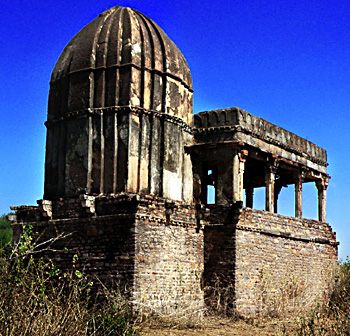 History of Raisen district deals with the rule of the Sultans of Mandu, the Rajputs, Sher Shah Suri, Akbar, Nawab of Bhopal, etc. Raisen with a strong fort was previously a major center of administration from the period of its foundation from Hindu times. In the fifteenth century, the fort of Raisen was ruled by the Sultans of Mandu, from whom it passed to the Rajputs. In 1543 Sher Shah Suri captured from Puranmal. During the rule of Akbar, Raisen was the headquarters of a Sarkar in the Subah of Ujjain in Malwa Plerateau. The third Nawab of Bhopal State, Fiaz Mohammad Khan, occupied it in about 1760, and later he got himself recognized as Faujder of Raisen by Emperor Alamgir II.
During the rule of the Mughal dynasty, Khamkhera was the headquarters of the area which is now in the Gairatganj tehsil. It has got its present name during the same Mughal rule. Shahpur was the headquarters of the Pargana and later it was shifted to Sagoni, which falls in the Begamganj tehsil. After Bhopal State became a part `C` state of the Indian Union, the present district of Raisen came into existence on the 5th of May, 1950, with headquarters at Raisen and it was decided to retain only seven tehsils in this district.
The district of Raisen in the state of Madhya Pradesh got its name from the massive Fort. This fort was erected on a sandstone hill, at the foot of which settles Raisen. The present name of the district is probably a corruption of Rajavasini or Rajasayan, the royal residence. The Raisen District is situated in the middle portion of Madhya Pradesh in India. It is surrounded by Sehore district to the West, Vidisha district to the north, Sagar district to the East and South-East, Narsimhapur district to the south-east, and Hoshangabad district and Sehore district to the South.
The ancient history of Raisen can be found in Sanchi. Sanchi is about forty six kilometers from Bhopal. It is a religious place with historical and archaeological significance. Regardless of the damage and restoration work done, Sanchi is still considered to be the most evocative and attractive Buddhist sites in India. The images carved on the pillars and the stupas narrate the moving story of the incidents from the life of Lord Buddha. At Bhojpur, the famous Shiva temple, Bhojpur speaks about the legendary Parmar king of Dhar, Raja Bhoj, after whom the place was named Bhojpur. Bhimbetka is a rocky terrain of dense forest and craggy cliffs with more than six hundred rock shelters belonging to the Neolithic age. Paintings in more than five hundred caves depict the life of the prehistoric cave-dwellers, making the Bhimbetka group an archaeological treasure, an invaluable chronicle in the history of man.
Geography of Raisen District
The District is located in between 22 degrees 45 minutes and 22 degrees 33 minutes to the North Latitudes and 77 degrees 21 minutes and 78 degrees 49 minutes to the East Longitudes. The Raisen district forms its borders with the Sehore district to the West, Vidisha district to the North, Sagar district to the East and South-East, Narsimhapur district to the south-east and Hoshangabad district and Sehore district to the south. The total area over which the district of Raisen is spread is 8395 square kilometres, which is about 1.93 percent of the total are of the state of Madhya Pradesh.
Demography of Raisen District
 According to the 2011 Population Census, Raisen District had a population of 1,331,699. Raisen District ranks 365th in India. The district has a population density of 157 inhabitants per square kilometres. The population growth rate of 2011 was 18.36 percent. Raisen has a sex ratio of 899 females for every 1000 males.
Education of Raisen District
The average literacy rate of Raisen is 74.26 percent. According to the gender, the male and female literacy rates were 82.46 and 65.09 percent respectively. The total literates in Raisen District were 837,567. Out of which the male and female literates were 490,921 and 346,646 respectively. For educational purposes, there are one thousand eight hundred and thirty three primary schools, six hundred and thirty one middle schools, eighty-seven high schools, forty-three higher secondary schools, twelve colleges, one technical institute, etc.
Tourism of Raisen District
 Tourism of Raisen district offers an excellent opportunity to venture into the rich and glorious past of this district of Madhya Pradesh. The most prominent attractions in the district of Raisen are Bhimbetka, Sanchi Stupa and Bhojpur.
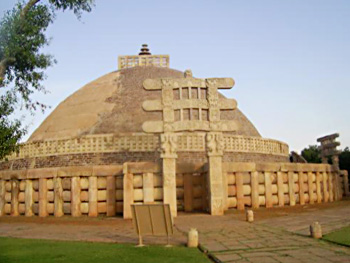
Sanchi Stupa : Sanchi is a place of immense archaeological and historical importance. It is famous for its stupas and pillars. Some of the stupas have been found possessing relics of the disciples of Lord Buddha. These stupas date as early as the 3rd century and are constructed of bricks made of stone. The Pillar of Asoka is one of the many pillars. These are scattered in the area some of these are in broken and some in shape. It is an excellent example of the Greco-Buddhist style and is known for the aesthetic proportions and the exquisite structural balance. Bhojpur is a place of great tourist interest in this district, which is named after Raja Bhoj. The place is renowned for the remains of its magnificent Lord Shiva Temple and Cyclopean dam.
 Regardless of the damage and restoration work done, Sanchi holds the reputation of the most evocative and attractive Buddhist sites in India even today. Sanchi is mainly a place of Stupas and pillars but the gorgeous gateways add grace to the place. These gateways are the finest specimens of early classical art, which formed the seedbed of entire vocabulary of later Indian art. The images carved on the pillars and the stupas tell moving story of the incidents from the life of Buddha. Though most of the stupas are in ruins now three remain intact and are of great archaeological value. The designs and the carvings on the walls and gates of these stupas spell a heavenly grace. Other attractions of Sanchi are the Four Gateways, the Ashoka Pillar, the Buddhist Vihara, the Great Bowl, the Gupta Temple, the Museum maintained by the Archaeological Survey of India, etc.
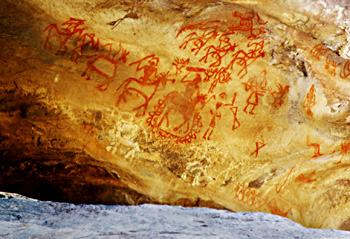
Bhimbetka : Bhimbetka in another major attraction in Raisen district possessing more than six hundred rock shelters belonging to the Neolithic age. There are over five hundred paintings on canvas, which depict the life of the prehistoric cave dwellers. Bhimbetka is surrounded by the northern fringe of the Vindhya Mountain Range. It is forty-six kilometers away from Bhopal. It is a rocky terrain of dense forest and craggy cliffs, where over six hundred rock shelters belonging to the Neolithic age were discovered recently. Here, in vivid, panoramic detail, paintings in over five hundred caves depict the life of the prehistoric cave dwellers; making is an archaeological treasure, an invaluable chronicle in the history of man. Prepared mainly in red and white with the occasional use of yellow and green, with themes taken from everyday events of Aeons ago, the scenes usually depict hunting, music, dancing, elephant and horse riders, animals fighting, honey collection, decoration of bodies, disguises, masking and household scenes. Popular religious and ritual symbols also occur frequently in these cave paintings.
The colours used by the cave dwellers were prepared combining manganese, haematite, soft red stone and wooden coal. Sometimes animal fat and extracts of leaves were also used in the mixture. The colours have remained intact for many centuries due to the chemical reaction resulting from the oxide present on the surface of the rocks. The superimposition of paintings shows that different people used the same canvas at different times.
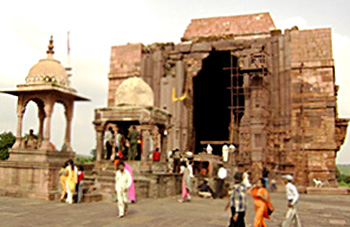
Bhojpur : Bhojpur is one of the most prominent centres of tourist interest in the district of Raisen in Madhya Pradesh state. Founded by the legendary king of Dhar of Parmaras Raja Bhoj, and named after him, Bhojpur is twenty-eight kilometres from Bhopal. It is known for the remains of the Cyclopean dam and the magnificent Shiva Temple, Bhojpur. The temple, which is famously called the Somnath of the East, is known as the Bhojeshwar Temple. Four pillars support the richly carved dome. In the west of Bhojpur was a vast lake, but nothing remains except the ruins of the magnificent old dams by which its waters were contained. The lake was destroyed by Hoshang Shah of Malwa (1405-1434), who cut through the lesser dam, and thus, either intentionally or in a fit of destructive passion, added an enormous area of the highest fertility to his possessions. According to a Gond legend, it took three months for the army to cut through the dam, and the lake took three years to empty, while its bed was not habitable for thirty years afterwards. The climate of Malwa is said to have altered by the removal of this vast sheet of water.
Recently updated articles in States of India
Bandare Waterfalls, Meghalaya
Bandare Waterfalls in South Garo Hills, Meghalaya, is a secluded natural attraction surrounded by dense subtropical forests and rugged mountain terrai...
History of Thissur District
Early History of Thissur District explains flourishing of the port cities. Now these port cities are transformed into archaeological sites.
Tippi Orchid Research Centre, Arunachal Pradesh
Tippi Orchid Research Centre in Arunachal Pradesh is renowned for its rich collection of exotic and endangered orchids. Surrounded by lush rainforest...
Tourism in Nashik District
Pilgrimage tourism in Nashik district involves visiting the various places of Hindu and Jain worship located here. Some of the holiest sites for Hind...
Mangadu, Kerala
Mangadu in Kerala’s Kollam district is a significant megalithic site known for its urn burials, cist burials, menhirs, and stone circles. Excavations...
Related articles in States of India
East Indian States
East Indian States comprises of Bihar, Jharkhand, West Bengal, Odisha and also the Union Territory of Andaman and Nicobar Islands. It defines the cult...
Purnia District in Bihar
Purnia District is located in Bihar and extends from River Ganga to Nepal. The district has a rich Hindu history and glorious past.
Hooghly district
Hooghly District along the bank of the river Hooghly is one of the principal trading ports of West Bengal.
Geography Of Chittoor District
Geography of Chittoor district is spread along the topography of the land which is divided into two natural divisions; Chittoor has a dry and healthy...
Districts of West Bihar
Districts of West Bihar is comprised of medieval monuments that were built by the different governors of Mughal era.