 Hinduism in the mediaeval period saw a major development that dates back to 1000 A.D. Muslim rulers had invaded India and the establishment of Muslim rule broke up the unity of the cultural life of the country. Innumerable religious cults sprang up in the country and they were all within the fold of Hinduism. The Muslim invaders came with a powerful world-religion which was alien in character. Hinduism remained invincible despite the political conquests and forcible conversions. However, it no longer enjoyed an undivided supremacy in India.
Age of Bhakti Movement
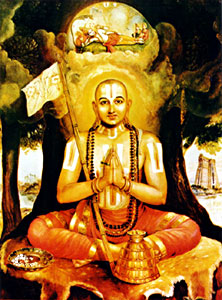
Four important theistic systems of philosophy arose in the south - the Vishishta advaita system of Ramanuja, the Dvaita Philosophy of Madhva, the Shaiva-Siddhanta system of Meykandar and the Vira-Shaiva system of Basava. Ramanuja advocated that the pivot of the whole system is the manner in which one can conceive the relation between God and the world of matter and souls. God, soul and matter were the ultimate three recognized realities. The Dvaita system of Madhva advocated unqualified dualism. According to him the three eternal entities are different from one another fundamentally-God, the soul and the world. The Shaiva-Siddhanta system of Meykandar belonged to the early years of the thirteenth century. This school of thought believed that the supreme reality is Lord Shiva. To attain salvation one must get rid of the - past Karma, false notion of a finite self and subjection to matter. Vira-Shaivism sprang up as an off-shoot of Shaivism which had come into existence earlier in the middle of the twelfth century. Basava was its founder. He rejected caste, denied Brahman supremacy, condemned sacrifices and insisted on Bhakti and the worship of one god- Lord Shiva.
Later Age of Bhakti Movement
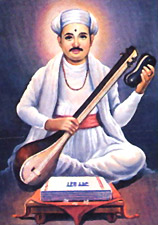 This age commences from1400 A.D.-1750 A.D. Maratha confederacy was established during this age. The Maratha Empire in the eighteenth century was the great protection for the Hindu civilization. A great Bhakti movement began and swept over Northern India during this period. Among the two parallel movements in Bhakti in the south, Vaishnavism spreads to the north and splits itself into two streams-the worship of Lord Rama and the worship of Lord Krishna.
The leader of the Bhakti centering round Rama was Rama Nanda. Kabir, Tulsidas were all his followers. Guru Nanak was the founder of the religion of the Sikhs and a younger contemporary of Kabir. He advocated that there is but one God who is eternal, spiritual and personal.
There are two types of Krishna worship-the worship of Krishna and Rukmini on the one hand, and the worship of Krishna and Radha on the other. The saints of Maharashtra like Jnaneshwar, Namdev and Tukaram represent the former, while the sects founded by Nimbarka, Vallabhacharya and Chaitanya represent the latter.
This period witnessed extensive religious activity. Thousands of hymns, songs and poems of the highest quality were written in the languages which common people could understand. The heavy burdens of rituals and caste were lightened and the complex philosophies were set aside in an abundant love of God.