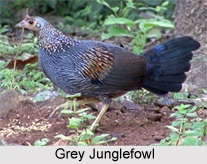
 Grey Junglefowl, one of the wild ancestors of domestic fowl together with the red junglefowl and other junglefowls, is native to evergreen hill forest in southern and western India. It is also known as Sonnerat`s junglefowl. This bird is responsible for the yellow pigment in the legs and different body parts of all the domesticated chicken. It is found mainly in peninsular India and towards the northern boundary.
Other Names of Grey Junglefowl
This bird has various local names. It is known as Jangli Murghi in Hindi, Kattu Kozhi in Tamil and Malayalam, Kaadu koli in Kannada, Tella adavi kodi in Telugu, Komri in Rajasthani, Geera kur or Parda komri in Gondi and Raan kombdi in Marathi. The scientific name of Grey Junglefowl is Gallus Sonneratii.
Physical Features of Grey Junglefowl
The males have a black cape with ochre spots and the body plumage on a grey ground colour is finely patterned. They have elongated neck feathers that are dark and end in a small, hard, yellowish plate. This peculiar structure makes them famous for making high-grade artificial flies. They have red wattles and combs and the central tail feathers are long and sickle shaped. The legs of males are red in colour and have spurs while the legs of females are yellow in colour and usually lack spurs. The females are duller and have black and white streaking on the underparts and yellow legs.
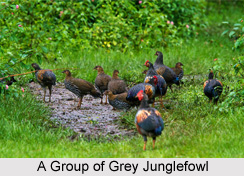 Habitat of Grey Junglefowl
The Grey Junglefowls prefer to live in thickets, on the forest floor and open scrub. They are mainly found in the Indian Peninsula but extend into Gujarat, Madhya Pradesh and south Rajasthan. Their calls of Ku-kayak-kyuk-kyuk are loud and distinctive, and can be heard in the early mornings and at dusk. They are mostly seen on the ground but fly into trees to escape predators and to roost.
Breeding of Grey Junglefowl
The breeding takes place in the months between February and May. They lay 4 to 7 eggs which are pale creamy in a scrape. Eggs are hatched in about 21 days. The male Grey Junglefowls have an eclipse plumage in which they moult their colourful neck feathers in summer during or after the breeding season.
Diet of Grey Junglefowl
The primary diet of Junglefowl comprises of grains including bamboo seeds, berries, insects and termites. The diet also include a mixture of small dog kibble, seasonal pulp seed fruits like pomegranate, pumpkin and hot peppers and a limited portion of a game bird pellet. Grey Junglefowls hunt food in small mixed or single sex groups.