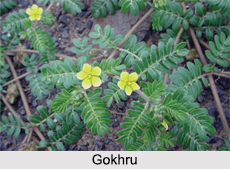
 Gokhru is a pubescent annual herb with prostrate primary branches. This plant is mainly found in drier regions on sandy soils in India. The fruits and flowers in this plant are available throughout the year. Gokhru is native to the Mediterranean region and the same was introduced and naturalized nearly throughout the tropics, subtropics and warm temperate regions of the world. Gokhru is regarded as an Indian Medicinal Plant which is found in all parts of India, mainly in the drier regions on sandy soils at an altitude of about 5400 meters in Kashmir.
Different Names of Gokhru
The Botanical name of Gokhru plant is ``Tribulus Terrestris``. Gokhru is known by different names in different Indian languages like ``Betagokhru``, ``Gokharu``, ``Bethu``, ``Nahanagokhru`` and ``Mithagokhru`` in Gujarati, ``Negilmull``, ``Negalu`` and ``Sanna Neggila`` in Kannada, ``Nerinnil``, ``Nerinjil`` and ``Nerungil`` in Malayalam, ``Gakhura`` and ``Gokshra`` in Oriya, ``Gok-Sura``, ``Gokshura``, ``Goksurah``, ``Ikshugandha``, ``Trikantaka`` and ``Svadamstra`` in Sanskrit, ``Chinnipalleru`` and ``Chirupalleru`` in Telugu, ``Chotagokhru`` and ``Gokhru`` in Hindi, ``Negilmullu`` in Konkani, ``Lahangokharu``, ``Ghokaru``, ``Sarala`` and ``Sharatte`` in Marathi, ``Bakhra``, ``Gokhrudesi``, ``Bhukri`` and ``Lotak`` in Punjabi, ``Nerunji``, and ``Sirunerinji`` in Tamil and ``Gokharu`` in Urdu.
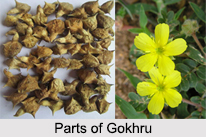 Parts of Gokhru
Gokhru is more or less a pubescent annual herb with prostrate or decumbent primary branches which is up to 1.5 meters long radiating from the crown of the taproot. The roots of Gokhru are slender, cylindrical, somewhat fibrous, 10 - 15 centimetres long, light brown and faintly aromatic. The leaves of this plant are opposite, paripinnate, up to 5.5 centimetres long, one of each pair usually smaller than the other. The leaflets are of 3 - 6 pairs and are 6 - 12 millimetres long, oblong to linear-oblong, with silky hairs on surfaces, apex mucronate, base rounded oblique and petioles are very short. Flowers of this Indian plant are pale-yellow to yellow in colour and are 0.7 - 2 centimetres in diameter. The leaves are opposed and solitary and the pedicels are 1.2 - 2 centimetres long, slender and hairy. The sepals are 6 millimetres long, lanceolate and acute and the petals are 1centimetre long, oblong-obovate, claw short and hairy. The fruits of Gokhru are globose and possess 5 - 12 woody cocci, each with 2 pairs of hard, sharp, divaricate spines, with one pair longer than the other. There are several seeds in each coccus with transverse partitions between them.
Medicinal Value of Gokhru
Fruits of Gokhru have been used in India to deal with kidney and urinary problems, and also as a sexual libido enhancer. They are used in Ayurveda in the treatment of kidney stones, painful urination and other genito-urinary disorders, mainly in the form of an infusion. They are also prescribed for the treatment of breathing difficulties, diabetes, rheumatism, piles, dropsy, heart diseases, impotence and Bright"s disease. The leaves of Gokhru are considered to possess stomachic properties and a paste prepared from them is used in the treatment of bladder stones. It helps in breaking and elimination of kidney stone from body. It also prevents recurrent stone formation. Gokhru also increases hormones secretion in body. It supports testosterone production and muscles building. The root of Gokhru is considered to have aperients and tonic properties. The fruits of this plant are used in various major compound Ayurvedic preparations. It is one of the ten roots used in preparation of Dashamula.