Ashtanga Yoga

Ashtanga Yoga is a dynamic, disciplined practice that links breath with a set sequence of postures to cultivate strength, flexibility, and inner focus. Rooted in Patanjali’s eightfold path, it encourages mindful living by integrating ethical conduct, physical practice, breath control, and meditation to promote balance, clarity, and overall well-being.

Introduction

In the second chapter of “Yoga Sutras,” called Sadhana Pada, Maharashi Patanjali mentions these eight steps to achieve Samadhi. In Sanskrit "Ashta + anga" creates ‘Ashtanga’; where "Ashta" means Eight and "Anga" refers to limbs, thus, the meaning stands as Eight Limb path. The Ashtanga Yoga or Eightfold Path of Yoga is introduced in the second section of the Yoga Sutras, known as the Sadhana Pada. In sutra 2.29, Sage Patanjali presents this path as ashtanga yoga, outlining it as a practical framework for spiritual development. Patanjali designed these eight limbs to guide practitioners beyond the universal sufferings of human life and toward self-realization and ultimate freedom. 

These eight limbs are:

Yama

Niyama

Asanas

Pranayama

Pratyahara

Dharana

Dhyana

Samadhi

Ashtanga Yoga

Yama

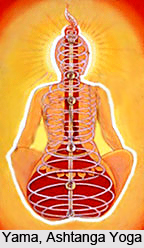
Yama means restraints and this stage of Ashtanga yoga is associated with social and moral conduct. There are five Yamas comprising of the following:

  • Ahimsa: Ahimsa means non-violence of action or not hurting anyone through thought, words and deeds. If a person adheres to the principles of ahimsa, all beings around him abandon their hostile behaviour.
  • Satya: Satya means truthfulness by all means. By the practice of truthfulness, the practitioner develops a power in himself and his mind becomes clear like mirror. This clarity reflects through his speech.  By observance of satya, spoken words fructify into action. 
  • Astheya: Astheya is the state of non stealing, not only material but other’s ideas and thoughts also like we take someone else’s credit or cheat. All kinds of treasures are bestowed on him who observes asteya. 
  • Brahmacharya: Brahmacharya means sexual abstinence. Brahma means supreme being and charya means living, but here the word brahamcharya means sexual contentment. Veerya means semen, about which it is said that one drop is made out of forty drops of blood. Veerya means vitality. It is essence of life which ultimately converts itself into energy. There is an intimate connection between physical energy and spiritual energy. In order to bring about spiritual potentiality, it is necessary to conserve physical energy, known as 'ojas.' It is formed by conservation of veerya. When the physical fluid called semen is conserved and converted into ojas, that is called reta or seminal energy. When it is sublimated and drawn inward, it produces energy. For a brahmachari, vigour, vitality, energy and spiritual knowledge flows like a river.
  • Aparigraha: Aparigraha is non-possessiveness. It means giving up the tendency to accumulate objects of utility and enjoyment. To keep those objects that are essential for living. This keeps mind unoccupied and one does not have worry about anything because there is nothing to be protected. One who observes aparigraha will come to know of his past and future lives.

Ashtanga Yoga

Niyama

Niyamas mean practice or observance and are to be observed for self development. There are five Niyamas:

  • Saucha: Saucha means cleanliness or purity of body & mind. It is said that by practicing cleanliness you develop in the course of time a kind of indifference towards your own body. At the same time of non-attachment to others is also developed.

    Sauncha is also associated with internal purity. This means getting rid of all negativity and replace it by positive thoughts. When internal purity is focused upon, mind gets purified. Firm practice of Saucha brings cheerfulness, concentration and sense control.
  • Santosha: Santosha means contentment. Dissatisfaction causes many undesirable complexes and brings about a state of psychic illness, and if the mind is ill, no sadhana is possible. By practice of Santosha, unexcelled happiness can be achieved. As a result one can go very deep in meditation.
  • Tapa: Tapa is a burning effort involving purification, self-discipline and austere practice. It involves subjecting the body to hardships so that it can endure heat, cold poisons and so on. For meditation, strong body is required. By practising austerities, toxins are removed from body so that it becomes suitable for meditation.
  • Svadhyaya: Svadhyaya means self study or reflection on self, deeds, and thoughts. Svadhyaya is practiced by closing the eyes and observing one’s own self. While practicing, Svadhyaya evokes a faculty by which one is able to concentrate deeply.
  • Ishvarprandhana: Ishvarprandhana means surrendering all your actions to the higher reality or god. Practice of Ishvarprandhana brings down the ego and humbles a person. 

These disciplines of yama & niyama help to channelize the energy of the organs of action and develop the sense of perception toward the right direction.

Ashtanga Yoga

Asanas

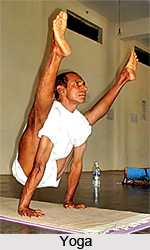
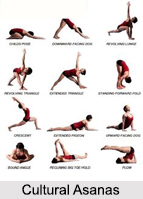
Asanas means a steady or comfortable posture in yoga. In Ashtanga yoga, Asana refers to different meditative postures. The practice of asana makes the physical body strong and ready for the inward journey.

Pranayama

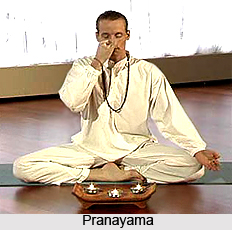
'Prana' means breath and 'ayama' is widening through control. Together they form 'Pranayama.' When breathing is controlled so as to retain the breath, it is pranayama. Here, holding breath either inside or outside is pranayama. When the breath is controlled for longer time, the number of respirations per minute decreases. Retention of breath brings about a certain condition in the brain, a certain change in the spinal cord and physical body. It also influences the nervous system and thereby brain. Pranayama practice activates the psychic centers and as a result, the covering of knowledge is removed. It also helps in developing capacity for concentration.


Ashtanga Yoga


These first four stages- Yama, Niyama, Asana and Pranayama are called Bahiranga, which means external. And last three are called as Antaranga.

Pratyahara

Pratyahara means abstraction of the senses, detachment of the senses of perception from other objects. Pratyahara is the link between the external and the internal. It refers to controlling of the 5 sense organs of sight, hearing, touch, speech and smell. When the mind becomes ripe for meditation, the senses rest quietly and stop tuning the mind for their gratification. Then the mind which acts as a bridge between the senses and the soul, free itself from the senses and turns internally to enjoy the spiritual heights. Pratyahara forms the foundation for dharna, dhyana and Samadhi.

Dharana

Dharana means concentration of the mind. When the mind is concentrated on a point, perception becomes intense. When eyes are closed, objects, which may be a thought, an idea or a word, appears intensely in the consciousness. Dharana includes concentration with breaks. In the beginning, one experiences the breaks in the concentration. It is called Vikshepa (disturbances or distractions). One needs to bring the mind back to the concentration.

Dhyana

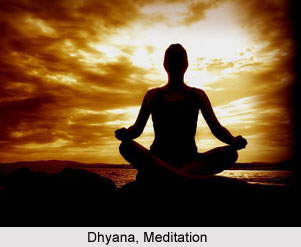
When there is no break or vikshepa in the Dharana, it turns in to Dhyana. In this state, one becomes oblivious but there is an awareness of Dhayana. This is called sakshi bhava. One is able to see with sakshi bhava and without any attachment. Dhyana is meditation (quiet activity that leads to samadhi). Sleep, subtle desires and cravings, agitation of mind, attachment to objects, sloth, lack of Brahmacharya, gluttony are all hindrances in meditation. It is best to reduce one's desires and cultivate detachment.Ashtanga Yoga

Samadhi

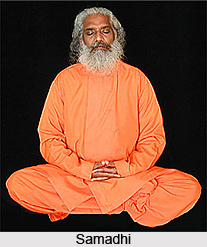
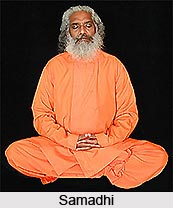
Samadhi is a state where there is only the object appearing without the consciousness of one’s own self. In Dharna the concentration is broken, in Dhyana it is continuous, whereas in samadhi, it becomes one with object of concentration.

Dharna, Dhyana and Samadhi together constitute Samyama. 

In Samadhi, the self consciousness is lost and the object of concentration remains, and then they merge together. Samadhi is of two kinds:

Samprajnata Samadhi means conscious samadhi. The mind remains concentrated (ekagra) on the object of meditation, therefore the consciousness of the object of meditation persists. Mental modifications arise only in respect of this object of meditation.

This state is of four kinds: 

Savitarka:  The Citta is concentrated upon a gross object of meditation such as a flame of a lamp, the tip of the nose, or the image of a deity. 

Savichara: The Citta is concentrated upon a subtle object of meditation, such as the tanmatras 

Sananda: The Citta is concentrated upon a still subtler object of meditation, like the senses. 

Sasmita: The Citta is concentrated upon the ego-substance with which the self is generally identified. 

Asamprajnata Samadhi means supraconscious. The citta and the object of meditation are fused together. The consciousness of the object of meditation is transcended. All mental modifications are controlled or stoppped (niruddha), although latent impressions may continue.

Ashtanga Yoga

Kaivalya -Goal of Ashtanga Yoga

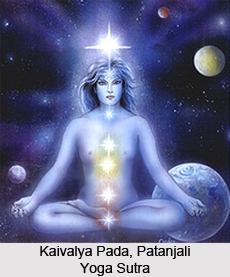
The core purpose of yoga is liberation from suffering, a condition that arises from the mind’s entanglement with the world. This freedom is achieved through ‘viveka,’ the discriminative discernment that separates Purusha, the witness-consciousness, from prakriti, the cognitive apparatus that includes the confused mind and its kleshas. Patanjali presents the eight limbs of yoga as the systematic means for cultivating this discernment, gradually uncoupling Purusha from its identification with Prakriti and all involvement with the ‘citta.’

 Ashtanga Yoga

At its heart, yoga is a discipline of meditation that culminates in a state of consciousness free from all forms of active or discursive thought. Ultimately, the practitioner reaches a condition in which awareness is no longer directed toward any external object, but rests solely in its own pure nature, consciousness unmixed with anything else. 

Patanjali maintains that liberation (moksha) arises from a combination of disciplined practice—personal, systematic experimentation, and the epistemological framework of Samkhya philosophy. Central to this path is the recognition that avidya, or ignorance, gives rise to all five kleshas, which in turn generate suffering and bind beings to samsara. Like several other Indian philosophical traditions, the Yoga school teaches that liberation is attained through the removal of ignorance by means of discriminative knowledge and deep self-awareness. 

 Ashtanga Yoga

Thus, Astanaga yoga consists of eight steps to experience Kaivalya.

Integrating Ashtanga Yoga into Modern Life

Patanjali’s Eightfold Path offers enduring wisdom which can be integrated into modern lifestyle with the following path.

Practice Ethical Living (Yama) and Personal Discipline (Niyama):
Aim to live with integrity, compassion, and contentment. Incorporate habits such as honesty, non-attachment, self-study, and regular reflection into everyday life.

Engage in Regular Pranayama:
Maintain a consistent routine of physical postures and mindful breathwork to support both physical vitality and mental balance.

Cultivate Inner Awareness (Pratyahara) and Focus (Dharana):
Dedicate time each day to turn inward through self-reflection and meditation, strengthening your ability to concentrate and think with clarity.

Pursue Meditation (Dhyana) and Seek Enlightenment (Samadhi):
Experiment with different meditation practices to deepen your spiritual journey and move toward a state of inner stillness, harmony, and realization.

Recently updated articles in Yoga

Khanda Manda Yoga
Khanda Manda Yoga Thumbnail

Khanda Manda Yoga

Khanda Manda Yoga is a difficult form of yoga where the Yogi cuts off his own arms and legs with a sharp cleaver, that is axe-like knife, and throws t...

Kaivalya Pada
Kaivalya Pada Thumbnail

Kaivalya Pada

Kaivalya Pada, the fourth chapter of Patanjali Yoga Sutra denotes an absolute, indivisible state of existence of the Yogi. The Kaivalya Pada is someti...

Vibhuti Pada
Vibhuti Pada Thumbnail

Vibhuti Pada

Vibhuti is the Sanskrit term for “power” or “manifestation.” In this third chapter, Patanjali introduces the final three limbs of Aṣṭanga Yoga, collec...

Sadhana Pada
Sadhana Pada Thumbnail

Sadhana Pada

Sadhana Pada in Patanjali Yoga Sutra denotes the idea of practicing yoga that leads to spiritual illumination. Sadhana, the Sanskrit term for “practic...

Samadhi Pada
Samadhi Pada Thumbnail

Samadhi Pada

Samadhi Pada is the first chapter of Patanjali Yoga Sutra. In this chapter, the author explains the essence of yoga, the nature of samadhi, and the me...