 With the advent of the British change was witnessed in almost every sphere. Developments in public works were a sphere in dire necessity of improvement, both in the city and rural areas. Every site needed well-built reinforcement however The shortage of money was indeed the hindrance in reinforcing the infrastructure at that time. The British then took active part and gave India a whole new look. The reinforcement of infrastructure both in urban and rural area was adequately developed by British government under the public works department.
In 1820, the Western Jamuna (present-day Yamuna River) Canal opened from the Himalayan foothills to Delhi and Hissar.
During the times from 1823-1830, the Eastern Jamuna (present-day Yamuna River) Canal was restored in its 129-mile length. This move extended irrigation waters to parts of the Saharanpur, Muzaffarnagar and Meerut districts.
In 1836, Colonel John Colvin (1794-1871) conceived of using the Ganga River to irrigate parts of the Doab. After the development of several concepts, James Thomason (1804-1853) and Lord Dalhousie (1812-1860) settled on a plan allowing for both navigation and irrigation. Public works were being given a facelift in every corner of India, with developments slowly becoming visible even in rural areas.
In 1840, Henry M. Lawrence (1806-1857) initiated construction of the Bari Doab Canal for irrigation of the Doab in Punjab. The 500 miles of channel were completed in 1859.
Within the years of 1842-54, the Ganges Canal was constructed under the supervision of Sir Proby Cautley (1802-1871). The irrigation system was completed and opened on April 8, 1854. It stretched from Haridwar to Cawnpore (present-day Kanpur, Uttar Pradesh), possessed 350 miles of additional branch lines and irrigated approximately one million acres. These stellar examples of developments in public works under British India can be hugely credited for present-day inspiration in irrigational methods and improvements.
In 1854, Lord Dalhousie created a public works department in each of India`s presidencies (the three presidency areas being Bengal, Bombay and Madras) and provinces consisting of civil and military branches. Dalhousie also provided for a Central Public Works Secretariat in Calcutta. These departments ramped up roads and bridges and carried out irrigation projects, including canals, dams and reservoirs.
Within the years of 1858-1866, private companies took over the development and funding of irrigation and public works. In 1863, the Madras Irrigation Company was created with a one million pound account. Later the East India (Orissa) Irrigation and Canal Company was formed in Madras.
In the duration between 1863-68, Sir Arthur Cotton (1803-1899) and Sir Proby Cautley (1802-1871) became engaged in a hotly contested dispute over the engineering measures used for the construction of the Ganges Canal. Following lengthy committee investigation, Cautley was finally cleared in 1868 of Cotton`s charges.
Within the period of 1866-69, the Government of India created the post of Inspector-General of Irrigation and named Sir Richard Strachey (1817-1908) to the post. From 1866 to 1869, Strachey promulgated a policy of the maximum development of canal irrigation as a hedge against drought. These precise illustrations sum up the `yet to be brutal` British administrators in their far-reaching good work in the form of developments in public works, not once worrying about native impact.
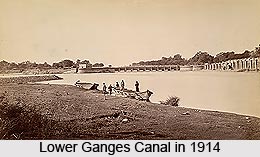
During the span of 1867-75, the Government of India yet again assured the stable funding of irrigation projects by providing loans from annual revenue collections. From this source the Agra Canal, Lower Ganges Canal, Sirhind Canal in Punjab and Mutha Canal in Bombay were financed.
In the time period of 1878-1900, additional canal construction included: Lower Chenab and Lower Jhelum Canal in Punjab, Lower Swat Canal in the North West Frontier Province, Jamrao and Nira Canals in Bombay, the Son Canals in Bihar and the Periyar and Kumool-Cuddapath Canals in Madras. Irrigational works can be called the main field of developments included in public works in the later half of the 19th century.