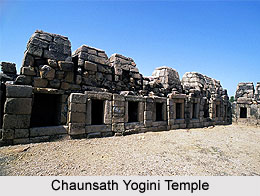
 Chausath Yogini temple was constructed with granite blocks and it is dated back to 900 AD. Chausath Yogini Temple is situated under the Vindhya mountain range in Madhya Pradesh. The temple is known for its simple architectural design made of coarse granite rocks. The Yoginis represent a form of Shakti, which is the manifestation of great power. The temple is built on a low rocky ridge of Vindhya hills on a Jagati or platform. The Jagati is 14 to 18 feet high, made of local granite. The entire structure is made with the granite ashlars including the terrace. This temple belongs to the western group of temples of Khajuraho.
Chausath Yogini temple was constructed with granite blocks and it is dated back to 900 AD. Chausath Yogini Temple is situated under the Vindhya mountain range in Madhya Pradesh. The temple is known for its simple architectural design made of coarse granite rocks. The Yoginis represent a form of Shakti, which is the manifestation of great power. The temple is built on a low rocky ridge of Vindhya hills on a Jagati or platform. The Jagati is 14 to 18 feet high, made of local granite. The entire structure is made with the granite ashlars including the terrace. This temple belongs to the western group of temples of Khajuraho.
Chausath Yogini Temple is the only temple in Khajuraho which is not oriented due north and south but directed northeast to southwest. This is the only temple among the Khajuraho temples which is made with local granite. Moreover, the structure of Chausath Yogini Temple is simple in plan and design. There are hardly any carvings or ornamental decoration.
Chausath Yogini Temple is constructed on a huge raised platform that is located in an open place surrounded by several small temples. The temple is erected on a low rocky mount, consists of sixty-seven cells. Each of the smaller cells used to house a Yogini, while the larger cell had an image of Durga-Mahishasura Mardini, inscribed with the label `Hinghalaja`. In 1865, there were only three images, one of goddess Hinghalaja in the principal cell and the other two of Matrikas Brahmani and Maheshvari in the cells besides.
The shrines are tiny plain cells. One can enter these by a small doorway and roofed by a curvilinear sikhara of an elementary form. The shrine in the back wall, facing the entrance, is the largest. A few simple mouldings on the facade are all the decoration that the temple displays. It reveals some basic traits of Khajuraho style like a lofty platform and a wall divided into two registers. This is the most primitive in construction and unique in being quadrangular on plan. The three surviving images, representing Brahmani, Mahesvari and Hingalaja (Mahishamardini) are massive and squat in form. They are among the oldest sculptures of Khajuraho.