 Bharat Ratna is the most prestigious and honorable Indian civilian award, presented by the Government of India. The term Bharat Ratna means the "Jewel of India" or the "Gem of India". The award is given for artistic, literary and scientific achievements. The award is also given for public service of the highest order. Though Bharat Ratna awardees carry no special title like Knights in England, they do occupy a special place among civilians.
History of Bharat Ratna
Bharat Ratna award was introduced in the year 1954 and the first President of India namely, Rajendra Prasad presented the award to Sarvepalli Radhakrishnan on 2nd of January, 1954. Since then, the award is being given to the best talents of India, on a regular basis. However, it was suspended for a brief period from 13th of July, 1977 to 26th of January, 1980.
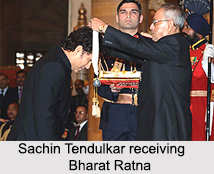
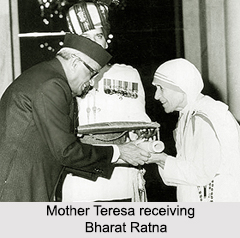 The award to Netaji Subhash Chandra Bose was withdrawn, due to a legal technicality and this was the only case of a Bharat Ratna award being withdrawn. Sachin Tendulkar is said to be the youngest personality to have received the Bharat Ratna. He became its recipient at the age of 40. The eldest Indian who lived to receive Bharat Ratna award was Dhondo Keshav Karve, at the age of 100. There is no strict or formal provision that the recipients of Bharat Ratna award ought to be Indian citizens. It is important to note that two non-Indians namely, Khan Abdul Ghaffar Khan (1987) and Nelson Mandela (1990) and a naturalized Indian citizen namely, Agnes Gonxha Bojaxhiu (better known as Mother Teresa (1980)) have received Bharat Ratna award.
Design of Bharat Ratna
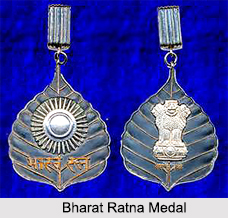
The design of Bharat Ratna has undergone certain transitions. In its very first year, a circular gold medal, with a diameter of 35 millimeter was given to the winner. The sun was on the obverse of the medal and the term `Bharat Ratna` was written in Hindi script, with a floral wreath below. The state emblem and motto was on the other side of the medal, which was attached to a white ribbon. The winners then used to wear it around their neck.
 The design of Bharat Ratna Award was altered within one year after its inception. There is no evidence available whether specimens of the design were made. The award has been redesigned in the shape of a leaf from Pipal tree and the term `Bharat Ratna` is written in Hindi language, in the front side of the award. The other side of the award carries the state emblem and motto and is attached to a 2 -inch long ribbon. The other side of the medal also possesses the image of sun, which is about 1.6 cm in diameter, below which are engraved the terms `Bharat Ratna` in Devanagari Script. The award measures about 5.8 meters in length, 3.1 meters in thickness and 4.7 cm in width and is made of toned bronze metal.
Bharat Ratna Awardees
A total of 45 extraordinary talents from India have received the Bharat Ratna award, since its inception. These Bharat Ratna awardees are mentioned below.